It’s been a truly crazy and chaotic year on many fronts. Trump’s tariff wars and general unpredictability, wars in the Middle East and Ukraine as well tragedies closer to home paint a bleak picture of 2025, not to mention the cost of living crisis and economic uncertainty at home. The advertising industry has not been immune to rather choppy waters. In true Christmas sprit, it’s our great pleasure to give you our handy A-Z of the year that was for media marketing and advertising. Tune in tomorrow for N-Z.
A – American Eagle
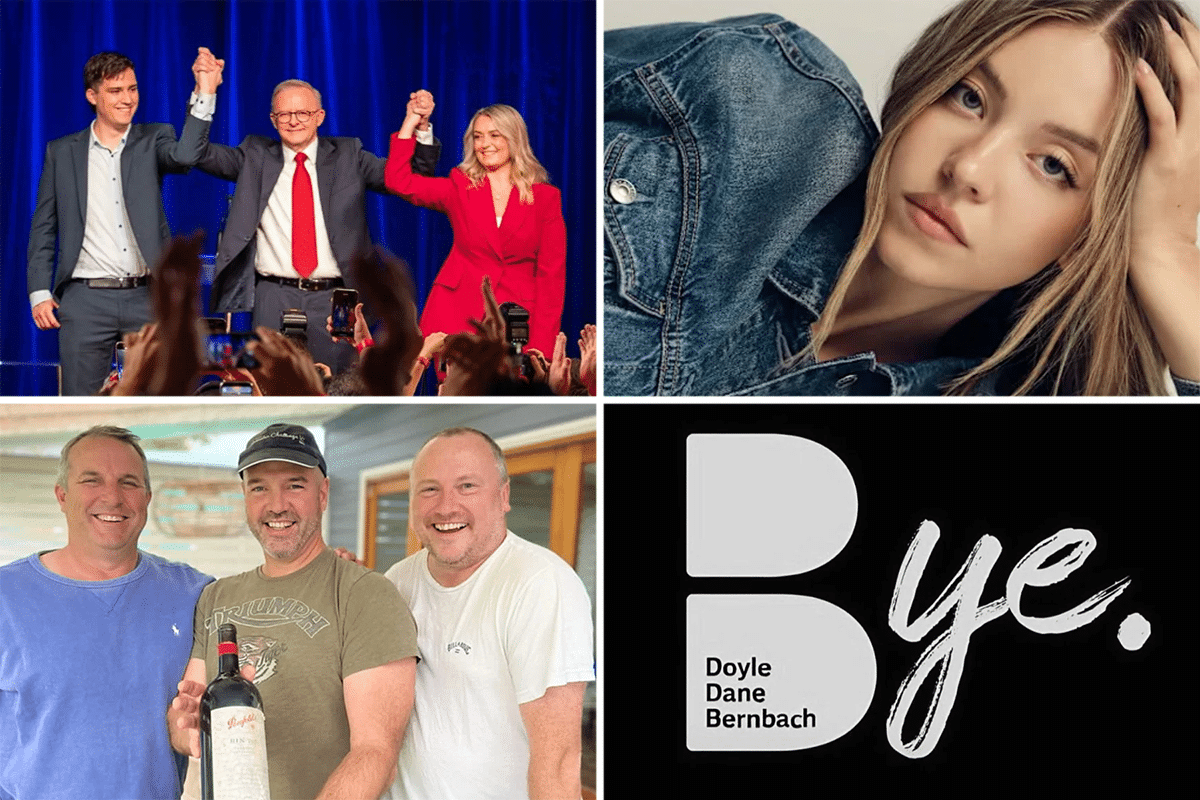
Few advertising campaigns had the industry in knots over American Eagle’s ‘Sydney Sweeney Has Great Jeans’ campaign.
The campaign showed the Euphoria star in a series of risqué videos dressed up in a full denim outfit discussing how great her genes are.
Some industry leaders described it as “racist, sexist and eugenics-coded”, while others, including Mark Ritson, questioned if the industry had “lost its collective minds”. The campaign caused such a furore that even Donald Trump waded in, calling it the “HOTTEST” ad.
In the end, LinkedIn went into a frenzy, B&T grabbed its popcorn (and plenty of traffic),
American Eagle’s price soared, but sales didn’t, and plenty of people who hadn’t heard of (or cared about) American Eagle now know the brand.
Another bonus is that B&T could avoid writing more words about the obvious ‘A’ – AI. A shout out to WPP Media’s Aimee Buchanan, who has had another outstanding year leading WPP Media and its agencies to huge success.
B- Bob Katter
In an era of Donald Trump, it is incredibly difficult for an Aussie to compete with the batshit level of crazy from the other side of the Pacific pond. That is, of course, unless you live in the far north Queensland federal Division of Kennedy.
Bob Katter made headlines for threatening to punch a Channel Nine journalist after calling him a “racist”. The journo’s crime, you may ask? Asking Katter about his Lebanese migrant heritage (see the video below).
For the record, Katter’s paternal grandfather, Carl Robert Katter (originally Khittar) emigrated to Australia from Bsharri, Lebanon in 1898.
C – Consolidation
This year will be remembered for major consolidation. This includes perhaps the most seismic advertising acquisition in a generation—Omnicom’s takeover of Interpublic Group (see entries below)
Southern Cross Austereo is also due to merge with Seven, creating Australia’s second largest media company with strong TV, radio and print assets.
There are persistent rumours that out of home giants may look to either acquire to create greater scale or join one of the TV behemoths, while there is also the consolidation of certain functions. For example, Nine’s sales team now represents HBO Max inventory, and there are rumours they could soon add other rivals.
Consolidation is not a flash in the pan, expect more of it in 2026 and the Australian market is continually squeezed by global rivals.
A shout for another notable ‘C’ in Cathy O’Connor, who steps down from oOh!Media, a business she led for four years with great success.
D – DDB
In October, B&T reported that Omnicom’s storied advertising network DDB (Dane Doyle Bernbach) would soon be dissolved. This was confirmed in November when DDB was folded into Clemenger BBDO as part of Ominicom takeover on Interpublic. The plan is to consolidate its creative agencies into three brands: BBDO, McCann and TBWA.
In Australia, DDB introduced McDonald’s to the country and has produced iconic work for Maccas, and other clients including Coles, VW, Westpac and more.
A recent favourite of B&T’s is the Original Mouthful campaign below.
E – Election win and Labor
One of the most significant moments of the year was Labor’s landslide federal election victory in May. Anthony Albanese’s Labor Party won 94 seats crushing the Peter Dutton led Coalition.
The agencies that were critical to Labor’s successful campaign include Dee Madigan’s Campaign Edge, WPP Media’s Mindshare and digital specialist Sparro.
Albo won the TikTok battle in an election where the battle fronts were as much on digital channels as traditional media.
Labor’s win is significant to the media and advertising sectors. Since retaining power, the Albanese government has enacted a social media ban for under-16s, and is looking into a new version of the news media bargaining code, gambling advertising regulation and other important pieces of regulation, such as the spectrum tax for broadcasters and anti-siphoning laws.
F – FHM’s comeback
In one of the less predictable moves this year, lads mag FHM returned in print. First published by EMAP and then ACP Magazines between 1998 and 2012, the magazine has been revived in Australia by Michael Downs and Nuclear Media, which also publishes Women’s Fitness, It Girl, and Krash.
According to a report in Mumbrella, the magazine is targeting men who “train harder, think bigger, and still appreciate the perfect cover girl”.
Just what the market needs in 2025!
G – Google
Google has rarely been out of the headlines this year due to a number of high profile antitrust court battles from the US and Europe coming to a head.
They have alleged Google operates illegal monopolies in search, adtech and app distribution (Google Play Store) by using anti-competitive contracts such as making Chrome default.
On the latter, Google recently agreed to a $630 million settlement to resolve claims from all 50 US states that it violated antitrust laws by monopolising app distribution and in-app billing services through its Google Play Store.
It’s not all bad news for the tech titan; Google persuaded courts to keep the status quo in search and advertising.
And it is rapidly gaining traction in the roll out of its Google AI overview answer machine, which provides answers, rather than links, to search queries. This is having a devastating impact on publishers with wide reports of Google search traffic falling off a cliff.
Google’s grip on the advertising industry has tightened in a year when many had predicted it might slip.
H – Havas
One of the holding companies that has gone slightly under the radar this year is Havas. That is until recent months.
Havas Media hired Mindshare’s Kate O’Ryan-Roeder as its new CEO, succeeding Vriginia Hyland, who left earlier in the year and has set up her own consultancy.
The group acquired Nick Behr’s independent media agency Kaimera, which has been on a tear lately.
Lately, Havas has rolled out a new market positioning, ‘Deliberately Different’ proposition, shoring up new group leadership roles for Richard Clarke and Alastair Baker, and winning a significant travel industry account.
There’s something interesting brewing over at Havas HQ, located in the old Bushell’s Building in Sydney.
I – IPG Mediabrands
In November, Interpublic Group was no more, being swallowed up by Omnicom as part of its $20.4 billion (US$ 13.5 billion) takeover.
For Australia, this means the end of the IPG Mediabrands brand and, more importantly, the departure of some of the most revered industry leaders in the market.
The highest profile departures are IPG Mediabrands CEO Mark Coad, APAC boss Leigh Terry, chief investment officer Lucy Formosa Morgan and CFO John Clements. Harry Preston, the MD of Mediabrands Content Studio, has also left.
These are some of the top advertising executives B&T has worked with, and this masthead hopes to see them back in action soon enough.
So far around a dozen IPGers have left, more could join them as Omnicom works through other parts of the business.
IPG Mediabrands agencies are safe for the foreseeable future. Client conflicts make mergers undesirable, for now. Here is a B&T’s breakdown of the takeover and what it means.

J – Joy Agency
One independent that is turning heads is Joy Agency. When Peter Horgan confirmed one of the industry’s worst kept secrets, that he was joining Joy, it placed the agency firmly on the map.
Horgan’s appointment follows Des Odell, Phil Pollock and Matt Keegan to the full service agency, while it has also picked Picklebet’s and Mecca’s media accounts as well as others.
Joy have caught the eye in 2025 and are one to watch in 2026.
K – Kristiaan Kroon
Kristiaan ‘KK’ Kroon is another to confirm a poorly kept industry secret when he was rubber stamped as Omnicom Media Australia’s chief executive.
He now presides over Australia’s largest media agency group, by some distance, and has assembled a strong leadership team, including chief partnerships and investment officer Marelle Salib, chief operating officer Mark Jarrett and CFO Donna Bartlett.
Agency leads are also in place with the exception of Hearts & Science, although there are whispers that Stevie Douglas-Neal could fill that void.
Following the takeover, KK moved OMG leadership pieces around the board and enters 2026 with a great foundation to build Omnicom 2.0. What this space.
L – Labubu
B&T is perplexed how an ugly, overpriced kids doll could be the viral phenomenon it is. But that could be more a reflection that B&T is 75 years old, not 5. Nonetheless, Labubu fans have evolved into an online community generating an exponential amount of content from fans around the world, particularly on TikTok.
An Aussie influencer went viral by decorating a Christmas tree with the strange little critters.
There may be other ‘Ls’ more deserving, but none that have gotten Gen TikTok in such a frenzy.
M – The two Marks (Read & Coad)
Two Marks have left giant holes in the industry this year. Mark Read left WPP as global CEO this year. He led a transformation of WPP for many years after succeeding its founder Sir Martin Sorrell. His focus was on simplifying the myriad of agency brands (including sunsetting Y&R and ‘Group M’), sold Kantar, and focussed on the digital and AI transformation. He aimed to create a leaner, future facing holding company, but has left his successor Cindy Rose with much work to do.
Closer to home, IPG Mediabrands CEO Mark Coad left alongside APAC boss Leigh Terry following the Omnicom takeover and left an enormous legacy in the industry. Coad played a pivotal role building OMD, PHD and IPG Mediabrands in the market, and is the MFA chair. He has also mentored countless advertising executives and leaders, and is widely regarded as one of the genuinely nicest blokes in advertising.