
Last year (give or take a couple of weeks) WPP’s media agency collective, then known as GroupM, became WPP Media.
At the time, the world’s trade press was awash with stories of redundancies, potential client conflicts and much hand-wringing over the reduced value of agency brands.
WPP Media’s agencies, EssenceMediacom, Mindshare and Wavemaker, were brought together to serve as dedicated teams rather than distinct businesses. They also started to operate under one profit-and-loss sheet. WPP Open, the holdco’s AI-enabled marketing system, became significantly more important to its operations and its go-to-market.
But in Australia, that wasn’t the case. As we wrote in an exclusive chat with the newly minted WPP Media bosses at the time, the Australian business had begun to make some of the changes much earlier.
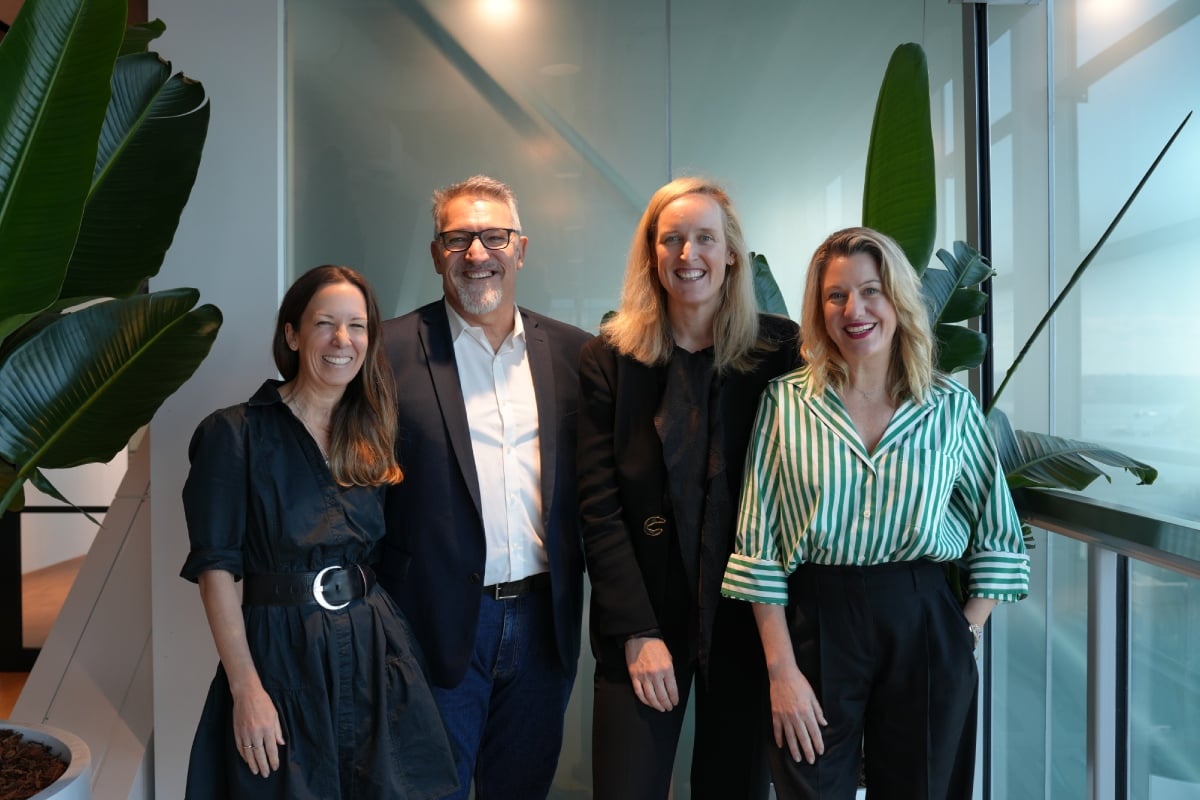
So what, if anything, has changed for WPP Media’s staff and the country’s marketers one year on? We caught up once again with EssenceMediacom CEO Pippa Berlocher, Mindshare CEO Maria Grivas, Wavemaker CEO Peter Vogel and head honcho Aimee Buchanan to find out.
Wavemaker is B&T’s reigning Media Agency of the Year. Think you can best Vogel and team? Enter now!
Two Days On The Gold Coast
“We started the journey probably 18 months before the name change and global transformation. It started when I joined, Maria joined, Pippa joined and PV inherited us all,” said Buchanan.
“We quite consciously knew that a fairly steep transformation was needed. We didn’t get everything right. We didn’t do exactly as the global team asked us a year ago, because we’d already started a lot of those things, but it allowed us to fast-track some of those decisions. The noise in the market was worse than the reality that people experienced.”
While there might have been noise in the market (and some strongly worded industry reactions in B&T), Buchanan believes that on the ground disruption in Australia was minimal. In fact, the change only seemed to strengthen the business’ momentum and resolve.
A few weeks after the change was announced, WPP Media’s entire 1,000-strong Australian business descended on the Gold Coast for a two-day off site experience. The timing was coincidental and it had been planned for some time, “you don’t often get that lucky,” said Buchanan.

It was there they set out the vision, the plan and assuaged concerns of staff. The vision was simple: to deliver limitless growth for clients and staff. The goal is to make the Australian WPP Media business truly world-class through centralising and disseminating knowledge and expertise whilst also ensuring its staff have access to the best training.

“We were able to get in front of all our people and say ‘Here’s the vision moving forward for WPP Media. This is where we’re going to go.’ That really energised and excited people about the opportunities we were creating, rather than any complexity or confusion,” said Berlocher.

“Quite often, there are these moments in time that just signal change and the GroupM to WPP Media was one,” said Vogel.
“There was a lot happening at the time and I remember there was a big drive at our conference to find the services and capabilities of the future… It was a moment in time and it was the right thing to do.”
Clients, Capabilities & Centralisation
Clients, the bosses told us, experienced no immediate changes.
“Our whole focus was to make sure that our existing clients didn’t feel disturbed or disrupted in a negative way,” she said.
“I think what they’re probably seeing is the industrialisation of things like thought leadership, our future of media work and access to a broader depth of capability.”
To be clear, WPP Media didn’t invent new capabilities for clients.

Instead, its new structure and focus allowed greater investment in, incubation of, and scaling of capabilities that had previously been more siloed or focused into particular agencies. Specialised functions became centres of excellence.
Wavemaker, for instance, had a very strong influencer and social practice led by Shivani Maharaj.
Marc Lomas, WPP Media’s head of commerce, found himself with a wider remit.
Tom Braybrook, MD of WPP’s data and tech business Choreograph, found himself with a significantly expanded role and leading WPP Media’s analytics centre of excellence.
Chris Hitchcock had been leading EssenceMediacom’s sport partnerships work and this too was expanded across the group.
Mindshare’s Dan Benton now leads WPP Media’s experience work, which encapsulates SEO, generative engine optimisation and affiliate marketing.

“It had been a natural evolution,” said Vogel.
“Sport and entertainment was still rating on TV. Influencer was coming, content strategy, discoverability and so on. What we’ve done extremely well is put the data, the measurability and the technology behind all of those services. This made it more measurable and strategic in terms of how we execute for clients.”
“If I think about it from a Mindshare lens, we didn’t have an influencer capability prior to us bringing that across as a group capability,” added Grivas.
“So many of our clients now utilise that capability and see value in it which is because they’re such specialised capabilities. If we tried to build that three times over, you just wouldn’t get the excellence.”
WPP Media’s specialised staff are now embedded into clients or sit within their traditional agencies but report up into the central function. Wavemaker’s L’Oreal team, for instance, sits within the client’s operation. It’s this that avoids conflicts and sharing of confidential client information.
“It’s really important that we have those capabilities oriented around our clients,” continued Grivas.
“The centre of excellence really drives the capability and its evolution so it remains on the cutting edge and reflect what the future requires. But then they get embedded with people dedicated to delivering the output from that capability into the client workstream.”

The change is proving popular with clients, too. Mindshare and EssenceMediacom placed first and second, respectively on B&T’s final 2025 New Business Winner round up.
COMvergence had the pair second and third on its 2025 New Business Barometer, behind Publicis’ Zenith. Though it’s worth noting that Mindshare topped the pile for net new business—i.e. excluding client retentions.
Wavemaker was far from the third child and is B&T’s reigning Media Agency of the Year. With our judging panel comprised solely of the country’s leading client-side marketers, that’s no mean feat. It beat out both EssenceMediacom and Mindshare too, with all three WPP Media shops named finalists in the awards, “another highlight,” said Buchanan.

Such success during a “perfect storm” (Buchanan’s words) of economic headaches and technological disruption is not to be taken lightly.
To an extent, WPP Media globally has been playing catch up to Publicis Groupe, in particular. The French holding company launched its ‘Power of One’ strategy 11 years ago.
“The idea consists of reversing its current structure, built around the concept of worldwide networks, by breaking down silos in order to offer clients the Groupe’s entire know-how and expertise through the “Power of One”: all Publicis Groupe capabilities will be available to each of its clients – in a simple, flexible and efficient way,” the holding company wrote in a press release at the time.
Omnicom is also pursuing a similar strategy in Australia and New Zealand. The Omnicom Oceania model, let by CEO Nick Garrett, launched in July 2024 and aligned all of its practice areas in Australia and New Zealand, bringing creative, media and PR agencies under a single operating structure, along with performance marketing, production and more.
“What Omnicom has done lately but now aggressively is finding the cross-pollination and integration between the brands,” Garrett told B&T last year.
Talent
Throughout our chat, however, all four of the CEOs continually return to WPP Media’s staff proposition, often through an AI lens.
“The evolution of our talent through the year has been personally exciting to witness,” said Grivas.
“We talked about AI as this loose ‘ChatGPT thing’ towards the end of 2024. Then in 2025, all our staff became so proficient, not just in understanding how they can personally use the LLMs that WPP Open gives them access to but equally proficient in understanding how the media landscape is is evolving as a result of a shift in brand discovery that LLMs is driving. That’s what continues to excite me for our people.”
Buchanan said that WPP Media has been clear in how it has positioned AI to staff.
“We haven’t told anyone they must use it. We’ve just opened the toolkit up. It’s the human ingenuity of our people that will set us apart,” she said.
“But they will be augmented, powered and accelerated through the use of technology. People have freaked out a little bit around AI, in my view.”
It has also expanded its development and training for staff of all stripes and seniority. Each agency’s MDs have been given a new learning syllabus which centres around leading through change and the application of technology to human skills. It also offered a significantly expanded training program for senior staff with residential off-sites.

Its new Craft Masters sessions focus in on one particular area of work—account management, for instance—and elevate it across the group.
While clients might not have noticed much change immediately, perhaps a new email address and letter head on the paper, there’s a distinct feeling that the change from GroupM to WPP Media was far more than a simple rebrand.