



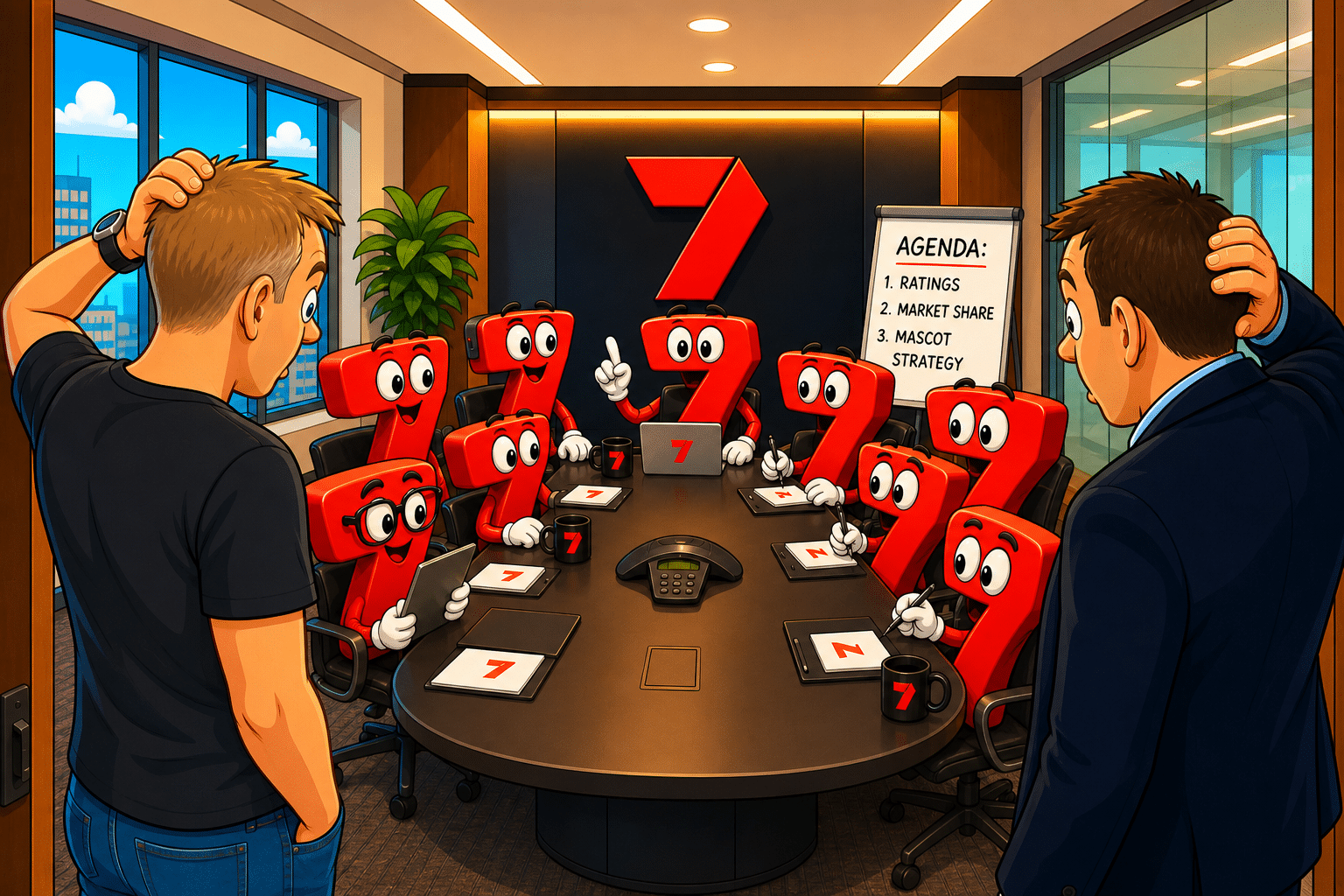
Earlier this week, the industry was met with news that the recently appointed chairman of Southern Cross Media Group Heith Mackay-Cruise has stood down after just 73 days in charge. Taking the reins as the third chair in six months is Teresa Dyson.
The news follows media mogul Kerry Stokes walking away from the business after 30 years in charge, closely followed by the departure of CEO Jeff Howard.
These comings and goings have been described as a “power struggle” and a “game of thrones” as executives jostle for power within the new media group. Much has also been made of the previous affiliations of those involved—namely whether they were formerly of Seven West Media (TV and publishing) or Southern Cross Austereo (radio).
“It’s a power struggle between historical Seven stakeholders and historical SCA stakeholders,” Ian Perrin, MD of media agency SPEED, told B&T.
When the news dropped that Seven West Media would merge its TV business with Southern Cross Media Group’s (SCA) radio and audio assets, media buyers were excited with the opportunities that could arise for brands.
However, with this board-level musical chairs, it appears some of the excitement has dulled.

“What is most frustrating in all of this is the missed opportunity. When the merger was announced, we were all probably a little bit sceptical as to how an audio company and a broadcast company could come together. But, we were also mindful that it could be a great solution for how you could improve the fortunes of two legacy businesses and create something more valuable. So, we were all hoping to see how they could push content across various different platforms, how they could find synergies in areas like sport and news, and how they could potentially become a genuine competitor to Nine,” said Perrin.
Fast forward to now and Perrin is dissatisfied with the leadership team of the merged media entity.
“We all hoped that in a merger like that, there would be a unified strategy, the leadership would all be on the same page, and it would make it a lot easier for us. Now, we probably couldn’t have seen the more complete opposite of that and it seems like a totally disunified company with leadership that keeps on changing. And from our side, there’s no clear vision as to what the organisation will look like next month, let alone in the next three years,” he added.
Chris Walton, managing director at Nunn Media, shared Perrin’s bemusement.
“The boardroom shenanigans does make for some kind of head scratching, and a little bit of what is going on over there type reaction. When there’s a chairman, then there’s a CEO, then pair are both gone, you kind of scratch your head a bit about what’s going on there. Maybe even crack a right smile in terms of thinking, well, glad these guys don’t work in communications,” he told B&T.
B&T approached several of the country’s leading advertising holding companies for their views on the matter, all of whom declined to comment.
But, both Perrin and Walton aren’t too concerned with the “boardroom bickering”, as the teams of the merger are still delivering results and audience.
“From what I’ve seen, the day to day efforts of both the teams that used to be Seven and Southern Cross are doing a very good job. If this was to go on for months and months, I can see how it could filter down to start impacting on the day to day. But at the moment, I think with this is a backdrop, you could actually say that the sales teams and the servicing of agencies has been bloody good despite what the grown ups are doing in the boardroom,” said Walton.

“We chase the audiences and the opportunities, but we also want to have the confidence to know that they’re going to continue to deliver a business that can create audiences and create content opportunities and grow share, rather than just bicker internally,” said Perrin.
“From our side, Southern Cross, going into the integration were in a far better shape than they have been in previous years, and we’re seeing some really strong value and really great opportunities out of Southern Cross that isn’t going to change overnight.
“But we’d certainly be hopeful that unless they find some more consistency and leadership, and give us a strong sense of where they’re going as a business, we will continue to support them, but the problem is at the moment we’re not seeing that.”
Speaking to B&T, a Seven spokesperson reiterated the audiences are strong for the broadcaster.
“Seven continues to perform strongly, as evidenced by our audience growth this year, the rapid growth of 7plus, the continued success of key content – including 7NEWS, the AFL, Sunrise, Home and Away, The Chase Australia, Australian Idol, The 1% Club, Better Homes and Gardens, and more – and the success of new programs such as Glenn & Mick’s Celebrity Intervention and My Reno Rules.”

Finding consistency
Above all, the MD and CEO appointment of NRMA’s ex-chief executive, Rohan Lund has both Perrin and Walton intrigued.
“Rohan Lund has got an incredible leadership record outside of just the fact that he comes from a broadcast background. He’s got really diverse scaled leadership credentials. His appointment has been welcomed by us in the industry. He’s a competent leader who can bring their business forward, rather than the fact that he comes from more of a Seven oriented background. But I think hopefully that consistency in his appointment will be reflected in in how they move forward,” said Perrin.
For Walton, it’s not just his credentials that are exciting for media buyers, but its the fact that he doesn’t come form one side of the business.
“Let’s see when Rohan turns up. It’s going to be quite interesting, he’s more independent than taking a CEO from one side of the business or the other to assume full control. He’s coming in new to both.”
The Seven spokesperson added, “as I’m sure you appreciate, we do not discuss board matters publicly”.


