
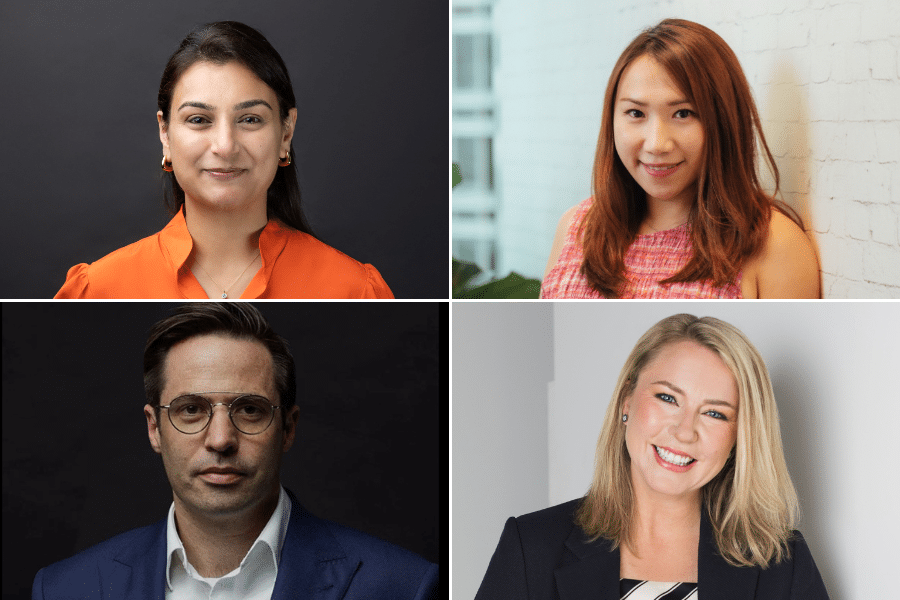
This year we saw significant shifts in the way AI has impacted advertising, marketing, customer experience and audience engagement. In this piece, we speak to industry experts who reveal some of the critical trends to expect for the year ahead.
AI & The Future Of Creative Campaigns
As 2026 quickly approaches, the answer for AI-focused agency BRX’s Marty Hungerford is clear. The company’s co-founder and chief innovation officer believes a new era is unfolding, shaped by the profound and potentially philosophical impact of AI.
Hungerford predicts that the use of AI-generated models and imagery will become the new standard in e-commerce. Already he notes that a significant portion of all new images posted online are AI-generated. He also said that the use of AI for video production, from product placement to full-scale localisation campaigns, will become the norm due to the advanced level of “directability” AI now offers.
“If you look at almost any e-commerce site, particularly when it comes to fashion, you’ll see that they’re using AI models. According to Meta, 50 per cent of the new images that are posted on its platforms, like Facebook and Instagram, are AI,” he said.
“We watch this technology very closely and it’s very powerful, you can artistically create photos and art-direct videos with prompts. It’s incredible. Soon enough every agency that is in the loop on this will want to leverage it.”
Aparna Watal, partner, Halfords IP, agrees the decade ahead is set to redefine creativity as a collaboration between human and machine, especially as AI tools ingest, remix, and regenerate vast amounts of creative content. But she has warned brands should be aware the traditional concept of authorship (who the creator is) no longer fits neatly, especially as we are moving toward a framework that values data stewardship as much as creation.
“We’re likely to see hybrid authorship regimes emerge which recognise human contribution as the anchor of protection, but allowing limited AI attribution where there’s meaningful human oversight. The shift won’t happen overnight, but I suspect that by the end of the next five years, our focus will move from ownership and exclusion to transparency, attribution, and fair value exchange,” she said.
Agentic AI & Brand/Consumer Interaction
Looking deeper into the future of communication and touching on developments with brain-computer interfaces, Hungerford believes in the next 10 years, brand and consumer communication might be mediated by AI agents operating at a speed far beyond human capability.
“You’re going to have personal agents talking to brands at a pace that far exceeds that of analogue human communication,” he added.
“A brand’s AI might actually design and implement ranking strategies, content generation and flooding, and product design recommendations to appeal to other AIs. There might also be AIs pitching to other AIs. The tech is accelerating so fast that we just don’t know.”
In this future, brands will need to develop strategies for their AI agents to communicate with consumers’ personal AI agents, possibly leading to a new type of “pitching to other AIs.”
AI & The Ad Campaign Lifecycle
In 2025, Nexxen unveiled nexAI, a comprehensive suite of artificial intelligence-powered assistants and features vertically integrated across its unified advertising technology platform.
The launch represented what the company described as an elevation of every stage of the advertising lifecycle, taking a transparent approach to planning, activation, optimisation, insights and monetisation. The reveal sets a tone for what the organisation believes will be transformative changes across the advertising industry in 2026 and beyond.
Janice Chan, VP of platform and client services APAC at Nexxen, expects AI assistants to not only transform advertising workflows in 2026, but also empower marketers with real-time visibility into performance and outcomes.
“From a client perspective, AI-driven capabilities like those offered by nexAI are driving accessibility and efficiency. They simplify the process of translating complex data into actionable insights and campaign strategies, which can then be directly activated within the platform. What once required platform and optimisation specialists is now becoming more intuitive and seamless for marketers,” she said.
Chan also anticipates AI-driven campaign optimisation will reach new levels of sophistication and automation in 2026.
“nexAI monitors and optimises campaigns in real time, leveraging machine learning to maximise performance and ROI; this includes advanced algorithms that evolve and adapt with predictive modelling of audiences, bidding, pacing & budget allocation, exponentially improving over time through iterative learning.”
Additionally, she expects AI automation will enable marketing teams to focus on higher-value initiatives.
“By automating repetitive tasks such as data collection and campaign optimisation, nexAI enables teams to shift focus toward strategic priorities — from uncovering growth opportunities to deepening client relationships. This shift also compels leaders to accelerate plans and initiatives aimed at upskilling teams and evolving organisational capabilities to keep pace with AI-driven transformation.” she added.
For Chan, 2026 will mark a turning point where, with AI embedded into day-to-day operations, marketers can expect to see complex analysis and campaign optimisation handled automatically, while they dedicate their attention to strategy, creativity and delivering long-term value.
AI, The Ad Evolution And Media Networks
Belinda Lloyd, senior technical account manager, Amperity says many retailers believe the challenge for the year ahead will be about increasing advertiser demand, but in reality, it’s about data.
“Most retailers sit on massive, fragmented datasets scattered across ecommerce, loyalty programs, and in-store transactions. Without a unified identity layer to bring this data together at the customer level, even the most sophisticated media platforms struggle to deliver performance and results,” she said.
According to Lloyd, a significant obstacle to retail media network success is the reliance on rented, third-party data, rather than owned first-party intelligence. For next-generation networks, a critical shift is underway that is key to transitioning from impressions and clicks to measurable impact.
“However, moving forward, the third-party model can’t sustain the next generation of retail media networks. Today’s networks need speed, transparency, and accountability. In a performance-driven environment, the inability to measure and prove impact is a liability. Advertisers are demanding transparency and proof of sales impact—and budgets will follow the retailers that can deliver it,” she explained.
The Australian retail media market won’t slow down any time soon. According to IAB Australia. But Lloyd highlights scale alone is no longer the differentiator in the year ahead. Success won’t be defined by who can build the biggest network—but by who can build the smartest one.
“Without unified, AI-powered identity, there is no retail media network,” she added. “Clean, organised customer data is the foundation for everything. When retailers connect that data seamlessly across systems, they drive faster activation, deeper insights, and measurable business growth for themselves and their brand partners.”