
In this latest Weirdo Science instalment, Maddy Ross, a behavioural sciences thinker at Thinkerbell, and Adam Ferrier explain why chickens are worse at selling things than people.
There’s a fairly well-established idea in advertising that if you want to capture attention, create positive emotion and be remembered, animals can be a powerful shortcut. Ideally ones that are a bit unexpected, a bit human, and maybe even a bit ridiculous.
Creating characters to represent brands is very of the moment in marketing for all these reasons and more.
So that’s exactly what we did.
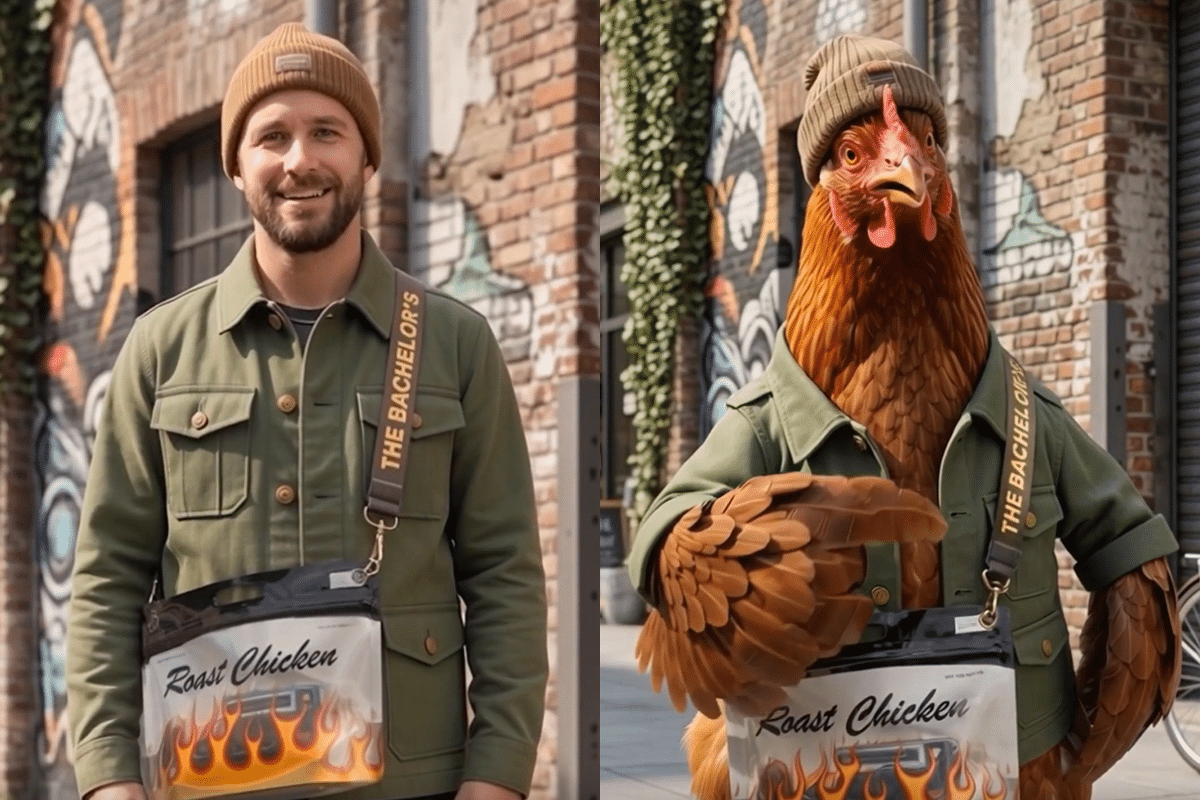
We created two ads for The Bachelor’s Handbag, a handbag styled to look like a roast chicken bag (created through Thinkerbell’s Pot of Gold initiative in collaboration with Size 11). One ad featured a human while the other showed a talking chicken delivering the exact same script. The only thing that changed was who (or rather what) was doing the selling.
Based on research showing that animals and humour can increase attention and positive affect, we expected the chicken might have an advantage. Studies have found that animal imagery can enhance entertainment and improve brand attitudes (Keller & Gierl, 2020), and in some cases influence purchase intentions (Trivedi & Teichert, 2020). For a product that is already quite absurd, it seemed like a strong fit.
So we ran a test.
The Ads:
Human Man Ad:
The Chicken Ad:
The Results:

From a similar number of impressions, the chicken ad generated add-to-carts at a cost per result of $37.44, reaching around 2,300 people. The human ad on the other hand delivered add-to-carts at a $10.26 cost per result, with slightly higher reach at 2,611.
The human ad therefore drove more than three times the number of add-to-carts, at roughly a third of the cost. The breakdown of who converted adds another layer. Of the eleven add-to-carts, eight came from men and three from women showing men responded more favourably to the ad.
Despite being less novel, less visually distinctive, and arguably less entertaining, the human version converted significantly better.
Which raises a more interesting question than what worked.
Why didn’t the chicken convert well?
The biggest difference between the two ads is how easy it is to see yourself in the idea.
The product itself is already playful. It’s a handbag designed to look like a roast chicken bag, and part of the appeal is that it feels like a joke you’re in on. It’s slightly absurd but still wearable and importantly, still something you can imagine owning. The human ad keeps you inside that idea. It shows the product in a way that feels grounded enough to picture in real life. You can quickly imagine who might wear it, when they’d wear it, and whether that could be you. The chicken shifts your role. Instead of feeling part of the idea, you’re watching it. The focus moves from “could I wear this?” to “this is funny.” It becomes something to observe rather than something to step into.
That distinction matters. Research shows that ads are more persuasive when they enable mental simulation, allowing people to imagine themselves using the product (Escalas, 2004). When that process is easy, decisions feel more natural and require less effort. The human ad supports that because it provides context and makes the product feel more real and usable. The chicken, while more distinctive, creates just enough distance to interrupt that process.
That pattern also shows up in who responded. The human ad’s performance was driven largely by male add-to-carts, which may reflect how easily this audience could see themselves in the execution. Featuring a male model likely made it simpler for men to picture using the product, reinforcing the role of self-relevance in driving action.
The result isn’t that one idea was better creatively. It’s that one made it easier to imagine using the product.
What this means for marketers
Animals can still be powerful in advertising. They can be distinctive, engaging, and help a brand stand out if used well.
But this experiment shows where that starts to break down.
At the point of conversion, it matters whether people can see themselves in the idea. Ads are more persuasive when they make it easy to imagine using the product (Escalas, 2004), because the decision feels more concrete. That’s where the difference showed up.
The human made the product easier to picture in real life. The chicken, while more distinctive, made it feel more like something to watch than something to wear. There’s still a role for animals, especially when used consistently to build meaning over time (Trivedi & Teichert, 2020). But in a single execution, distinctiveness alone isn’t enough.
As production becomes easier with AI making more ambitious ideas possible, the challenge isn’t just to create something distinctive, it’s to create something people can still see themselves in.
The easier it is to picture yourself using something, the more likely you are to buy it.