




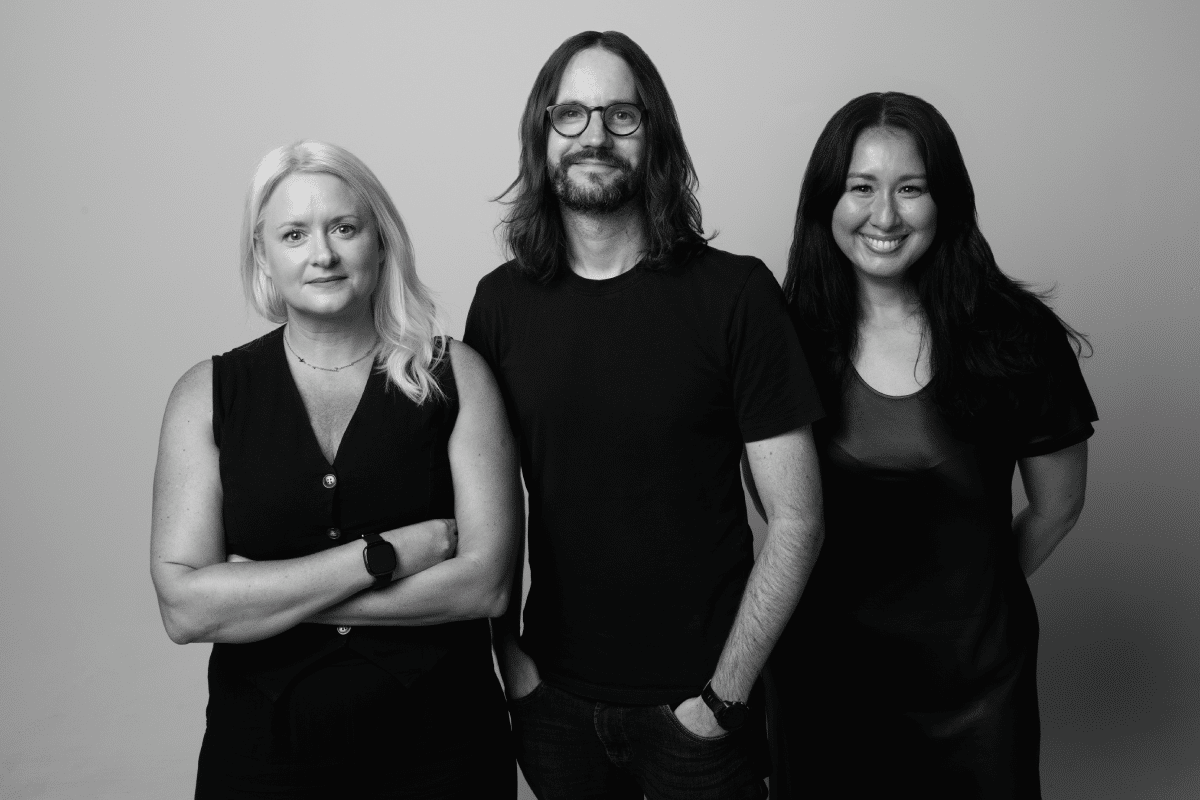
The last 12 months at Leo Australia have been a 12 months to remember.
CEO Clare Pickens joined the team in April 2024 after spending some time in Amsterdam working for Wieden+Kennedy, Red & Co and HERC. She replaced Emma Montgomery, who left to join DDB Chicago the previous year. While chief creative officer Andy Fergusson and chief strategy officer Catherine King have been with the business a while, five-and-a-half and three-and-a-half years, respectively, there’s a decidedly new feeling around the business.
“Leo had been a bit of a sleeper agency, quietly doing great work and not necessarily out there shouting about it all the time. But all the pieces of the puzzle were there when I came in,” Pickens told B&T.
“Cath and Andy had done a lot of work on evolving the positioning in terms of our go-to-market story so when I came in, we could hit the ground running and test it in some of the pitches early last year, what was working, what resonated and what feels relevant to the challenges that our clients are facing right now.”
And hit the ground running, they did. Over the last six months, the business has picked up two very important and sizable accounts. First, it won the consolidated creative account for Suncorp.
Following the divestiture of the Suncorp Bank in July last year, chief marketing officer Mim Haysom took the chance to reassess the agencies working across the myriad Suncorp insurance brands, including AAMI and GIO, both previously serviced by Ogilvy. Now, Leo, incumbent on the master Suncorp brand, holds the creative keys to all the accounts.
Following the Suncorp creative consolidation, Leo won the creative work for ANZ in a very hotly contested pitch. We put it to Pickens that it was a win that B&T didn’t see coming.
“The testing in the smaller pitches that happened early in the year set us up brilliantly so that when we got to ANZ, we were very clear as a team who we are, what we do, why it’s relevant and important and how to tell the story,” Pickens said.
Find out more: Leo Burnett’s Agency Scorecard
“We went in swinging, to be honest with you, because we felt really confident in the story that we were telling and that’s where we landed our whole position about the business of reinvention. It’s about not just creativity, but creativity at the service of commercial goals. The foundation of Leo is always about what helps people helps business. It’s still about how we unlock human value and what people really need from us.”
Reinventing The Brand Wheel?
In practice, that approach means that Leo’s team in Australia “heroes creative effectiveness” and has “ideas that are agnostic to campaign solutions,” in Pickens’ words. While Pickens thinks that Leo has been a “sleeper” agency, it has and continues to receive plaudits and attention for its ‘One House To Save Many’ campaign for Suncorp. While the work is now several years old, Pickens believes it serves as an exemplar or a model of what Leo does differently from other ad agencies.
“When we think about things like ’One House,’ it really stacks up on the way we think about problem solving. It’s not just about communications but actually solving these problems,” said Pickens.
“When we looked at that positioning and the way we’ve talked about it, it came from actually looking at the work we’ve made over the last five years. There’s been a real push in the group to focus on the big work for the big brands that’s enduring, non-traditional, innovative, brand transformational,” said Fergusson.
“It’s even to the point that when we think about which awards we want to win as a network, it’s innovation, brand transformation, effectiveness. It’s focused us going into creds presentations for pitches, into looking at five-year platforms for Suncorp and saying, ‘Here’s the long-term thing, with multiple products, innovation, different shaped ideas, but building big brand things.’ It’s never ‘Here’s just a great ad we’ve made’. It’s behavioural, platform-led and non-traditional in its execution. It’s something that when we looked at everything we had in our work, we were like ‘We’ve reinvented that, we’ve reinvented that’. It’s a very different way of looking at it, and that’s been our creds.”
Most heavyweight network creative agencies offer similar prose about thinking differently and solving larger, sometimes existential problems for clients. It’s no secret that most of the country’s top order of marketers are thinking well beyond ads to get their message out, and it’s one helluva way for agencies to make a retained piece of business more sustainable. But the Leo team talks about it in such an earnest and serious way that it really cuts through.
“In terms of [our] proposition and comparisons to other networked agencies, lots of [others] focus on how they operate or what they do, not on the customer promise of what they deliver to clients,” said King.
“When we look at it, Leos or any agency or business, what clients need evolves over time, the remits that our marketing brand teams are under, how that’s expanding, they’re expected to do more with less. They’re expected to know about so many different facets of business, not just about consumers but also about data and tech. Reinvention is a very compelling promise because it doesn’t mean that we’ll throw the baby out with the bathwater. We want to be able to understand, identify, and activate really strong levers of growth that, to Clare’s point, demonstrate our potential creativity.
Much of that big picture creative thinking comes from the crack team Leo has and is continuing to assemble, having recently signed the likes of Ogilvy’s Hilary Badger to serve as its Melbourne ECD, for example. But the team believes that just as much of it comes from the structure of the Publicis Groupe and the leadership team’s experience outside networked agencies.
The ‘Power Of One’
As mentioned, Pickens had been with Wieden+Kennedy in Amsterdam before joining Leo and worked on such seminal campaigns as Nike’s ‘Write The Future’ campaign. King, meanwhile, also has a long experience within independent agencies, serving at Naked and Thinkerbell, among others, before joining Leo.
But rather than feeling like (do we need a spoiler alert for a nearly twenty-year-old show?) Don Draper, upon joining McCann as one cog in a massive machine, the team at Leo believe that Publicis’ integration and single P&L empower them to think bigger and, more importantly, deliver it.
“It was refreshing and exciting to come into a network group that lived up to its promise. Coming in and learning all about the ‘Power of One’ proposition and everything that we have at our fingertips in this building through the Groupe was such a compelling story to tell to clients because when everybody’s looking at consolidation and efficiency and how to drive more value with flat or less budget, we can be a bit like a kid in a candy shop. We can say ‘Hey Digitas, can you lend us that person and hey, media agency, can you lend us that person?’” said Pickens.
“We can get to better solutions that are more robust. We can get to them faster, and it doesn’t come at a cost or an extra layer of admin or management to our clients. You don’t have to add more agencies to the roster. You have this white-labeled ‘Leo powered by Publicis’ team that can deliver.”
“I’m similar to Clare in that I’ve worked in a lot of independents and almost specialised in that before coming here,” said King.
“It’s a bigger strategic challenge to take a legacy agency and restructure it to achieve the success that we’ve achieved. It’s a real challenge because, particularly in this market, we’re predisposed to shiny new things, whether it’s a new agency or a new toy. In this environment, there’s an inclination to build to last, not just to win and gain attention. It shapes things differently. It means you go after clients in a different way, you build teams in a different way [and] the relationships have a different lens over them.”
It’s worth noting that this interview was conducted before the sprawling changes at WPP and GroupM were revealed via ADWEEK. But it’s also worth noting that many in the industry believe that the changes in Sir Martin Sorrell’s old fiefdom, spearheaded by global WPP and GroupM CEOs Mark Read and Brian Lesser are thought to have been inspired by Publicis’ simplification and streamlining of its operations.
“Having spent a long time at Wieden, I’ll say that I’ve always been sceptical about what the big networks say they offer and the practicalities of how it manifests,” continued Pickens.
She added that the steps taken by the business to remove barriers between agencies and foster a culture grounded in striving for collective Publicis Groupe success, instead of the intra-agency or even intra-office rivalries of old, had been noticeable.
“There’s still competitiveness within our teams,” said Fergusson, “there’s always that aspect in anything creative.”
“That comes when people want to be the best at their game, anyway, which is what we want to attract, the best talent,” added King.
Maintaining that culture as an agency grows can be tricky. And Leo is certainly growing to help service its two big new clients. Fergusson described it as “really exciting” and not least because it stands at odds with the rest of the industry.
“The industry has been moving in the last few years [to] more project work. You can’t often hire against that, so you’re just moving from project to project. You might get new clients, but it isn’t making a sizable difference,” he said.
“But when you can get these big, meaty clients, you can finally start to shape things as we’ve always wanted, we can hire the right people and structure things the right way and promote the right people that have helped us get to this point. A lot of the people in these leadership positions are the people who have come up through the ranks… It’s been amazing.
“A lot of the people who’ve been on my radar and my team’s radar, we can finally say ‘Hey, we’ve got a job for you and it’s a really exciting one, particularly with Suncorp and ANZ with huge creative upside, big opportunity, big budgets, big ambition and proven work as well.’ Particularly for Suncorp, we’ve won Grands Prix for this work, and that’s what they’re expecting more of,” Fergusson said.
The Long & The Short Of It
So what’s on the horizon for Leo? In short, delivering for clients.
“It’s really about the promises that we’ve made to those new clients, the clients we’re expanding or the clients we’re already working with,” said Pickens.
The team isn’t pitching for any new business for six months to produce the work it said it would for the likes of ANZ, but also, according to Pickens, they don’t need to be “chasing unsustainable growth all the time”.
Fergusson, meanwhile, said that it has a “whole heap of work” coming for ANZ and Suncorp as well as its other clients, including Superloop–an account it won in 2022 with the same “big, behavioural ideas” that won the day with ANZ and Suncorp. You’ll often hear in the trade press (not least in B&T) that much of the industry is currently stuck in short-term ways of thinking.
“To the point about short-termism, we’ve been chatting about this a lot. The biggest work that we’ve done, whether it’s ‘One House,’ or other things, they were two-year projects, and we’ve been doing a lot of that with our brands and that takes a lot of trust and collaborative working between a different way of working with our clients as well, thinking about the long-term of each of goal,” he continued.
That said, with many CMOs operating on three- to four-year tenures, agencies might find it hard to get long-term projects signed off, let alone out the door. For Pickens, however, it takes the agency to understand where a CMO is in their tenure, rather than thinking that a project is either unmanageable or simply undesirable.
“Even if a CMO is in for a smaller, finite tenure, unlike some of the clients we’re lucky enough to work with, we know they’re in the space where the thing they have is driving efficiency. They’ve got to drive the bottom line. They’ve got to show ROI. That’s where we think about what the shape is of what we actually deliver and how we deliver it. We’re helping them with efficiency,” added Pickens.
“Ultimately, you hope that what feeds into that is an understanding that that value can be reinvested, so then we think about clients that are in the stage of the lifecycle where they’re focused on creative effectiveness and excellence, because we’ve already done the efficiency part, it’s how we reinvest that in value and drive that value. That’s where you’re having conversations where you’re bridging the short term and the long term because you’re setting up a future that is driving exponential value that can’t just be bought through optimised media effectively,” she continued.
“Then we think about the clients who are in the intelligence phase of their lifecycle, where they’re wanting to do more interesting things with data that go beyond just insight and measurement, but how they form innovation and product and utility. We’re really conscious with our clients in understanding where they’re at in that journey, what their key challenges are internally as well as with their customers, and being able to help them navigate through that process.”
Again, Suncorp is a shining example.
“We don’t just think of brand reinvention. We do think of business and behavioural [reinvention] and that opens the door further than just the marketing team, where we do talk to boards, CEOs and have a wider aperture of influence beyond what’s typical because our ideas span beyond. We’re able to take and use data to close that point really cleverly to demonstrate what we can do to grow businesses and brands. We find that gives you a very different seat at the table,” said King, adding the ‘Resilience’ platform it delivered for Suncorp has and continues to deliver massive customer lifetime value.
Leo’s top team said, however, that they’re not the only folks in the industry operating in this manner. Where they and the agency stand out more, however, is in the non-traditional forms in which the campaigns they and the agency produce are executed. Its ‘Leo Constellation’ stablemate in France, Publicis Conseil, has been taking a similar approach with Renault, as Fergusson explained. In his mind, it leads to better work, but also clients being more interested and invested in their agency.
This has been a long article. But it would be remiss of us not to mention the name change. What was once Leo Burnett became Leo earlier this year. As far as the team here are concerned, the rebrand or perhaps “brand reinvention,” has not changed anything materially in the way that it operates or thinks. The legacy of the agency that the Leo Burnett founded in 1935 is still very present, too. We still talk about the long-term brand assets and thinking it created, including Tony the Tiger, the Marlboro Man, the Pillsbury Doughboy and the Jolly Green Giant, for instance. But in a sense, it is perhaps strange for an agency brand as storied as Leo Burnett to talk about the long-term value of brands whilst also dispensing with an instantly recognisable part of advertising history. Even people who don’t work in advertising know who Leo Burnett was.
Regardless, the team at Leo are concentrating on their current clients–for the next six months anyway. What happens once its six-month no-pitching timeline elapses is anyone’s guess. But we wouldn’t be surprised if there was a queue of CMOs at the door.


