Every marketer worth their salt tells anyone who’ll listen, particularly those on their board of directors, that they want to get close to their customers. It sounds and feels inherently right.
But a panel of the country’s leading marketers has told B&T that too many forget that they do not experience their brands through their customers’ eyes.
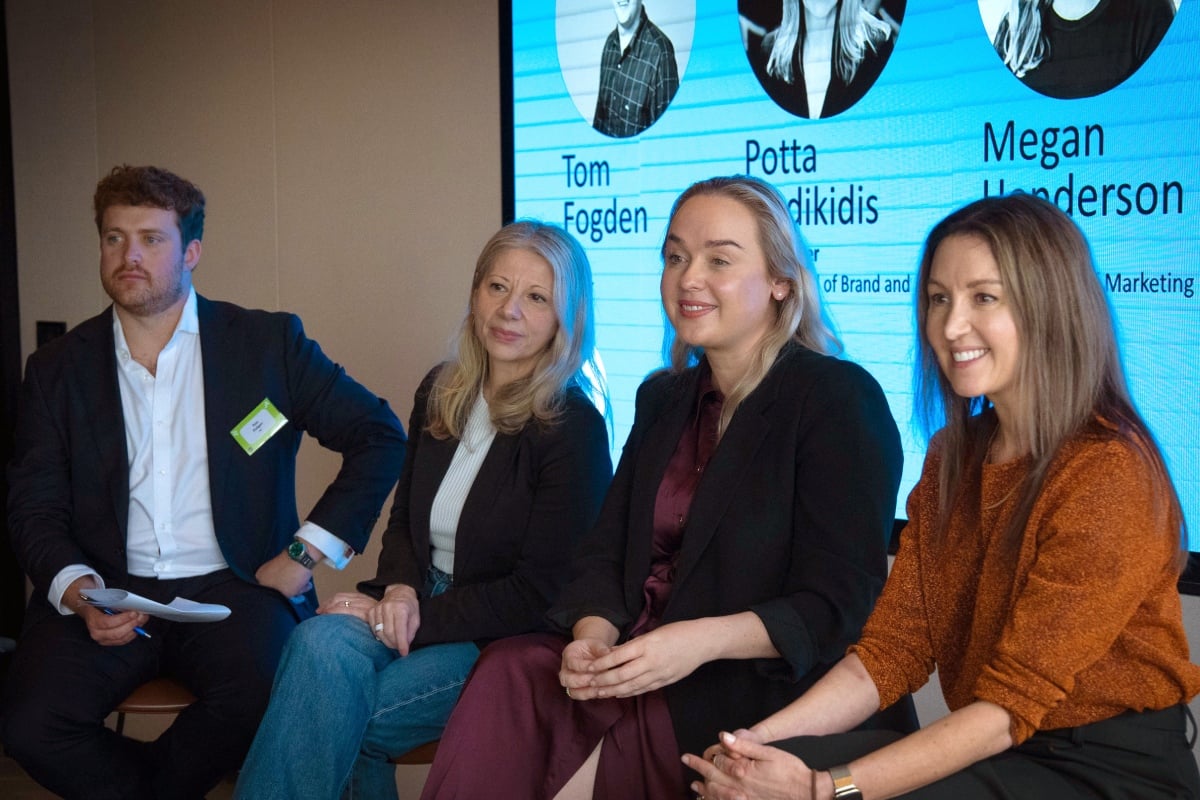
“The minute you sign a contract with the business, you’re suddenly the farthest removed you’ve ever been from your customer,” Megan Henderson, Flight Centre’s global head of marketing, told a crowd assembled at an exclusive B&T CMOs to Watch breakfast event, presented by Zenith.
“We all as marketers or media experts believe that we know our customer. We say that on paper, but we don’t. We have to work so hard to understand our customer. We knew more about the customer when we were an everyday person, not correlated to the brand.”
It’s an insight that would make many uncomfortable. For all the data produced in today’s marketing organisations, it can be hard to see the wood for the trees.
“Get out on the front line. Don’t sit in the ivory tower. That’s how you start to become a much more credible senior leader of a marketing team — when you really spend time on the front line,” said Potta Findikidis, group head of brand and marketing at Cbus Super Fund.
“[The front line] varies across businesses. I spent a lot of my career at Telstra, for example. I was out there with the technicians, watching them do the wiring, I had the steel toe-capped boots on. It’s the same at Cbus, I’m out there now talking to the tradies and the builders on site. It’s the best advice. You have to learn the operations side of the business. But to know the customer, you have to be out there watching and listening.”

For all the data, signals and information marketers possess about any customer at any given time, creating a brand that appeals to customers is about feel as much as anything else. Consumers’ assumptions of your brand are based on their real-world interactions.
“Whenever we have a new person in our business, I tell them to write down one good, bad and ugly about our business,” said Henderson.
“The more time staff spend with the business, the more likely they are to tell me things I want to hear and vice-versa. I need them to be honest. They’ve probably got about 90 hours before they’re tainted.”
For Penny Shell, Zenith’s chief strategy & product officer, marketers who can step back and spot opportunities when few others can are those destined for success — and, importantly, promotions.
“The best marketers I’ve worked with are those always looking for the gaps, even when the business is doing well,” she told the crowd.
“It’s easy to do what you’ve done before. But it’s hard to ask what you aren’t doing, what’s next or what isn’t being filled in the category. You should also look at other categories and learn behaviour there. It fosters a safe space for big ideas and a real spirit of generosity with your team.”
Winning Over the CFO
Many column inches have been dedicated to discussing the need for marketers to understand and embrace the commercial language enjoyed by boards of directors and corporate bean-counters. As the panel explained, this is a skill that must be taught by senior marketing leaders to their more junior staff.
“All the teams that I’ve led want to know that what they’re doing connects to the business and is part of the strategy,” said Findikids.
“No one wants to go to work and have to say to themselves, ‘Well that was a waste of time’. Taking time to train people who might not naturally have that sort of commercial acumen is important. It goes back to language. Keep it simple. Help people — even the most junior person in the team — understand that the work they’re doing is going all the way up the food chain and contributing to new customer growth.
“Putting in the effort will help build people’s skill set. They don’t have to become financial experts, but it’s helping them ensure they can have conversations with stakeholders.”
Findikidis made it clear that the actions of junior members of marketing departments can be underappreciated for their impact on big business problems.
“People see the end product and say, ‘Marketing did that, it must have been easy’. They’re not seeing everything that goes on underneath. Even the most junior member of staff is doing data-driven work. It comes back to narrative and storytelling to demonstrate that we’re not just coming up with advertising all day,” she said.
However, in B&T’s conversations with the industry — and during the panel discussion — there was a feeling that other areas of businesses must also understand the role that marketing plays in growth in a competitive landscape.

Just as marketers can inadvertently become disconnected from their consumers, others in the business can become disconnected from the environment in which their brands operate.
“Marketers are inherently tough on ourselves and we’re always trying to prove that we do more than ‘just’ marketing, in a conventional sense. Leaders set the weather, and it, to an extent, depends on the CEO or who you’re reporting to and their understanding of marketing,” said Henderson, who added that her CEO had a product and marketing background, so understood the value of her team’s work inherently.
Henderson continued to explain that when it came to budget-setting time, being able to explain to various stakeholders about the risk of curtailing spend is important in a competitive and tricky market — the kind of market the travel industry has been operating in for almost the last six years without a break.
“I’ve changed my framing. I no longer talk about whether we’re going to lose a certain number of impressions or TVC ads. I say ‘Ok, we’ll bank half a million dollars and we’re going to give 7 million impressions, whatever amount of airtime, and we’ll give additions to our database to our rivals’. By saying that to leaders, they’ve realised that if we don’t act, our rivals will take our place. They’ll find someone else to book with,” she said.
“Generally, the best commercial solutions are often creative ones,” Shell concurred.
“Whether you’re looking at a new ROI approach, or unlocking something like a new commercial gateway or revenue stream. I don’t think it’s creative or commercial. It’s the right solution.”
The power in all of these conversations, Findikidis said, belongs to the person with the data to back up their assertions. Marketers must be very clear on the give-and-take in any conversations that involve budget setting or fine-tuning.
Culturally Speaking
We often hear that audiences are fragmented. They are splintered across different channels and are unreachable en masse in the way they previously were. This is a matter of some conjecture, given that most people are regularly engaged on just a handful of digital channels.
But the idea of unifying cultural moments — the FIFA World Cup, major TV series or significant music festivals or artists — has been presented as a tonic to this attention dispersion. Finding a moment that not only fits your brand, but where your brand will be welcome and your actions will prove effective, is not an exact science.

“You don’t need to get involved in every trend around. You need to assess whether it’s a cultural moment right for you. Does it fit with our aspirations and audience, and does it make sense? Sometimes you need to make that call in less than 24 hours,” said Findikidis.
“Some brands were jumping on the Coldplay concert. And I was thinking ‘Is that somewhere you really want your brand to be?’”
For Henderson, context and production is everything. Flight Centre recently allowed its in-store staff to create their own social media content — reversing a longstanding blanket ban on employee-generated material. This, so far, hasn’t resulted in any brand calamities. If anything, it’s only been a positive for the company.
“After Justin Bieber’s set at Coachella, our store in Cairns edited the video of him to show him looking at flights on our websites with some great deals. I’d never have thought of that! They’re being creative, mucking around before the shop opens,” she said.
“It also leaves our social team to focus on other things — brand authority pieces, the comms we’re giving to customers about flight disruption in the Middle East.”
The thing with trends, however, is that they come and go. Zenith research, as Shell explained, found that it takes between three and seven days for a trend to build, reach critical mass and then start to die.
“We look at the motivation behind the trend. At Christmas, one of the most sought-after gifts was a dumb phone. Nokia 3210 was back. Mattel released a Barbie dumb phone. The phone was the trend, but the motivation was that consumers wanted to go back to tangible media and experiences. Spotting that underlying motivation means we can create interesting stuff with clients to drive ROI,” Shell said.
The trick for brands to win again and again today is about experiencing the world — for all its faults, which most likely includes some aspects of your brands — as though you are standing in your customers’ shoes.