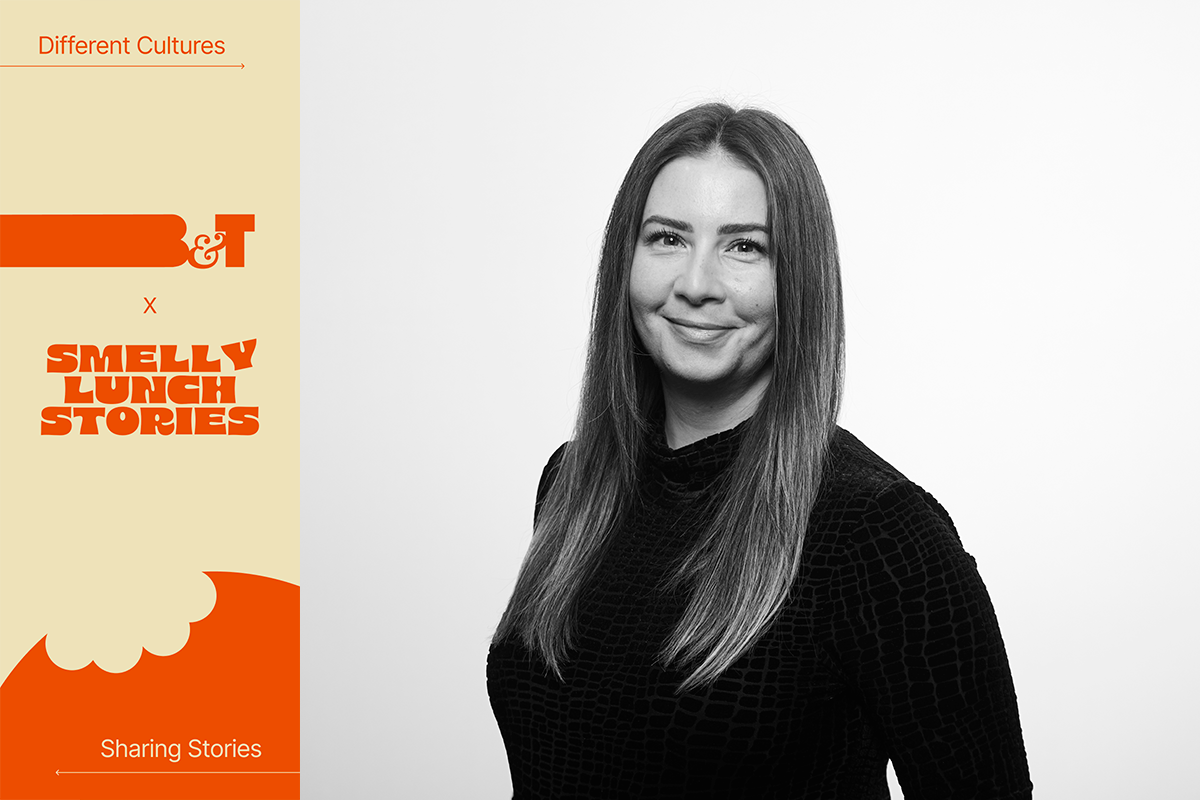
Adland has a diversity problem, particularly at the pointy end of marketing and communications companies. In this new series, B&T has partnered with Smelly Lunch Stories to amplify stories of culturally diverse talent who have risen to the top.
Even though a third of those starting out in the industry are from ethnic minority backgrounds, only 12 per cent rise to the C-Suite. We hope these stories inspire the next generation.
B&T will run a new Smelly Lunch Story every two weeks. EssenceMediacom’s Sydney client managing director, Marcelle Hoyek is the first to share her Smelly Lunch Story.
1. Tell us about yourself in one sentence.
I am a creative problem solver, a strategic thinker, a commercial minded businesswoman, an empath, a collaborator, and a damn good leader.
2. What’s the “smelliest” lunch dish you’ll proudly defend forever?
My absolute favourite dish that I could eat all day every day is koosa mahshi (stuffed Lebanese zucchini) with warak enab (stuffed vine leaves). They are often made together (but not always), and consist of lamb, rice and fragrant Lebanese spices, which I always eat with natural yoghurt. IYKYK.
It is labour intensive dish that is prepared over several days, so it is often made in large quantities to bring friends and family together. It is quintessentially Lebanese, reflecting our hospitable nature and is a true labour of love that always reminds me of my grandmother.

3. What did your parents actually want you to do when you were growing up…and do they understand what you do now?
I don’t feel like there was any pressure to pursue a particular profession, although my mum says she thought I would make a good lawyer!
What was important to my parents was that I went to university, as neither of them had the opportunity to do so.
Around 26 years later and mum can tell you what I do, but dad can’t. I think it helps with a general leadership role as you can say MD and people have a broad understanding of what that job is regardless of the field. But try telling people you’re a chief investment officer and explaining that to someone who knows nothing about the world of media!
4. Please tell us your Smelly Lunch story.
I am a fiercely proud first generation Lebanese-Australian on my dad’s side and second generation on my mum’s side.
I grew up in Sydney’s southwest in a pretty multicultural area, but from memory, my sister and I were the only Lebanese kids at the school.
We didn’t grow up in a suburb surrounded by our culture, but it was always front and centre with our family life – aunts, uncles, cousins, grandparents, through the language, customs and of course, the food. We have a large family both here in Australia and back in Lebanon.
Our first family trip to Lebanon was in 1995 when I was still in high school. It was a transformational experience for me, to see my origins, meet family I’d only ever heard about (this was pre-internet and social media), learn the history of the country, and understand my heritage. I can’t explain it other than to say to felt like coming home.
Since then, I’ve been back several times as an adult, but it is a challenging place to visit as it’s unfortunately not always safe to do so.

5. Was there ever a moment when you felt different or like an outsider because of your cultural or ethnic background? How did that make you feel?
I wish it was only a moment but unfortunately, I’ve experienced a lot of casual racism and in various situations throughout my life, including the workplace.
As soon as people find out I’m Lebanese, I get the barrage of follow up questions…
“Oh but you don’t wear a burqa. Are there Christian’s in Lebanon?”
“But you’re so fair, you don’t look Lebanese.”
“Oh but your English is so good, you don’t sound Lebanese.”
Or the offhand comments that are tried to deliver as a joke but land in a completely offensive way… “You Lebo” or “watch out, she’ll get her cousins on you” or “careful she might have a knife on her”.
And in case you are wondering, those are actual quotes of things that people have said to me. When I was younger, I would try to laugh it off but it would always affect me – I would feel misunderstood, disappointed and frustrated with others judgement. But as I’ve gotten older, I’ve learnt that’s more a reflection on them than me.
6. If you were stuck on a desert island, what one piece of media (book, podcast, film, album) would you take with you?
It would have to be an album because I love music – it has the power to lift your mood and I love to dance. It would be an RNB compilation album of hits from the late 90s/early noughties – a bit of Montell, Mariah, Lil Jon, Blackstreet, TLC, and the like.

7. Who opened a door for you, and who have you opened one for since?
The first door openers were my maternal grandparents who arrived in Australia in the 1950s not knowing anyone, not having a place to live and not speaking the language. My grandfather came first on his own, found a job and then saved money to bring my grandmother and uncle here.
The sacrifices they made and the hardships they endured are nothing short of inspirational. They built a life for themselves here and in turn my mother and her siblings. The second door opener was my dad who came to Australia in the late 1960s. He came in search of a better life for himself. In their collective bravery, my family paved the way for me and my sister and our children.
Career wise, I’ve been fortunate to have some pretty amazing mentors and advocates who have supported and guided me throughout my career. I would say Henry Tajer has been the most influential of those. I’ve learnt many things from ‘HT’ but one of the most important things I learned from him is the importance of authentic leadership and to surround yourself with people who are better than you.
I naturally advocate for others and ensure I facilitate opportunities for my team that challenge them and help them grow. I take immense pride in seeing those I’ve worked with succeed in their career, knowing I’ve played a part in that is so rewarding.

8. How does your cultural background influence the way you approach your role?
Coming from a working-class background, I understand the value of hard work and was brought up to believe that success comes for those who put in the effort. I have a strong work ethic and a get shit done mentality. That work ethic and ambition has been rewarded as I made a pretty quick ascent through the ranks.
One of the things I love about this industry is that you can move at your own pace, it’s not necessarily always about time in seat but more about aptitude and attitude.
9. What advice would you give to someone starting out who feels like they don’t fit in?
“Fitting in” is overrated. Embrace the fact that you don’t! Embrace your uniqueness, and harness it as your superpower. Use it to motivate you and propel you forward. Pave the path for those behind you. Show your resilience and what you are made of. There is so much more power in that, than there is in fitting in.
10. What do you wish more people understood about cultural diversity and why do you believe it’s important in leadership teams?
Personally, I really value cultural diversity because it brings diversity of thinking. When you have diverse thinking in the workplace, you have better debate and conversation, better collective decision-making, better innovation and ideation, and better team cohesion.
When you bring together different perspectives, experiences and cognitive approaches, as a business you benefit from higher engagement, increased adaptability to customer needs, and better financial performance. I am a firm believe in culture as a driver of growth.

11. What is one thing you think our industry can do to drive greater representation in leadership teams?
The industry has so much more diversity in it compared to when I started, but there is still so much more to do.
I think it all starts with recruitment into the industry, ensuring we are hiring from diverse backgrounds and skillsets, outside of the “Eastern suburbs media bubble”.
If we bring in more diverse talent and nurture them throughout their career journey, we will have so much more talent available in the future.
In terms of the now, we do have that diversity in our industry so it’s more about facilitating the right opportunities. Award on merit but ensure there is diversity in candidates for every senior leadership role being recruited. Be intentional in that to remove subconscious bias.
If you have a Smelly Lunch Story you would like to share, please email: [email protected]