




Wimbledon may have the tradition (and Pimms), the US Open has the hype and noise, and the French Open has… clay. But when it comes to creating a fun and brand-friendly festival of tennis, the Australian open is undoubtedly the grand slam champion.
Tennis fans who have been to the event get why it is known as the ‘happy slam’. Whether it’s watching world class athletes smash a furry yellow ball around a blue court in world class stadiums; enjoying fine food, drinks and live music in a festival-like atmosphere; or trying one of the many fun and engaging brand activations—there is something for everyone at the tournament.
The Australian Open’s commercial success over the past five years is also phenomenal. The tournament is on track to double its sponsorship revenue over this period. At this year’s tournament there will be close to 50 official Australian Open partners, with ten new ones added for this year’s show.
New partners include Nexo, Bupa, Realestate.com.au, Altos, A2 Milk, Yo Pro, DiDi and Lipton, while new regional partners include Stella Artois (in South America), Tsingtao (China) and De Cecco pasta (Europe).
Brands that have renewed and increased their partnership with Tennis Australia include ANZ (which upgraded to global rights and associate level partner), Chubb Insurance, Chemist Warehouse (expanding to be presenting partner of Cardio Tennis), Mecca, Red Bull and Chinese coffee giant Luckin.
They join major partner Kia, other associate partners Emirates, Rolex and Luzhoulau Jiao and a range of other brands including Bupa, Asahi, Infosys, M&M’s, Marriott Bonvoy, Polo, Jacob’s Creek, Mastercard, Haier and more.

In addition, around 1,000 companies buy hospitality packages throughout the tournament. Sponsorship revenue now makes up roughly a third of the Australian Open’s revenue; the rest is generated from hospitality and ticketing, and media rights.
“It’s been a pretty fruitful year,” Tennis Australia director of partnerships and international business Roddy Campbell told B&T.
“We didn’t think we’d do as many deals, to be honest…but we’ve got such a diverse event that you can find lanes for so many brands.”
Part of the AO’s expansion has come from a strategy to stretch the two week tournament into the three weeks.
Although the proper tournament started on Sunday (18 January), qualifying week has taken on a life of its own with a range of exhibition matches starring tennis stars and other fun events drawing around 30,000 fans to Melbourne Park on some days.
This included the AO 1 Point Slam, sponsored by Kia, that saw 29 year old Sydney tennis coach Jordan Smith upstage a field that included Jannik Sinner, Carlos Alcaraz, Iga Swiatek and Coco Gauff to win $1 million (watch AO 1 Point Slam final below).
Campbell told B&T that the concept was first tested last year, but has now gained so much traction that it will become a regular fixture (that can be supported by brands).
“That was a genius idea that’s been talked about internally for three or four years. We tested the format last year and knew it was going to be quite tense viewing,” Campbell said.
“It was incredibly successful and a fairy tale ending of an amateur winning a million dollars. If you saw vision of Carlos Alcaraz and Frances Tiafoe and all those players were so gripped by the content.
“We feel the broadcasters around the world are going to want to show this and it’s going to fill stadiums. It is a slightly different vibe to Grand Slam tennis and it also links to the grassroots, because you have to qualify at tennis clubs around Australia to take part.”
Could this be the tennis version of the FA Cup? Perhaps, but it was not all that was going on during qualifying week to entertain fans.
“We are kind of bursting at the seams during the main draw, so we thought lets bring crowds to the first week where you can get a cheaper ticket and slightly less crowds, and it’s proving really popular,” Campbell said.
“From a brand partnership perspective, it was a really busy week of brand events with many of them doing media events on site. So they can bring a celebrity or the media along in a certain part of the precinct and we create an event for them that gets good publicity.”
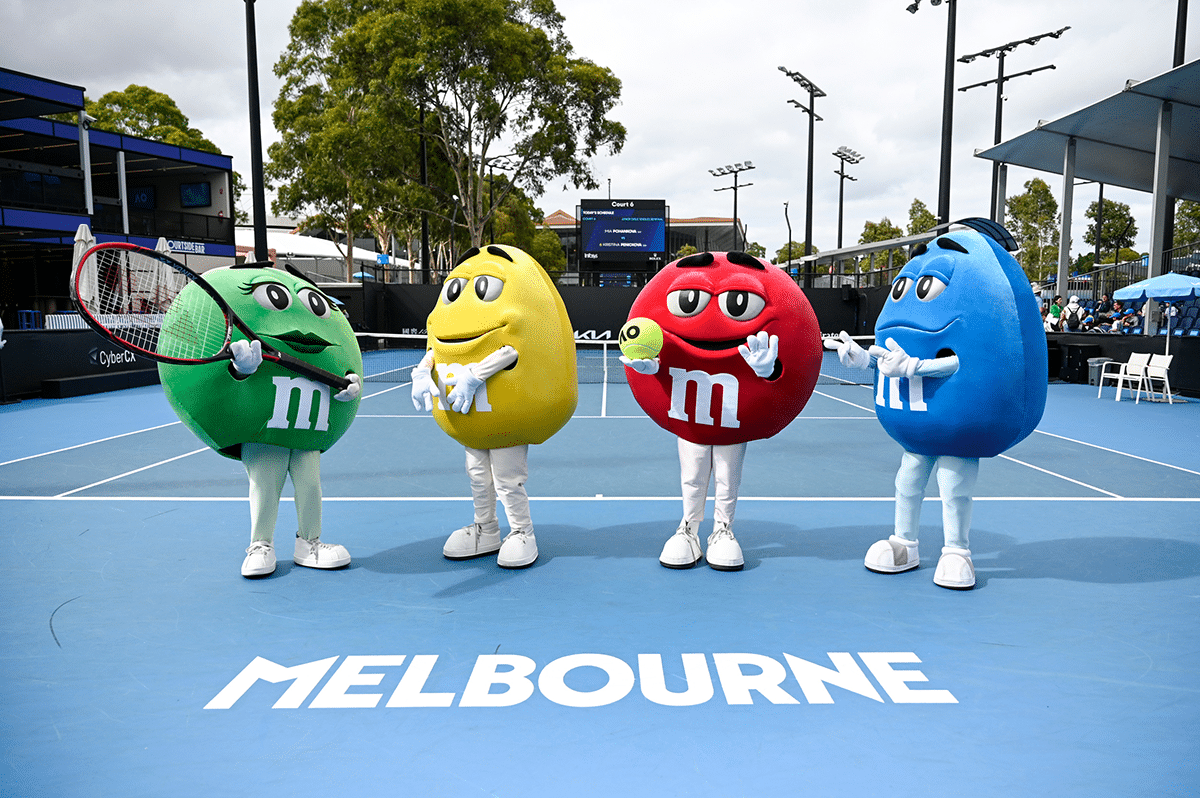
This included a Grey Goose party, a Dunlop tennis racquet launch, the M&M’s characters playing a tennis match and a swish Marriott hotel party.
There are also hundreds of brands who aren’t AO sponsors but have tennis interests running events outside of Melbourne Park.
“The whole influencer marketing space is quite an interesting trend that we’ve noticed in terms of how brands bring their AO partnership to life,” Campbell said.
“It’s great to see the demand for tennis from brands, and if you’re a partner, you get the IP and are allowed to amplify influencer content within Melbourne Park as well as receive behind the scenes access…content that we will also push through our own channels.”
Within Melbourne Park itself, more brands are flocking to newer sections such as Top Court, a Gen Z targeted precinct that features live bands, gaming content and stores, such as a multi-story Mecca shop.
“We struggled to get brands to go there in year one, but in second year we managed to secure four or five partnerships where they’re proud to show up there because they know we’re going to bring a crowd there,” Campbell said.
“So we have Lipton Iced Tea Island and YoPro Pickle Ball court, Shake Shack and Red Bull activating. There’s a music festivals for 3,000 people every night, influencers doing Q&A’s on stage, a Gaming Hub, and a lot of activity.
“We wouldn’t have been able to sustain those brand deals a few years ago, but because we have this new zone, we’ve managed to provide a footprint to new brands that is not just a physical space, but provides rich content.”

Finding the right balance between adding more brands and preventing the festival from being cluttered can be challenging.
Campbell said that providing zones, such as a retail zone and Gen Z zone provides “clean air” for brand activations to shine, but is also mindful that there is a finite number of partners that can fill Melbourne Park.
“Every year we will host hundreds of brands and try to identify where there’s an open category to craft a narrative or activation footprint that is going to work for that category,” he said.
“The team’s been phenomenally successful in converting those in the last few years and in the next few years we are focused on doing more with our current partners and doing more of the creative ourselves. We have a big activation team and a content team and are looking to act more like an agency for some of those 50 partners.”
For example, Kia is celebrating its 25th anniversary sponsoring the tournament by hosting a tournament for 800 Hyundai executives at the event that Tennis Australia has helped organise.
Mecca has a three-story store and is offering free makeup and hair treatments, creating fan experiences rather than just selling products, while Mastercard provides an express queue across retail and food outlets at Melbourne Park for fans who use their Mastercard.
Chemist Warehouse is one brand that has expanded its sponsorship with Tennis Australia beyond the Australian Open.
“We love brands that are a bit more invested in tennis beyond the three weeks and Chemist Warehouse has been a great partner and sponsor Cardio Tennis,” Campbell said.
Looking ahead, Campbell said the Australian Open will continue looking for brands that can naturally fit into the tournament and provide utility, what he describes as an “authentic use case as a passion point”.
“For example, technology brand X has an innovation that can enhance a sporting event. They bring all their clients, and they talk about it all year round in their own forums.
We were actually in Silicon Valley in September meeting a whole range of brands including some that we work with and some that we don’t. There’s definitely interest in using our event as a case study to show off their product.”
Last year, more than 1.2 million fans attended the Australian Open and 2026 is already on track to break that record.
Tennis Australia’s strategy to expand the event into three weeks is already paying dividends.
Opening week attracted 218,000 fans (around 100,000 more than 2025), and the opening day saw more than 100,000 attend the tennis, another record.
Campbell wouldn’t disclose how much revenue the Australia Open generates, but Tennis Australia’s most recent financial statement, for FY24, showed that the organisation made $590.4 million.
With a record number of sponsors and huge interest from brands overseas, the Australian Open is not only getting bigger, but also much more lucrative.
In spite of this success, Campbell said Tennis Australia is not resting on its laurels.
“We are delighted at the success we’ve had, and we want to keep pushing boundaries, and we need to support the rest of tennis,” he said.
“The AO is obviously so high profile, but we have a job to do to sell some of the other events, like the United Cup in Sydney and Perth. We also have the Brisbane International and we have grassroots tennis.
“We need to try and get brands to work with tennis all year round, whether it’s booking a court, whether it’s the Hot Shots program and. So that is definitely a focus of the team.”


