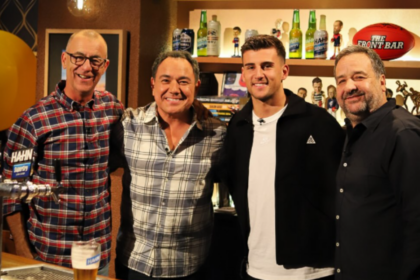

The room was heaving when Mark Ritson and Byron Sharp shared the stage at Cannes Lions for the first time. It was all that and more. But at the famed International Festival of Creativity, they seemed to forget one critical Truth, writes Ben Lilley, founder of HERO and a 2026 Cannes Lions juror.
Mark Ritson and Byron Sharp head to head at The Debussy Theatre in Cannes. It could almost be a marketing title bout for the ages. Between them, they’ve done more to reshape how serious marketers think about brand building than almost anyone alive. And all from Australia. They’re also as famous for what they disagree on, and how.
Ritson in particular has thrown some spectacular shade over the years (as Ritson does), with his most memorable moniker for Sharp being “The Dark Lord of Penetration.” Which he repeated again at the Palais. Sharp just laughed. Mark was good enough though to compliment Sharp for his seminal 2010 book How Brands Grow, calling it the most important marketing book ever written. Although he added it’s also the most boring book he’s ever read. You get the picture.
Suffice to say, these two know how to pull a crowd, without pulling any punches. Their session was “Five Marketing Truths We Can Actually Agree On.” And for the most part they did agree. Even if Sharp had to repeatedly correct Ritson along the way. These Five Truths should be essential reading for any marketer. And at its core, the Ritson-Sharp playbook is simple: build mental availability at scale using distinctive brand assets, reach as many category buyers as possible, and repeat the same message long after you’re bored of hearing it.

All five of these truths are empirical and irrefutable. In fact at HERO, our entire strategic approach is built on the Ehrenberg-Bass foundations Sharp pioneered: DBAs, mental availability, salience, consistency. It’s the Logic in what we call our HERO Logic + Lightning. But there was one final and crucial truth for marketing effectiveness that was missing: the Lightning. Creativity. Neither of them answered the thing the room most needed to hear: what kind of creative work actually does this?
Creativity is the hero of marketing performance. You can’t excel at one without the other. And again, the evidence and data prove this is an irrefutable truth. It may not be Ritson or Sharp’s area of research. But no conversation on marketing effectiveness at the Cannes Lions Festival of Creativity is complete without mentioning, well, creativity.
It’s a marketer’s exponential force multiplier. One that can make the difference between a brand that spends its way to average salience and one that punches so far above its weight that competitors can’t work out what happened. As Sharp pointed out, two brands running the same media spend over the same period with the same DBAs can produce wildly different results. The gap between them is creativity.
Our own work that’s shortlisted at Cannes this week is the perfect proof of this. HERO’s Transit Tales campaign for Mastercard, for example, isn’t just a technically sound campaign built on solid DBA principles. It’s an insanely creative AI-powered storytelling platform that turned Sydney commuter journeys into personalised literary escapes. It came from a creative mental leap that nobody had tried before.
So if I were adding a sixth truth to what Sharp and Ritson laid out on The Debussy stage, it’s this: outstanding creativity is the hero of marketing effectiveness. Of course, creativity alone is also nothing without their own 5 immutable marketing truths. And both flew through these in a wildly entertaining back and forth. So let’s look at what they did cover:
Mental availability beats brand love, every time. The shift from “what does the brand mean?” toward “what makes the brand come to mind?” is the most important course-correction in modern marketing. As Ritson put it, if your brand comes to mind in buying situations, 70 to 80 per cent of your job is already done. Nobody is mulling over their emotional relationship with a toothpaste brand at the checkout. They just grab the one that pops up first in their head.
Distinctive brand assets are non-negotiable. Logos, colours, sonic identities, characters. Sharp’s line, which Ritson quoted, is that DBAs are what create “A brand that looks like itself.” Both agreed that DBAs are too often ill-defined, underused, poorly measured and routinely sabotaged by marketers who get bored long before their consumers have even registered the asset exists.
Sophisticated mass marketing beats niche thinking for brand building. For decades, Kotlerian marketing orthodoxy told brands to segment hard, target narrow and differentiate. Sharp’s evidence shows “the Kotlerian world is a bit wrong.” Reach more people. Build more memory structures. Stop hiding your brand from the vast majority of potential buyers just because they aren’t in market this quarter.
Brand purpose is largely nonsense. Here Ritson and Sharp are in fierce agreement. Ritson’s take is that purpose works for “two or three companies” but becomes meaningless at scale. While Sharp quipped “No one goes yes, I want to buy the brand that saves the dolphins” and noted CMOs should not be spending shareholder money on causes their consumers don’t care about.
Consistency is criminally underrated. The average campaign runs 30 to 40 days. Both said this was insane. The consumer has barely seen your ad once, but you’re already bored and ready to pull it. As Ritson said, “You’ve got to leave your cake in the oven for longer.” He then went on to make the point even more colourfully, saying that while marketers might get sick of their own campaigns, they need to “push through the vomit” and stick with what works.
Just make sure it’s creative enough that people actually remember it too.