


With the finalists for Cairns Hatchlings, presented by Yahoo, having been revealed, we are turning our focus to the work that earned them their place in the spotlight. This week we take a look at the OOH category.
Want to see who comes out on top? Join us at the Cairns Crocodiles, presented by Pinterest.
All entrants must work in pairs. The finalists for the digital category are: Sophie Whitehead and Sophie Harper, Abby Roberts and Hannah Bryce, Ruby Meers and Cara Edwards.
The pairs were challenged to develop an innovative, OOH campaign that inspires the nation to participate in Bandanna Day. Their goal is to show teens with cancer that they are not alone.
The brief asked them to reignite awareness around the national day, as well as drive mass participation and demonstrate how visible acts of support can help teens with cancer feel more supported and seen.
Have a look at their work.
Sophie Whitehead & Sophie Harper, Saatchi & Saatchi Australia
Whitehead and Roberts discovered a core tension, Aussie’s don’t lack care for Bandanna Day, they’ve just stopped showing up for it. The day was once recognised as a highly visible, collective act but has now faded into something remembered.
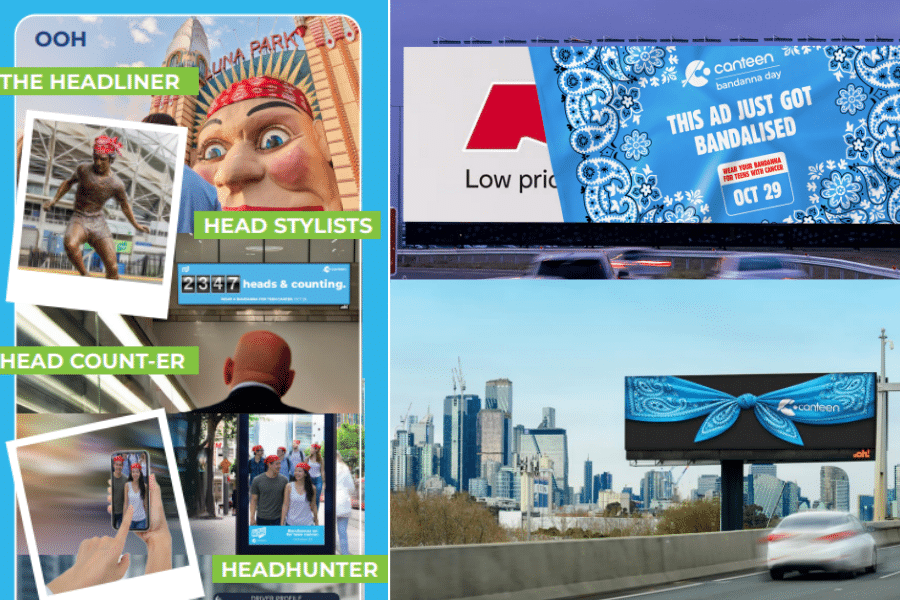
Their response frames the challenge as not awareness but visibility. ‘Calling All Heads’ tackles this by turning a the collective human experience of having a head into the campaign’s key organising idea. As part of their campaign, a bandanna is transformed from a product that is purchased, into an accessory that belongs everywhere.
By placing bandannas on large-scale, recognisable heads across Aussie cities, the campaign creates a visual takeover. It aims reintroduce Bandanna Day at scale and externalise solidarity in a way that feels collective.

Abby Roberts & Hannah Bryce, Rumble Strategic Creative
Roberts and Bryce identified that Bandana Day hasn’t lost its meaning but instead its cultural relevance. They have found that people don’t gravitate towards ads but movements. They core insight flips this idea: The issue isn’t the asset, it’s how it is being framed.
‘Bandalism’ reframes support as disruption. By wrapping OOH sites in bandanas, the campaign behaves like street art rather than an ad, to create intrigue.
Their idea scales through partnerships, while embedding itself into the spaces audiences truly care about like iconic landmarks and cultural moments.

Ruby Meers & Cara Edwards, POLY, oOh!media
Meers and Edwards believe that the problem with Bandanna Day isn’t awareness but reality. Their key insight is behavioural, people engage more when they can actually see their role in a larger movement.
‘23,000 for 23,000’ aims to turn a statistic into something tangible. The OOH features stripped back billboards that hero the unmissable bandanna. Each iteration contributes to a national count totalling 23,000.
Their work transforms passive viewing into participation, making support more visible, trackable and shareable.