With the Cairns Hatchlings, presented by Yahoo, now wrapped for another year, we thought we’d take a look back at the work produced by the Round 2 runners up, live in Cairns.
Round 2 tasked entrants with one of the most ambitious briefs in the competition’s history: respond to a real UN Foundation and OCHA challenge to raise US$23 billion (AU$32.8 billion) to save 87 million lives in 2026, built the single unifying platform idea ‘Reunite for Humanity’.
The brief asked entrants to make the global personal and tap into the subscription economy to reframe humanitarian giving as something ongoing, automatic and culturally resonant across Asia-Pacific.
Entrants had 24 hours to respond to the brief and submit their final work.
Across eight categories the finalists delivered work that pushed the brief in bold directions. Over the coming weeks, we’ll be showcasing the ideas that made it to the final round and the thinking behind them.
To kick it off, we’re taking a look at the Strategy category.
Annabelle Harrington and Sophie Stone, This is Flow
Harrington and Stone identify compassion fatigue as the central obstacle. They noted that while self-optimisers are obsessed with personal progress, they simultaneously crave connection and collective meaning.
Their insight: you can’t truly understand someone’s reality until you’ve walked in their shoes.
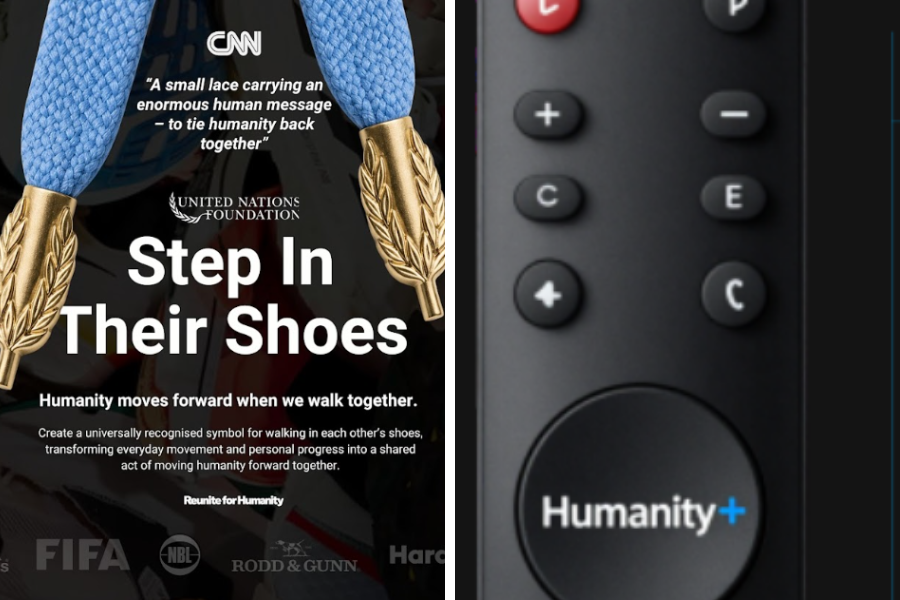
Their response was ‘Step In Their Shoes’. A strategy that aimed to transform the shoelace into a symbol of shared humanity. A UN-blue lace worn by anyone, anywhere, that becomes a wearable act of solidarity that contributes directly to the ‘Reunite for Humanity’ fund.
The three-pillar rollout launched ‘Humanity Laces’ as a product, scales them onto the world stage via the 2026 FIFA World Cup and extends the movement through fitness and self-tracking app partnerships. It’s goal, to turn personal milestones into moments that connect individual progress to the realities of others around the world.

Gabi Richardson and Susannah Brown, Nine
Richardson and Brown identify overwhelm as the core tension at the heart of the brief. They argued that as the world becomes harder to face, people increasingly escape into streaming services, creating a value equation where entertainment gains and humanity loses.
Their insight: the same subscriptions people use to disengage from the world, could be redirected to save it.
Their response was ‘Humanity+’, a strategy that embeds fundraising directly into existing streaming platforms rather than asking people to change their behaviour.
By partnering with major services to introduce an opt-out 50-cent monthly increase, the campaign turns passive viewing into passive giving. The three-phase rollout aims to build awareness through nostalgic global talent, drive mass subscriptions via a one-month free trial mechanic and retain donors through personalised, shareable content.

Winners: Elizabeth Nan Tie and Darshan Pawani, Starcom
In the end, it was Elizabeth Nan Tie and Darshan Pawani from Starcom who took out the Strategy category with their ‘Play It Forward’ campaign, which proposed turning YouTube’s skipped ad inventory into a $23 billion humanitarian funding engine.
For their campaign, the answer was to change the system that behaviour already runs through.
What if the 30 seconds you were going to skip could actually save a life? Every day, billions of dollars in media value evaporates through skipped ads, wasted impressions, and inefficient inventory.
‘Play It Forward’ proposed an opt-in through YouTube’s 2.7 billion active users. Watch a 30-second ad, and that viewing funds humanitarian impact through brand investment.
In a category that rewards thinking over execution, Nan Tie and Pawani delivered both.

Click here to view all the 2026 Cairns Hatchlings, presented by Yahoo winners across every category!