



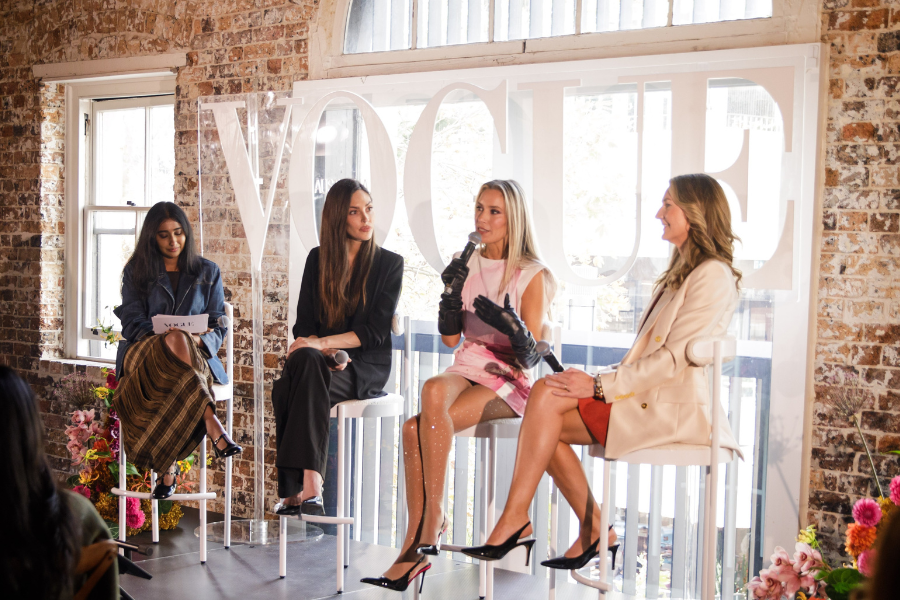
Ahead of this year’s Vogue Codes Summit, Vogue Australia hosted a Visionary Women’s Lunch where its director of audience, Nikki Chowdhury, spoke with three panellists about what is needed to help build success for women at work rather than simply ask more of them.
The panel comprised High Heel Jungle founder Kathryn Eisman, Tap the Gap founder and chief executive Lucy Kough, and environmentalist and author Natalie Kyriacou. Chowdhury asked each to consider what an optimised world looks like within their own field, and what tends to get lost in the process.
Kough’s answer was the clear. Tap the Gap, her platform addressing the gender superannuation gap, isn’t pitched as a tool to make women more financially disciplined. It was built on the premise that the superannuation system was designed decades ago around continuous full-time employment and wasn’t built with interrupted careers, lower average pay or unpaid caregiving in mind.
Rather than adding financial literacy as another item on an already long list, the platform connects to everyday banking and routes spare change into super automatically. Kough pointed to women driving the majority of household purchasing decisions as the reason the product meets people in behaviour they already have, not behaviour they’re expected to adopt.
“Women make 80 per cent purchase decisions in a household, so let’s bring this conversation about wealth creation into a space where they’re already engaged.”
Eisman made a parallel argument from a completely different category. She built High Heel Jungle in hosiery and accessories because she saw it as a part of the market the wider industry had left “sleepy, boring, and generic,” not through any inherent limitation of the category, but because nobody had bothered to ask whether the existing options reflected what women actually wanted to wear.
She argued that algorithm-driven exposure has manufactured the appearance of personal taste, with constant exposure to the same trends standing in for genuine preference.
“We become more and more homogenised in our tastes, in our aesthetic preferences. What we think of as free will has actually been dictated to us.”
Kyriacou’s section of the panel pushed the same idea into a different register: sustaining attention.
She spoke to the challenge of keeping people engaged with environmental issues once the initial urgency of a headline wears off. She argued that the usual approach, more facts and doom, isn’t an optimisation problem but more of a trust and engagement one.
Her preferred fix pointed to examples including a 12-year-old forest defender and Australia’s largely unpaid, majority-female wildlife rescue workforce.
Asked what they each refuse to optimise, the panel cited curiosity, downtime, and the slower groundwork that ideas often need before they take shape. It was a fitting end to a conversation that spent most of its time arguing against efficiency as the only measure of progress.
Vogue Codes returned for its eleventh year last Saturday, with the theme “Optimism in motion: Acting now to shape the future”. The event spotlighted the women changing the world for the better through conversations at the intersection of innovation, empowerment and the next generation of people and tech.
What tied the lunch’s three panellists together isn’t industry, it’s the pattern underneath their work: each identified a system, superannuation, fashion retail, environmental communication, that had been quietly built around assumptions that didn’t include women, and then built something new rather than asking women to adapt to the existing structure.
It’s a useful frame for thinking about visibility in media and marketing, an industry where women make up a large share of the workforce but remain underrepresented.


