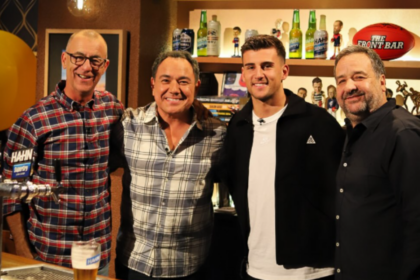

Brent Hill has spent much of his career selling destinations to the world. But as the chief marketing officer of the Brisbane 2032 Olympic and Paralympic Games, he now has the biggest brief of his life: convincing billions of people that Brisbane – and Australia – can stage the greatest Games in history.
Speaking at Cairns Crocodiles, presented by Pinterest, alongside Omnicom Oceania CEO Nick Garrett, Hill outlined an ambitious vision for Brisbane 2032.
He wants the Games to stretch far beyond sport, putting Brisbane firmly on the global map and uniting Australia to create a lasting legacy for decades to come.
“When that phone call came through to say, ‘We’d like you to join the team’, it was a pretty easy response,” said Hill, who previously served as CEO of Tourism Fiji and has held senior tourism roles in South Australia.
“The scale is massive. When you look at the Winter Olympics… and then you think that the summer Games is 10 to 14 times bigger than that; to work on something really meaningful that can leave a legacy, there’s a real challenge in that, but that’s exciting.”
Hill said the Brisbane Olympics is unlike any marketing role he has ever held because of the emotional investment Australians have in the event and the sheer number of eyeballs that will be zoning in on brand Australia for two weeks. This means that how Brisbane shows up is incredibly important.
“I joke that if I had $1 for every time somebody said, ‘Can you make sure bin chickens are in there? Can you make sure Bluey is there? And what role is Baz Luhrmann going to play?’ I’d be a billionaire,” he said.
Hill wants Brisbane 2032 to showcase a more nuanced version of Australia than the stereotypical international image of beaches and kangaroos.
“Look at our dining scene, and look at our events, including the Cairns Crocodiles, we’re a bit more sophisticated than that.
“We don’t all just walk around in togs, but that’s what the world wants. So there’s that lovely balance (between global perception and reality), a real juxtaposition, but the one thing I would say, we’re going to put bin chickens in somewhere.”

While many view the Olympics as a two-week sporting extravaganza, Hill said Brisbane 2032 is about long-term transformation. That means building an experience that extends far beyond stadiums and medal ceremonies.
He pointed to the Australian Open, where “30 per cent of people that go…don’t watch any live tennis”, as proof that major sporting events have become cultural and lifestyle experiences as much as sporting ones.
“The one fundamental message, if you take nothing away from this, is do not leave Queensland when the Olympics is on,” he said to a packed auditorium of marketers, media and agency executives in Cairns.
Hill said Brisbane 2032 is a massive opportunity for marketers, media companies, agencies and brands to help shape how Australia presents itself to the world.
“The budget that I have, just to be really clear, is less than what we had in tourism annually for my lifetime,” Hill said. “So it’s not about the money per se, but what you have is unprecedented eyeballs.”
He used the session as a rallying cry for the broader media and advertising industry to get involved.
“If you’re a media company, come and talk to us about how you can help put our brand out there,” he said. “If you’re TV and radio, we’ve got moments starting with the emblem launch in the middle of the year… there are moments all the way through.”

Australia house
One of the projects Hill is most excited about is Australia House at the LA 2028 Olympics, which Brisbane 2032 will use as a launchpad to build hype and anticipation ahead of the Games.
“We’re building this thing called Australia House in LA28. It’s a three-storey venue on Venice Beach,” Hill revealed. “It’s going to be the greatest celebration of Aussieness… we’ve hired it for 60 days over the Olympics and Paralympics.”
He also revealed that the Brisbane 2032 emblem has already been approved and will launch later this year.
“I can’t wait to launch the emblems,” he said. “We’re really proud of them. It’s amazing, you spend weeks geeking out over fonts and colours.”
But beyond logos and campaigns, Hill repeatedly returned to the idea that Brisbane 2032 represents a defining cultural moment for Brisbane itself.
“We will be the smallest city to ever host a summer Olympics,” he said. “But the city will be a stage.”
Hill painted a vision of an interconnected Olympic city where fans can walk between venues, entertainment precincts, restaurants and live sites in a way few previous host cities have managed.
This includes a new 66,000 capacity stadium that is likely to be repurposed for footy and major events after the games, as occurred in Sydney.
Hill believes the infrastructure upgrades attached to the Games will permanently reshape Brisbane, much like Adelaide Oval transformed Adelaide’s sporting and entertainment economy.
“When you look at Brisbane Stadium… that’s a great decision,” he said. “It completely changes everything.”
Having spent years overseas, Hill said Brisbane 2032 offers Australia the chance to remind the world what makes the country special.
“I honestly believe Australia is the promised land,” he said. “When you think about Sydney, Athens, Beijing, London, Rio, Tokyo, Paris, LA and then there’s Brisbane. We’re sitting alongside these great world cities and will forever be an Olympic city.
“I was a part of that with Sydney, and it just felt like all of a sudden the world knew who we were. This will be the greatest party and time of your life.”