
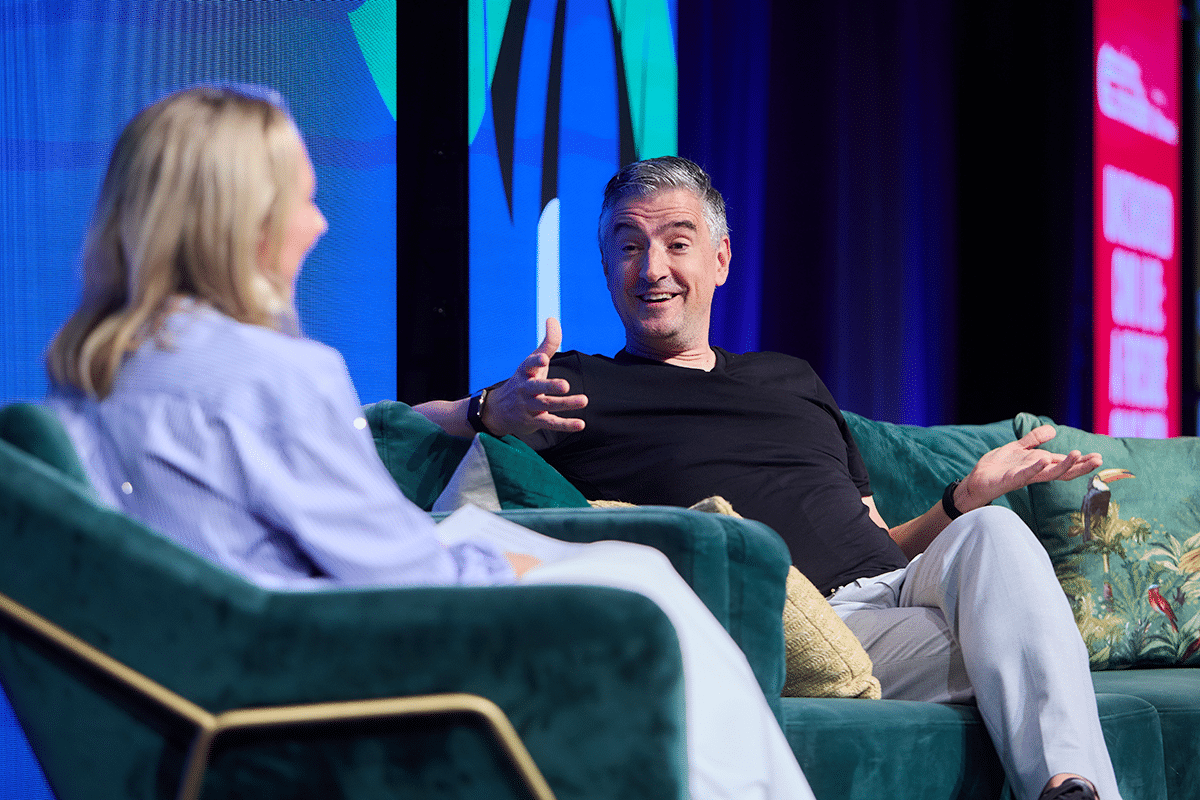
Marketers are uniquely positioned to lead companies but not enough are rising to the top job, according to Uncensored CMO presenter Jon Evans.
This is partially due to marketers inability to communicate in the language of c-suite colleagues, but there are also other factors at play.
“You (marketers) are perfectly positioned for the top job. I don’t get why there’s not more CMOs that rise to CEO,” he said.
“The CMO represents a customer; they are also at the heart of the organisation and responsible for change.
“Also, we’re supposed to be good at communicating, and the CEO’s job is communicating to shareholders, to customers, to internal staff. CMOs have the skill set and I think a CMO would be much more interesting as a CEO than the finance person or the ops person.”
Roughly one in ten CMOs make the leap into the CEO hotseat, whereas more than a third of CEOs come from a finance background.
Evans believes that part of the problem is perception.
“The issue is we talk in terms of ‘coloring in’ rather than talking in terms of numbers, ROI, business change, vision, and all of those kinds of things. We’ve got to be better at speaking the language of the board,” he said.
“The CMO role is the only role in the C-suite that is genuinely looking ahead,” he said.
“The marketing job is to identify where the business is going, build a vision around it, identify the strategy, deliver the tactics and unite the organisation around it,” he said.
“Most marketers are failing at the first point, which is that they’re not creating a clear vision of their company that their own boss can buy into, let alone the staff.”
Evans, who has interviewed the best marketing leaders in the world for his Uncensored CMO podcast, observes a common trait in those that rise to the top.
“If you go to the US and you talk to some big CMOs, you’re basically talking to the press release. Every answer is from the press release, and you don’t get a sense of them actually doing the job,” he said.
“The most successful marketers in the world act like founders of their organisation. Mark Ritson has this quote, ‘Your job as marketer is representing the customer in the room when decisions get made’.
“What the best marketers do is have a direct line straight through to their customer. They’re with their customer every single day, they’re at the coalface.”
One marketing leader that Evans highly rates is Kory Marchisotto, the CMO of the e.l.f. cosmetics.
Under her watch, e.l.f. has lifted its marketing investment from 6 per cent of revenue to 24 per cent, and the cosmetics company has from from a $200 million company into more than $2 billion in sales.
Marchisotto believes that success is determined by the distance between a brand and the customer and the time it takes turning insight to action.
“Your job is basically to set that consumer insight, turn it into action and deliver it very, very quickly,” Evans said.
Another brand he admires is Liquid Death, which essentially sells water in a can. Its success, argues Evans, is purely driven by “the power of marketing”.
Evans was asked by CRA chief executive Lizzie Young what are the major concerns marketers face.
The first one will sound familiar to many Australian marketing teams: trying to grow a company with fewer resources.
“What that means is everyone’s going short so, like all the spend is going short term. And this is insane,” he said.
“There’s so much data out there to show that if you balance it up and go long, you win. All your competitors are going short, so you should go long. But the pressure to perform on a smaller budget is absolutely massive.”
The second major concern is improving strategy; marketers around the world want to get better at strategy.
The one thing marketers cited that they believe would enable them to win is navigating internal politics.

The power of audio
Earlier in the discussion, Young asked Evans about the role that audio plays in advertising.
The former marketing director for Lucozade at Suntory said that sound not only has a massive impact on effectiveness, but it can also influence how audiences perceive an ad.
“One of my big learnings as a marketing leader is had I realised the power of a soundtrack, I’d have spent a much larger percentage of my budget on getting the right soundtrack because it’s so potent,” he said.
“Sound, whether its a jingle, music melody or sonic device is the most effective way of creating emotion and creating memory. If you can create an association between a bit of sound and your brand, you don’t need a logo.
“The tragedy about this is that it’s gone out of fashion. But this is like a Jedi move. If you want to get one up on your competition, just get a character, a jingle, a sonic device, and your home and hosed.”
Evans’ final piece of advice, which he received from Mischief US co-founder Greg Hahn, is to be brave.
“The best piece of advice I think I’ve ever been given, which is what Greg Hahn asks of every client is this, what would you do if you weren’t afraid?
That question is so transformative, because the thing between you and what you want to achieve is fear.”
This year, the Cairns Crocodiles unveiled a new Mogo (musical logo) that was produced by Rajeev Raja’s BrandMusiq.
The mogo was performed with help from a live band composed of local Cairns musicians and incorporated a litany of different instruments from a saxophone and trumpet to a pulsating didgeridoo.