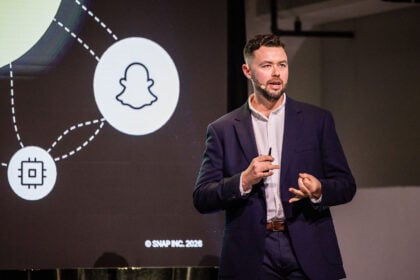

One of the world’s leading marketing consultants and futurists, Tom Goodwin, believes that AI technology can reinvent marketing and increase the importance of strong brands. However, speaking to B&T at the ADMA Global Forum in Sydney, he said he is concerned that tech leaders are not responsible custodians of AI technology, and he worries about the impact the tech will have on the next generation.
Driven by short-term results, these tech leaders will resort to fuelling LLMs with cheap content, outrage bait and “maintaining a population that’s anxious, agitated and angry the whole time while distrusting each other”.
Goodwin, the co-founder of All We Have is Now and author of Digital Darwinism: Surviving the New Age of Business Disruption, believes that the industry is in a unique position to utilise AI to elevate marketing and advertising. He describes most of the current efforts as “irrelevant” or “average-vertising”.
“This is one of the best times it’s ever been to rethink what marketing can be in a world where technology allows us to do extraordinary things,” he said. “It’s quite unfashionable to be optimistic and calm at the moment, but I actually think that we are sitting at an amazing moment in time.
“The canvas of opportunity to do what we do has never been greater. We’ve never had better devices. We’ve never had more data. We’ve never had more extraordinary technology.
“At the same time, what we do has never been more important. Some people go around saying that ‘brands are dead’. Some say marketing doesn’t matter because bots are going to buy things from other bots. I think it’s absolute nonsense. Brands are the way that we navigate the world, in a world where everything is more abundant, except for our attention spans.”
Goodwin believes that AI technology shouldn’t be an efficiency and scale play; he believes it should be used to make marketing better, not necessarily cheaper or quicker, adding that top-line growth is far better than bottom-line efficiency.
Nonetheless, he told B&T that to date, marketing is the only industry that technology hasn’t improved.
“I actually think that the quality of marketing done today is probably worse than it’s ever been in living memory, and therefore we have to ask why that is,” he said.
“We’ve looked towards lubricating the way that we’ve done things with new technology. And therefore, we’ve taken the processes and the outputs and the formats of the past, and we’ve kind of added a bit of technology to them.
“We need to go through a completely different process, where, rather than finding a TV ad and sticking it on a phone, or finding a print ad and sticking it in a social feed, we need to think about what new things we can do. How do we seduce people? How do we get people to feel emotions about our brands? How do we give people offers that are timely and helpful? How do we ultimately help people make decisions to buy our products? And that involves very different thinking.”

Attribution aggravation
Goodwin also rails against what he describes as advertising’s “era of attribution”, which has taken hold since 2023.
Features of this era are: claiming success is more important than creating success; whatever isn’t tracked is irrelevant; sales trump profitability; conversion beats growth; optimisation beats craft; and “we’ve trained ourselves to be robotic”.
He said there is an unhealthy obsession among senior marketers to measure everything immediately. If they can’t, it becomes irrelevant.
“Now, over the last 10 years, we’ve been forced into the illusion that we can predict it. We’ve been told that we can show what the return on ad spend will be. The reality is, you can’t measure the value of something that’s never been done. You can’t create a list of other people who’ve done it before, if it’s truly innovative,” he said.
“We really need a bit of a shift away in business culture where we’re prepared to give people the freedom they need, we’re prepared to trust people. We’re prepared to trust the decisions we’ve made with instinct. And we need an environment which is much more growth-focused.”
Goodwin also believes the divide between brand and performance marketers is counterproductive and that ads need to grow brands and performance to achieve the best outcomes.
“In particular, now performance is basically where everything’s happening, and now that we’re moving money closer towards the point of purchase, everything is short-term,” he said.
“We really need to fight to ensure that there is patience and there is a respect and an appreciation of stuff that gets done that doesn’t have an immediate impact but really, really matters.”

Brands in the Gen AI era
When asked whether Gen AI technology would soon make brand marketing obsolete—as predicted by marketing professor Scott Galloway—Goodwin believes the opposite to be true in an era of average ads and AI slop.
“The entire way that we live our lives is illogical. We make decisions primarily on emotion, and then we use logic to defend those decisions to ourselves,” he said.
“If you actually had to explain it in logical terms, we would not make any sense at all. We would never buy HP Sauce. We would never buy Kellogg’s Corn Flakes. We would never go to McDonald’s when we’re drunk. We’d never get drunk. We are completely irrational, magical beings and brands exist in an era of abundance.
He continued: “We’ve never actually had more free time, we’ve never had more money, we’ve never had more choices. We’ve never had more decisions to make, and the only way we can navigate that is through having enough information. And by far, the best way for us to wrap up that information is into a brand.”
Rather than answer engines such as ChatGPT rendering brands useless, Goodwin believes LLMs could store personal information to supercharge recommendations. In fact, it’s only a matter of time before LLMs serve up advertising that is more sophisticated and useful than that found on search, he believes.
“A lot of the principles, a lot of the architecture, a lot of the business models, a lot of the possibilities and a lot of the downfalls are going to be very similar. What’s slightly interesting is the LLMs appear to have more memory about us; they appear to be able to bring in more context,” he said.
“If I go to ChatGPT now and ask what the speed limit is, it’s going to tell me the speed limit in Sydney, not the speed limit in Miami, where I live. So there is this amazing opportunity to provide really helpful and valuable and wanted forms of advertising in that environment, but at the same time, there are huge implications when it comes to trust and privacy and the lines that we may step over.”

The pitfalls of AI tech
Goodwin believes AI tech could trip up when answer engines cross a line with the use of consumers’ personal data. However, this line is ill-defined and will differ for individual consumers.
For example, it may be acceptable for Samsung to know that a potential customer is in the market for a new TV, but it would be totally inappropriate for an IVF clinic to serve medication for a user’s sperm issues proactively.
Goodwin believes there are much larger problems around the people leading tech companies and their obsession with short-term performance.
“I think the people who are leading tech companies are so obsessed with performance, and they’re so obsessed with whatever it takes to get noticed that they are making two fundamental mistakes. Firstly, they favour content that’s cheap or free, and secondly, they favour anything that gets people agitated or aroused or angry or confused,” he said.
“We’re just seeing complete AI slop everywhere; when you go on Facebook, it is immediately hijacked by genuinely disturbing and awful stuff.
“The people who run these companies seem to be completely driven by short-term metrics. They appear to have no appreciation for their responsibility in safeguarding their audience. They seem to be happy to run A/B tests that may be harmful. They seem to want to promote discussions with AI chatbots that may make people kill themselves. I think there is an enormous responsibility that these companies have,” Goodwin said.
He believes that the traditional media always understood the responsibility it had to its readers, listeners or viewers and curated meaningful stories and information.
“Since the internet age came along, these people were no longer customers, they were users, and therefore they were there to be poked with and to be exploited,” Goodwin added.
“And I think we’ve created a really damaging situation where we’re maintaining a population that’s anxious and agitated and angry the whole time and distrustful of each other.”

Goodwin’s biggest fear
Goodwin is only too aware of placing too much trust in the hands of a few technology titans—people who “have no fucking idea what it’s like to be a human being”. He acknowledges the role that social media has played in fueling division and outrage.
And although he tends to strike an optimistic tone about the potential of AI in marketing, he holds huge concerns about its broader impact on society.
“My greatest fear from AI is not that my printer is going to talk to my fridge and I’m going to get tumble-dried to death by computers becoming self-aware,” he said. “My fear of AI is that my kids will be incredibly stupid and lazy. For me, it’s by far the greatest fear that I have, and it’s also the most likely problem.”
Goodwin likens the Gen AI era to the potential of the internet age, but on steroids.
“We can go back to 2000 and imagine what the internet would be,” he said. “We would imagine that we’d all be doing our jobs quickly. We’d be reading about Russian literature. We’d be doing video calls with my mom. We’d be having pen pals in Sub-Saharan Africa. We’d be so thoughtful, we’d be so knowledgeable. We’d be so kind, we’d be empathetic, you know, we’d be so informed.
“What actually happened is we got lazy, and we decided that we’d rather have things that supported our pre-existing viewpoint.
“We decided that, rather than learning French, we would just get Google to translate it for us. I think it’s highly, highly likely that 2 per cent of the world’s population will use this to learn how to code better, create a training chatbot that’s going to make them better at understanding their emotions, or learn other languages, but only a tiny per cent of people are going to become spectacular and brilliant. The vast majority of people are going to use it to never think they’re going to use it to phone in everything.
He concluded: “Technology is creating a sense of being overwhelmed. The funny thing is, we’re trying to use technology to do the stuff that’s actually really important for us, so we can then free up time to be unbelievably bored and then morosely scroll through Instagram, look at fast cars that don’t exist, or read articles that get us angry about politics.
“We’re using technology to take away things that make us feel alive, to create time that we then use in the worst possible way.”