




Snapchat is drawing a line between itself and the more public-facing social platforms, positioning itself as the place where the conversations that really matter happen — away from the public’s and brands’ eyes.
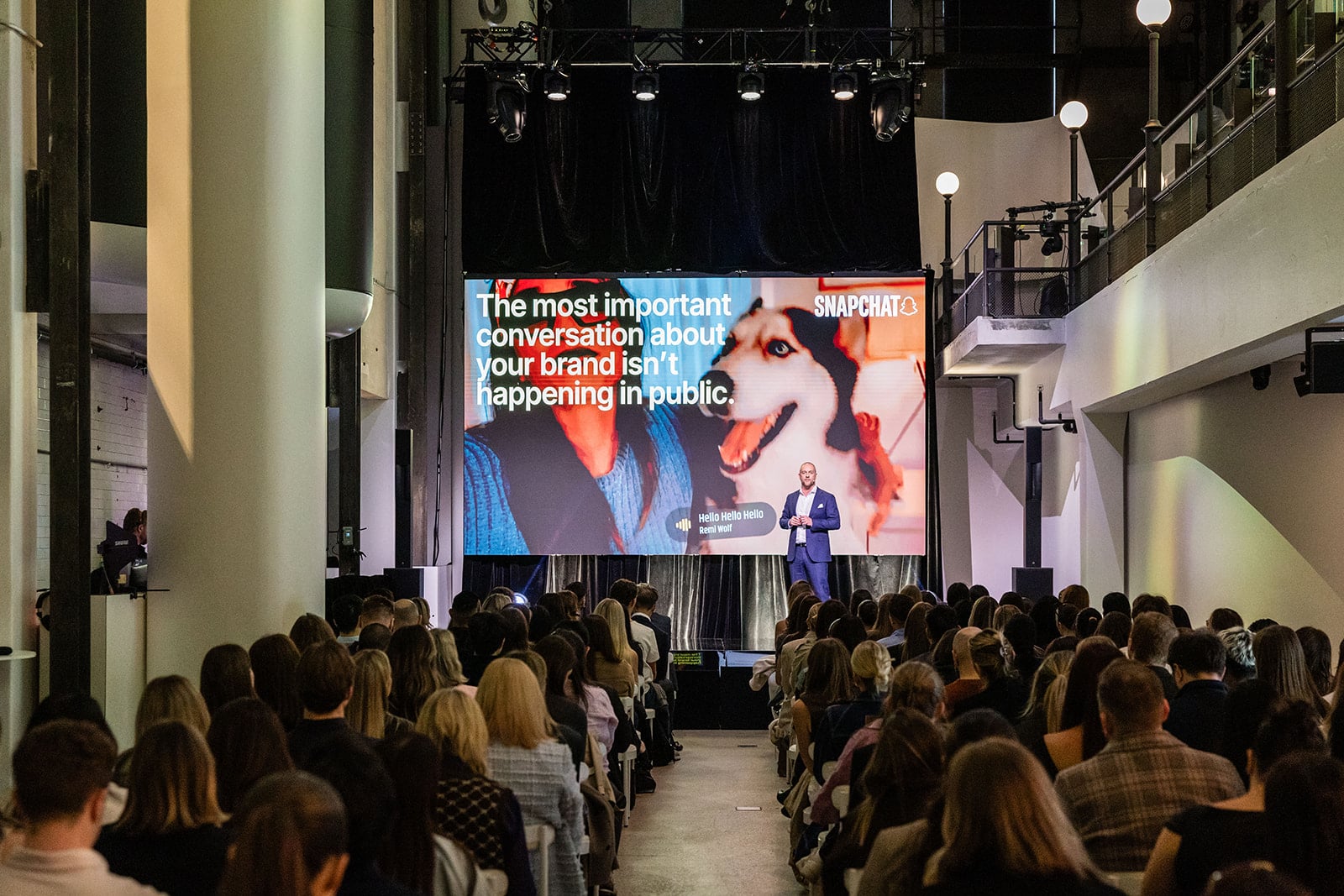
During its Snapchat Summit upfront event in Sydney, Snap Inc. ANZ managing director Ryan Ferguson, likened Instagram to “the mannequin in front of the shop” and Snapchat to “the conversation happening in the changing room”.
Held at Sydney’s Machine Hall, the summit brought together media buyers and advertisers as Snapchat made its case that consumers are yearning for a different kind of social experience, one built around the private moments and conversations shared between friends.
This idea was brought together by Eugene Healey, who took to the stage to unveil research from behavioural science consultancy Mindscope which looked into a “reset of social media”.
“Young people in particular are posting less because they’re acutely conscious of this presence and they fear its judgment. At the same time, we are also struggling to express ourselves, because we are caught in a situation where we are completely overwhelmed,” he said of the feed.
And for brands, he quickly outlined that they shouldn’t be showing up in these places anyway—regardless of the decline in feed use.
“First-class airplane walkers sit next to people marching in the streets. [They] sit next to, ‘come with me as I get a matcha’, [which] sit next to images of children being bombed. This is where your brand shows up, sort of like parachuting somewhere into the middle of this absolute street riot,” he said.
Healey was followed by Rob Fitzpatrick, head of global accounts at Snap ANZ. who delivered the announcements. More on that below.

Since 2022, audiences have retreated from public performance into private connection, so brands must stop renting attention on what are now entertainment platforms and start earning relational equity in private space, where Snap is natively positioned.
For the first time, real conversations have overtaken passive scrolling in Australian social media. This is not a marginal or generational quirk — it is a structural shift in how Australians use social platforms altogether. More than half of Australians (57 per cent) have designated at least one platform primarily for private messaging, and 84 per cent shared in a private chat or group in the last 24 hours – versus 65 per cent who shared publicly.
The same preference extends to brands, where 48 per cent of audiences prefer private brand interaction, including DMs, Stories and chatbots, compared with just 22 per cent who prefer public comments or feed based interaction.
Drawing on this data, Mindscope developed Reset Velocity — a composite score across three behavioural indicators: Connection Intent (who people share with), Authenticity Signal (whether sharing is driven by genuine expression or performance), and Relational Durability (whether interactions build lasting relationships). Australia scores 68 out of 100, up 24 points since 2019 and projected to reach 71 by 2027. At 70/100, Gen Z have crossed the behavioural tipping point, meaning connection-led social behaviour has become their new normal, not the exception. Millennials, at 59/100, are moving in the same direction.
The reset reveals a clear say-do gap. Public platforms have trained audiences to perform: likes, follower counts and curated aesthetics became the default currency of sharing. Yet when Australians are asked what they actually value, they describe something entirely different. Seventy-five per cent say staying connected with close friends is their reason to share, yet only 10 per cent say their last post was driven by likes.
According to agency folk, this shift puts Snapchat at the forefront of platforms giving brands a more direct way to connect with consumers.
“Snapchat is so different because people are engaging in chat specifically. We’re seeing social media move into more of a conversational, active space, and users aren’t as passive when consuming content. They’re there for a purpose, whether that’s talking to their friends, searching or buying,” said Carly O’Grady, former national lead of search and social at KINESSO before it was sunsetted by Omnicom.
“Snap plays a huge role in that, and a lot of social channels are moving away from that traditional social media space and into a more entertainment-focused one. They’ll play a pivotal role in having a space that’s really different for brands to be able to engage with users.”
For PHD planning director Lewis Farnell, that shift could be particularly valuable for brands looking to connect with Gen Z.
“Snapchat now sees itself as a communication network. And I think that’s the way we’re trying to plan against the platform. It’s like, how do you break into that conversation, into that DM, versus just being another ad in the feed which could get swiped and missed?” he told B&T.
That sentiment was echoed by fellow PHD colleague Lily Trainor, who believes Snapchat has a head start when it comes to winning over younger audiences.
“They’re leading the race with winning that next cultural generation. So they’ve got such an advantage against everyone else in market to really make a cultural shift and then bring people like us along for the journey, to then make sure that we’re also educating clients to that shift as well,” the PHD business director added.
But while there was plenty of excitement around Snapchat’s hold on younger audiences, not everyone was convinced the platform is having the success it could.
“Following on from Eugene, what he said in terms of connectivity and the death of the author, and how we’re growing away from performative social media interaction into a a more condensed, private communication style. Those messages are really important to have, and I am trying to get DM campaigns for all our clients everywhere. I love introducing Snapchat as an option. Whether it’s picked up or not is a little bit harder to do,” explained Ekaterina Elliott, the social director for WPP Media ANZ.
She believes that there are two reasons why Snapchat doesn’t make it into everyone’s campaign strategy: The decision makers are older and they don’t understand what’s happening in the world of Snapchat. And if brands don’t have budget, and they’re limited, they’re going to go to platforms that they feel familiar with.

No upfront would be complete without a few announcements. Delivering the “woos” was Fitzpatrick, head of global accounts at Snap ANZ.
The one that particularly caught the eyes of media planners, was the announcement of Promoted Places being “generally available to every advertiser”.
This announcement will bring more advertisers over the next couple of months into Snap Map. Fitzpatrick detailed how wildly popular Snap Maps are with 80 per cent of users using it to see where their friends are and 66 per cent use it to see what’s going on around them.
As he described it, “traditional maps help them get from A to B, whereas the Snap Map helps you find out where B is going to be”.
For brands, Snap Maps is a non invasive way to show up where people spend their time on Snap. To demonstrate it’s effectiveness Fitzpatrick talked the audience through the success Coles360 had leveraging it.
“We were absolutely thrilled to work with Coles 360 and Cadbury’s to launch the Biscoff block earlier this year… 2.5 million people were reached within the map, there was a 30 per cent lift in incremental visits and that translated to 324,000 store visits driven by this campaign,” he said.
And now every advertiser will have the chance to show up in Snap Maps via Promoted Places.
This announcement particularly caught the eye of Farnell. “You’re literally putting the product in the basket of the consumer,” he said.
As part of the event, Snap also outlined new capabilities within the AI space. The platform said these features are to help brands show up in the connection era and move from attention to action.
The new features are: AI-powered performance—Snap’s AI suite—including Snap Smart Assistant, smarter optimisation and AI Sponsored Snaps, which brings more intelligence into every stage of the campaign lifecycle, from planning through to 1:1 Chat.
Another that is launching soon is the Snap Creator Network. This is a new AI-powered system that simplifies creator discovery and campaign activation – advertisers can describe the creators they’re looking for and Snap Creator Network matches them with creators that fit their audience and campaign needs.
And finally the Commerce Power Pack. Launched for peak season, Commerce Power Pack helps brands turn discovery into purchase – including Dynamic Product Ads in Sponsored Snaps, which bring catalogue-powered ads into Chat. New tools including Value Optimization and Omnichannel Optimization give advertisers more flexibility to drive value and optimise for the outcomes that matter most.


