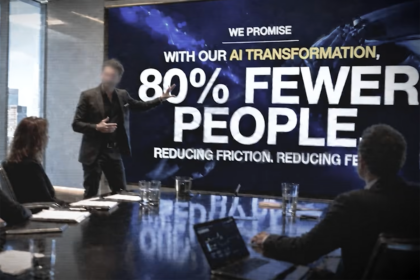





StackAdapt co-founder and chief technology officer Yang Han believes the advertising industry is still only scratching the surface of what AI will eventually become. In this interview with B&T, Han discusses StackAdapt’s ambitions, the impact of AI on the advertising industry and jobs, and what it means for training the next generation.
Marketers today operate across disconnected ecosystems spanning media buying, customer data, analytics, creative production, attribution and measurement. Each platform claims credit for results, yet few systems communicate effectively with one another.
StackAdapt, the Canadian AI-powered marketing platform, wants to change that by providing a single adtech and martech platform that operates as effectively on the buy side and the supply side and all of the layers of tech in between.
The company, which was founded by Ildar Shar, Vitaly Pecherskiy and Yang Han in 2014, has grown into a multi-channel platform that is powered by AI and allows marketers to manage native, display, video, connected TV (CTV), audio, digital out-of-home (DOOH) and email marketing.
“The whole industry hasn’t fully cracked a true holistic end-to-end self-learning AI. You have a platform for marketing channels, you have a platform for advertising, you have platforms for analytics, and they don’t really talk to each other very well,” Han said.
“That’s because platforms typically don’t have access to the entire marketing journey or control over it due to the industry fragmentation that exists. Ultimately, StackAdapt will get to that point in a year or so.
StackAdapt’s long-term ambition is to solve that disconnect by building what Han describes as a unified end-to-end AI-powered marketing platform that is capable of handling everything from customer data and creative personalisation through to programmatic media buying and measurement.
“We’re already building a lot of components of it, the creative personalisation AI, the strategic planning AI; our AI can already shift through your campaigns, and use analytics and data to provide insights and recommendations,” Han said.
A recent innovation is that the company expanded its dynamic creative optimisation tool into video and connected TV that produces different videos personalised to viewers.
“StackAdapt will have visibility into your customers, what they looked at, what they added into their cart on Shopify and what they bought,” Han said.
“So all these individual raw data points, which is a high volume, we then use machine learning and AI algorithms that can then dictate to show new products to customers and you can then execute a creative template in different channels.”

Master & Commander
Today, StackAdapt is aggressively scaling AI capabilities across every part of its platform. The company recently doubled its machine learning and data science headcount, while broader headcount has grown by roughly 30 per cent year-on-year globally. Today it employs around 1650 people with its growth in APAC four times market growth.
At a time when Big Tech, including the likes of Meta, Atlassian and Amazon, are pointing to developments in AI to cut their workforce, StackAdapt is taking a different approach.
“There’s a lot of companies out there that use AI simply for efficiency and cost cutting,” he said. “But for us, because we have a broader vision of becoming an end-to-end platform in advertising and marketing to drive growth for the customer, there’s a lot of components that are involved to do this very well. So we will grow and redeploy our teams into these initiatives simultaneously.”
When asked what he thinks the impact of AI will be on the advertising and marketing industry, Han, unapologetically, remains upbeat. Rather than machines taking jobs, he believes that they will enhance them, or what he describes as: “being the commander of an army”.
“Tools are still tools,” Han said. “You still need human judgment, especially as problems get more complex.”
“When it comes to the creative aspect, AI allows humans to focus more on the storytelling…when much time, historically, has been spent more on operational and redundant aspects that’s less human to human.
So you need to find the ideal partnership between the human and machine,” he said.
This means allowing the machines to do the heavy lifting in analysing the data at scale and having humans focus on higher level strategy decision making.
“I’m like a commander of an army. I’m given a list of options by AI agents, rather than having to come up with them from scratch, and then I decide what to do.”
Nonetheless, Han is cognisant that AI could shakeup how the advertising industry and marketers are trained, and that this needs careful succession planning.
He believes that a combination of younger talent being native AI users and older hands providing content and guidance will be key.
“When there’s new technology, people who have deep experience in the industry, sometimes have trouble going back and relearning things. That’s where the opportunity is for junior people; they’re often a lot better in new technology like AI, than even myself,” he said.
“People with more experience understand a long term view of things. So there’s a partnership that can be had with guiding junior people to leverage the AI tools, but providing the long term view about how we are using AI so that we can benefit from the right KPIs rather than the wrong ones.
Han concluded: “The concept of exactly what AI is best at versus humans is going to continuously shift as time goes on. But at the end of the day, tools are still tools, and you will always need human judgment, especially as problems get more complex.”