
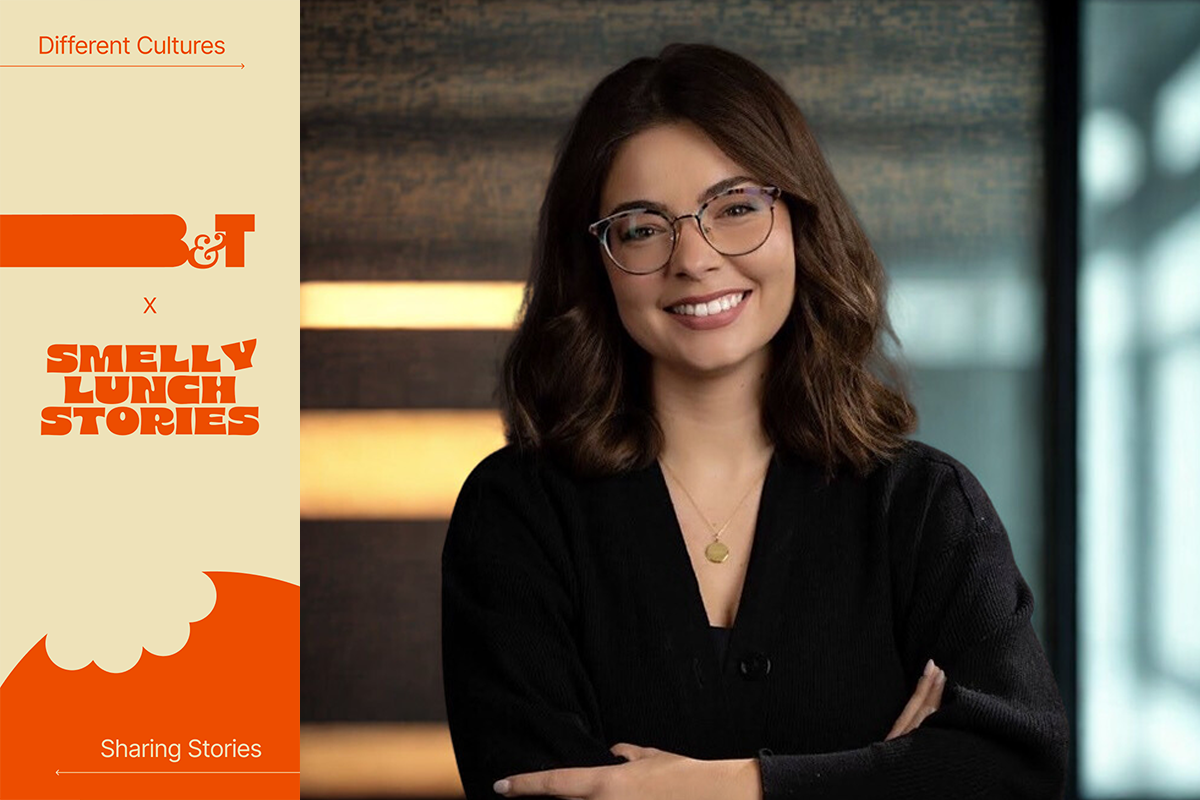
B&T has partnered with Smelly Lunch Stories to amplify stories of culturally diverse talent who have risen to the top. Even though a third of those starting out in the industry are from ethnic minority backgrounds, only 12 per cent rise to the C-Suite, and we hope these stories inspire the next generation.
In this column, Mutinex marketing science partner Andie Potter, a Spanish national who moved to Australia nearly ten years ago, shares her Smelly Lunch Story.
1. Tell us about yourself in one sentence.
I’m driven by curiosity and a bit of restlessness, which is probably why I ended up building a life on the other side of the world.
2. What’s the “smelliest” lunch dish you’ll proudly defend forever?
Seafood is a big part of my culture, so I’ll always vouch for Sardinas a la Plancha, fresh Mediterranean sardines cooked over an open flame. Yes they are smelly but It’s the taste and scent of summer in southern Spain. Yummy!

3. What did your parents actually want you to do when you were growing up…and do they understand what you do now?
I had pretty chilled parents who were always supportive of whatever I wanted to do. If they had to guess back then, it probably would’ve been something like a vet, something a bit more traditional and easy to understand.
They don’t fully get all the details of what I do now, but they know it’s something in marketing and tech and that it sounds “cool” which is good enough for them.
4. Please tell us your Smelly Lunch story.
I grew up in Spain in a close knit family, surrounded by Spanish culture, but with an English mum, so from a young age, it almost felt like navigating 2 different identities.
I was bilingual but I rarely spoke English outside of home because I was so self-conscious about my accent!
When I moved to Australia I often worried that my accent overshadowed my expertise, as if my credibility was being filtered through my phonetics.
Looking back, that experience has impacted how I show up in my day to day here. It forced me to build a deep confidence in what I say, rather than how I sound, and to decouple perception from capability.
Today, my accent is a small badge of honour. It’s a living reminder that I’ve built a life across hemispheres, and that is something I’m deeply proud of.

5. Was there ever a moment when you felt different or like an outsider because of your cultural or ethnic background? How did that make you feel?
Initially, the sense of being the ‘outsider’ lived in the subtitles of daily life: the jokes that didn’t quite land, the nuances lost in translation, and the missing cultural shorthand that everyone else seemed to share.
Even nine years later, that feeling hasn’t entirely faded. It’s like being in a room where everyone is operating on a frequency I can’t quite tune into.
This is often compounded by the perpetual question: Where are you from?’
While I know it usually comes from a place of genuine curiosity, it creates a subtle insecurity acting as a reminder that, despite nearly a decade of building a life here, I am still primarily viewed through the lens of being from ‘elsewhere’.
6. If you were stuck on a desert island, what one piece of media (book, podcast, film, album) would you take with you?
A book I wouldn’t mind reading many times over whilst stuck on an island is Here One Moment by Liane Moriarty.

7. Who opened a door for you, and who have you opened one for since?
I know I’m probably supposed to name a titan of industry here, but the truth is, my blueprint comes from my parents.
My mum was my first example of what ‘brave’ actually looks like. She left home at a young age, traveling solo to build a life in a country that wasn’t hers. Watching her gave me the permission I needed to eventually step out of my own comfort zone and move across the world to Australia.
My dad instilled a strong sense of character, work ethic, and confidence in my abilities.
I think that ‘opening doors’ isn’t just a one time gesture but more of an ongoing commitment. I know how heavy that search for belonging can feel, so I try to use my position to make sure the next person doesn’t just get into the room, but feels confident enough to actually take a seat at the table.

8. How does your cultural background influence the way you approach your role?
Being from Spain and building my career in Australia, I naturally bring a dual perspective because I’ve had to navigate different ways of communicating, working, and building relationships in both countries.
I’ve had to be intentional about how I communicate and build trust. Early on, I noticed that my natural communication style (being quite direct and expressive) sometimes came across as too strong here in Australia.
So whilst I don’t change who I am, it means I don’t assume my default style will land the same way with everyone so I can turn the expressiveness up or down depending on what helps the other person feel heard and comfortable. It’s about building trust on their terms, not just mine.
9. What advice would you give to someone starting out who feels like they don’t fit in?
I’d say first, If you feel like you don’t fit in please realise that ‘different’ isn’t a defect, it’s just a lack of shared history with the room.
Watch how people communicate and learn the local ‘rhythm,’ but don’t lose your uniqueness in the process. The goal isn’t to erase what makes you different, it’s to understand how to use it effectively.
And practically, find a few people you trust and who see you. You don’t need to fit in with everyone. Having a small group where you feel comfortable and supported makes a big difference especially early on.
Over time, as you build confidence and credibility you’ll discover that contributing meaningfully is far more powerful than fitting in. Your ‘outsider’ lens might be the very thing the team is missing.
10. What do you wish more people understood about cultural diversity and why do you believe it’s important in leadership teams?
For many people who have migrated or moved countries, that experience isn’t easy. It often means leaving behind family, language, and a sense of stability. A lot of people, including myself, go through genuinely challenging situations to adapt, feel safe, prove themselves, and build a life from scratch.
The ‘immigrant experience’ is a masterclass in resilience. It produces individuals who are uniquely wired for uncertainty, and who solve problems with a level of adaptability that you simply cannot teach in a seminar.
In leadership teams, that becomes even more important. If everyone has similar backgrounds and ways of thinking, you get blind spots. Diverse teams bring broader perspectives, challenge assumptions, and ultimately lead to better decisions. If we think about it strictly in numerical terms, research shows that diverse businesses are 35 per cent more likely to financially outperform peers.

11. What is one thing you think our industry can do to drive greater representation in leadership teams?
I think the industry needs to stop relying on “natural progression” and be far more intentional and measurable about building diverse leadership.
The reality is, if people aren’t given the right opportunities early on, they won’t be in a position to step into leadership later. So it has to start from the hiring stage building a more diverse pipeline and then ensuring people have equal access to the experiences and support that build capability.
From there, it’s about creating structured pathways and holding leadership accountable for outcomes. If it’s not intentional and measured, it won’t change.
Check out recent Smelly Lunch Stories: Marcelle Hoyek
If you have a Smelly Lunch Story you would like to share, please email: [email protected]