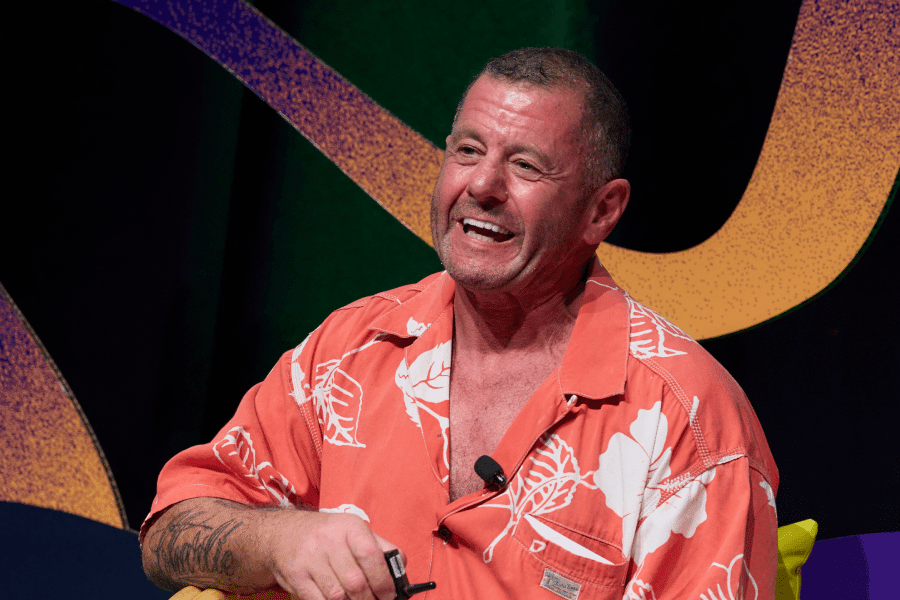
There is a significant opportunity for brands in Australia to speak to modern Australian fathers with nuanced and realistic depictions of parenthood through advertising and media, according to author Michael Ray.
Presently, advertising and media in Australia feature at best dated representations of caregiving and at worst, harmful stereotypes that entrench gender inequality for women and men, mothers and fathers alike, Ray told B&T following an event at Pinterest’s Sydney office that focused on representations of modern men.
“Only 3 per cent of government advertising show dads in anything less than a traditional gender role. Dads caregiving to daughters are rarely seen. We separate traditional masculinity from caregiving rather than making it a critical part of it,” said the former Cairns Crocodiles speaker and sole parent to his daughter.
“This isn’t just about being responsible with your advertising, it’s about future-proofing your brand. Single father households are the fastest-growing family demographic in Australia at the moment. Dads [in this generation] are spending triple the time in direct caregiving than their fathers just a generation before.
“There’s huge white space for brands to claim. It’s not about giving up the other part [of parenting]. Fatherhood is different, not less… When we say ‘Parents’ we mean ‘Mothers’. We see it overwhelmingly with organisations that might say something like ‘This affects parents’ and then in the next sentence they say ‘Mainly mothers’.
“It completely erases the stakeholders they need to engage to drive the change. I understand why they do that, it’s a quantitative [decision] but qualitatively, it’s probably harder on dads because dads don’t have the support groups around. If you’re going to draw an arbitrary line through that group of parents, how comfortable or appropriate would it be if we said ‘Mainly heterosexual mothers?'”
Ray’s journey as a sole parent to his daughter Charlie started in 2013. A few years later, he hit the headlines after being told he could not assist his daughter backstage at her ballet concert. In 2021, he published Who Knew!, a book which detailed his experiences and aims to empower mothers and fathers alike and dispels many myths about fathers.
“Advertising doesn’t mirror culture, it drives it,” Ray continued.
“When we constantly mock dads [in advertising and media], when we tell mums they’re better at caregiving than men and then we penalise them professionally for doing it, how is that fair?
“Then when we tell men they need to step up and when they do, we mock them, why would they do it?
“We all want to contribute something of value but we want to be seen to be doing so. Competency is a big thing for men. We like to be experts, sporting stars, stuff like that. But we don’t want to be experts in something that people take the piss out of. It’s not bias, it’s sabotage. When kids grow up marinating in the Homer Simpsons and dumb dads, they say ‘Mum’s the expert, mum knows everything, I’ll defer to mum.'”
Ray believes that current policies and everyday realities around parental leave harm both mothers and fathers. While efforts to give women the chance to be both mothers and successful career women have been well-intentioned, there are unintended consequences.
“There’s the motherhood pay gap and the father forfeit. The pay gap means men are locked out of some of the best and most joyous aspects of being present during their children’s lives because of finances. That’s how we get men on board. Instead of saying, ‘Mate, you’re winning’ we say ‘You’re not winning, you’re missing out on your kids,’ he said.
“If I said to fathers, do you want to take a 13 per cent pay cut to be more involved in your kids’ lives would they take it? Yes. But they can’t afford to take the time off because of financial commitments as a family. Their wives earn less but the motherhood penalty as a contributing factor to the gender pay gap is actually increasing.
“Access, education, opportunities, we’re providing all of those… but guess what we haven’t done? Got dads in. Two per cent of Australian workplaces have set targets for men’s engagement… Why? Because dads are seen as less vital in caregiving. That’s why I say we’ll never get rid of the gender pay gap until we address the parental value gap.”
A few ad campaigns stand out for Ray as steps in the right direction to portray fathers in a more realistic, positive light including work for Woolworths by M+C Saatchi and, in particular, this four-year old campaign for Google by 72andSunny.
“She’s learning to play AFL, he’s Googling it. She hurts her ankle, he learns how to tape it, he’s on the barbecue at the footy, she’s doing well. It’s just brilliant. Cultural integration, being accepted in community sports, dads doing it, the girls playing a male-dominated sport, it’s everything. But it’s real,” he said.
“It’s not genetic destiny, it’s not a mythical maternal instinct, it’s just competency. I learned to do this.”
The fact this campaign is now four years old perhaps tells its own story. None of this is about excluding women from work or parenthood. Instead, Ray believes it is about creating a media and advertising culture more reflective of modern Australia. Though the journey is far from over, the industry has made strides in many areas around diversity and inclusion. This needn’t be an ‘or’. It can very easily be an ‘and’.