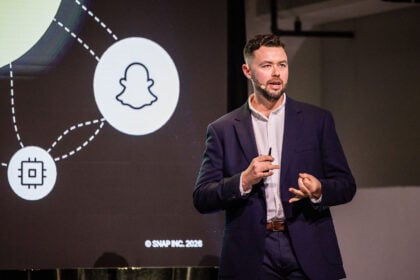

Marketing professor Mark Ritson has urged marketers to invest at least 11 per cent of the media budgets in radio and audio advertising to drive huge lifts in effectiveness.
Speaking to B&T ahead of yesterday’s CRA HEARD, Ritson believes that the industry has dated perceptions of radio being ‘un-sexy’ when it has been proven to be one of the most effective channels to lift: audience penetration, driving an emotional response, brand distinctiveness, and price insensitivity.
At present, only 7 per cent of media budgets are poured into radio when an 11 per cent share is the “sweet spot”.
At HEARD, Ritson presented research, drawn from the Advertising Council of Australia’s (ACA) Effectiveness Database that was analysed by independent marketing consultant Rob Brittain. It examined all Effie Award entries from 2018 to 2025, nearly 600 campaigns, adding two years of data to previous findings present at HEARD in 2024.
The headline message of 11 per cent investment is identical to what Ritson revealed two years ago, but this should provide comfort to marketers.
“In a world where the media numbers change and our digital friends two years ago were saying they offered ‘personalised targeting’ and now they’re saying ‘mass marketing’, there’s a reassurance in the 11 per cent message,” Ritson told B&T.
The build in this year’s research is to explore why radio continues to have a disproportionate impact on business and growth.
The research found that Effie winning campaigns with at least 11 per cent investment in radio and excess share of voice (ESOV) deliver nearly twice the impact for new customer acquisition (37 per cent with audio vs 22 per cent without), brand distinctiveness (40 per cent vs 22 per cent) and price insensitivity (23 per cent vs 12 per cent). Audio also connects with both head and heart, deepening emotional appeal (51 per cent vs 41 per cent).
Ritson’s presentation explained that investing more in radio alone isn’t a panacea. To drive maximum impact, brands need to: invest at least 11 per cent of their media budgets in radio; make ads emotional; employ seven sonic distinctive brand assets in ads; and run radio ads for much longer (six months to a year, rather than four weeks).
He caveats that the 11 per cent figure is an average and there are likely to be a scatter chart of results in which all brands do not see a similar effect. He also points out the spectre of reverse causality, whereby brands that are getting better business effects and are growing are simply investing more in audio.
“My argument, which I absolutely believe, is that if you invest in audio as well as excess share of voice, and if you can get past that 11 per cent share mark, greater business effects will be yours and your brand will be strengthened. Bunnings, for example, know what they’re doing and choose to invest in audio,’ he told B&T.

Radio’s image problem
The question remains why brands don’t invest 11 per cent into radio when seven years of analysing Effies-winning work provides such compelling evidence of its effectiveness?
Ritson believes a number of factors are at play, including radio’s image problem.
“The biggest issue for a long time has been that unless it’s ‘digital’ then marketers are not going to invest their money in it. Even though a lot of audio now is digital, it’s not perceived to be,” he said.
“Whenever you see an image of radio or audio or podcasting, it’s inevitably a radio from the 1950s, and that’s symptomatic of an industry perception of what some people would see as a ‘unsexy’ medium, which is really unfortunate.”
Ritson also accepts that proving the ROI of radio is not always as “simplistically” straightforward as some targeted digital media channels because audio’s impacts are tied to much broader brand effects that are harder to measure in a short space of time.
“What digital media has done really well with their walled gardens is they’ve demonstrated very clearly a purported ROI that marketers over the last 10 years have become used to accepting,” Ritson added.
“It’s true that digital media can be very targeted and, therefore, more short term, and they’ve able to demonstrate brand lift in a more simple way. But just because something is simple and easy to show, doesn’t mean that other media that is more complex isn’t doing more behind the scenes. If anything, what channels like radio are doing is more valuable.
“But you have to hold your hand out and say the digital media industries have done a brilliant job of owning and investing in their own measurement, and that’s turned the heads of marketers.”

What happened to media neutrality?
Ritson also wanted to be clear that although he is was in Sydney to promote the power of radio, he “loves all channels equally” and gets “unhappy” with the self-serving nature of the industry when a specific media channel recommends brands should move all of their money from ‘x’ into ‘y’.
“What does media neutrality mean and why have we forgotten it,” he said. “It means I will consider all media channels, and I will look at the investment levels based upon my current strategic situation.
“You can’t blanket say that some media are getting too much attention and investment, and some aren’t.”
It turns out radio is not getting enough love and attention. Time will tell if this shifts when Ritson gets up on stage to present the next iteration of radio effectiveness research in two years time.