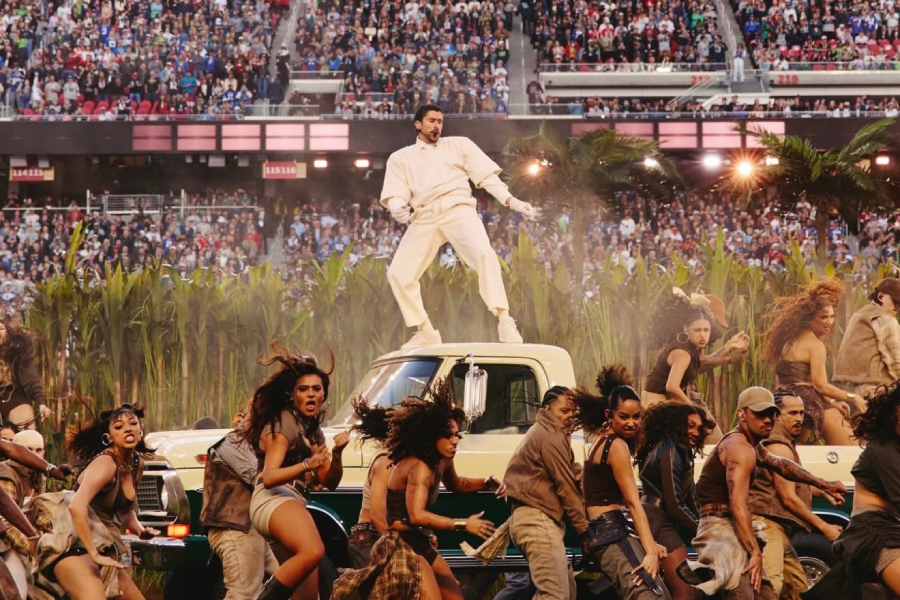
Bad Bunny’s halftime Super Bowl performance took the world by storm. Some turned off their TVs in protest whilst others tuned in for a moment of unity, belonging and dance.
Grammy-award winning Latin artist Bad Bunny, casually known as ‘Benito’, caused controversy when announced as the headline act for this year’s Super Bowl.
Benito has become one of the more outspoken artists of his generation, commonly using mainstream music as a platform to address concerns regarding immigration, racism and cultural identity.
B&T spoke to Eduarda Cuadros and Alvaro Bretel, two Peruvian members of the Thinkerbell team, to unpack the effect Bad Bunny’s halftime performance had on Australian and global audiences.
“It’s less about Bad Bunny himself and more about what culture gets framed as mainstream in Australia. Latin America is being shown as a niche.” Cuadros said.
“We’re falling into a relativistic world, where nobody can be too proud of where they come from, just so they are politically correct to everyone.
“That moment was saying you can be confident in being culturally specific.”
On the global stage, many brands that leant into the halftime show saw intensified relevance and visibility. Spanish clothing brand, Zara who dressed Bad Bunny for the halftime performance, generated US $3.1 million (AUD $4.3 million) in media brand value in the 12 hour period following the performance.
The vast distance between Australia and the Americas, combined with a lack of NFL presence down under, mean that most Australians simply don’t have the appetite for the sporting event. Latin Americans make up between 0.5 per cent and 1.1 per cent of Australia’s population thus there is less connection to the event and the cultural statements made by Bad Bunny. Without a deep-rooted fan based or community enthusiasm, the spectacle that is the Super Bowl halftime show often glazes over Australians who would rather broadcast national events.
“It’s not on Australians for not having the exposure to it, or not having the curiosity for it. It’s just that it’s a bit too far geographically,” Bretel said.
In Australia this type of cautious commentary or lack of commentary in general, suggests a more widespread hesitation throughout the Australian media landscape to embrace unapologetic cultural narratives and leverage international milestones in ways that resonate particularly with younger audiences.
“Culture moves faster than brands and Bad Bunny’s culture is a big part of his brand,” Cuadros said.
“Mainstream [Australian] media just hasn’t caught up to how culturally fluent people under the age of 35 are, there is a big lack of representation.”
Traditionally, Latin artists seeking mainstream global success were expected to sing in English in order to break into the US market, a route followed by stars like Shakira and Ricky Martin in the late 1990s and early 2000s.
“In the past, every Latino artist that wanted global fame had to start singing in English, in a language that more people would understand even though there are 1 billion Spanish speaking people in the world,” Bretel said.
Bad Bunny’s recent success, including becoming non-English singer to win the first Grammy win for Album of the Year, proves that artists no longer need to abandon their roots to be embraced on the global stage. Benito’s success signals a major shift in what is considered “mainstream” in music.
“Culturally there is a lot of things he’s done to make political statements mainstream, and easy for people to digest and celebrate,” Bretel said.
“When he gets on to the light poles, that’s a protest again. When Puerto Rico was suffering a lot of blackouts.
“Adding the sugar cane, that ties back to Spanish colonialism,” he added.
For media and audiences alike, Bad Bunny’s performance demonstrated how cultural and political narratives, when presented boldly and inclusively, can challenge assumptions, bridge communities and even influence mainstream media discourse, yet in Australia the ripple effect is only just beginning to be felt.
“The beauty of that Super Bowl halftime show was that he was saying, No, don’t hide. Show all of your colours, show exactly who you are and be proud of it,” Cuadros said.