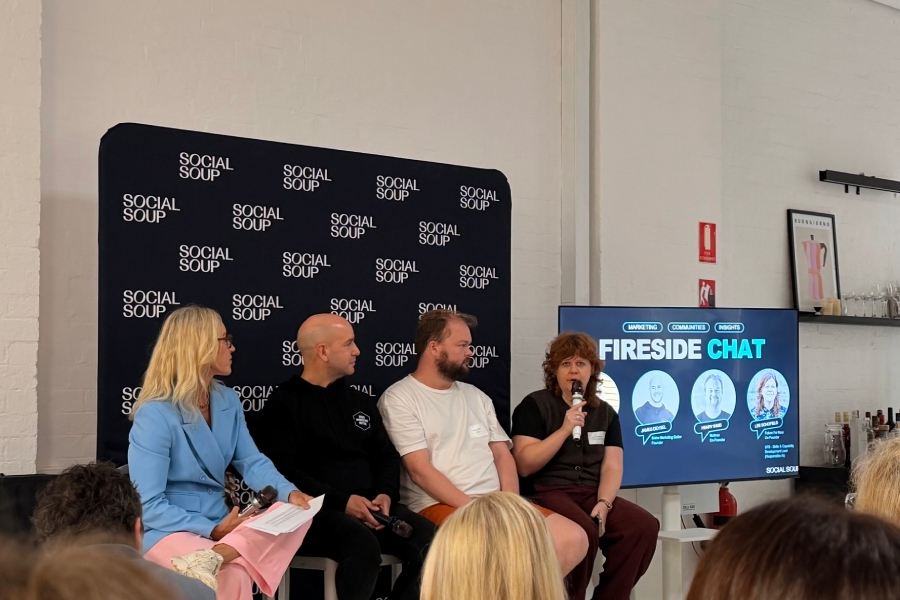
Consumer appetite for in-person experiences is growing, according to a range of industry experts who called on brands to follow suit. But does the data on Australian marketing spend tell a different story?
Social Soup CEO Sharyn Smith told attendees at the agency’s ‘upfront’ event yesterday.
“People are craving friendship and meaning and almost a third are doing it specifically because the digital world feels less human. People are telling us they want real connection, real experiences and real people. The brands that respond to that with another loyalty program or welcome email are going to keep losing.” Smith said.
Lee Schofield, a researcher at the UTS Human Technology Institute and co-founder of Future For Now, said consumers were actively retreating from digital formats. She noted that phone-free events including morning socials, communal long-table gatherings and run clubs, are up 567 per cent—though didn’t specify what over what period. Research she cited found 79 per cent of young adults consider shared in-person experiences important.
She argued that AI-generated content is compressing online culture and creating a homogeneity that audiences have become increasingly attuned to and resistant towards.
“You can see this compression of how people are talking online. It started with the em dash, everyone saw em dashes come up, and now it’s the contrastive negation. It’s not just community, it’s a way of life and people are calling it out, people are craving for real creators and real experiences,” Schofield said.
The contrastive negation, if you’re unaware, is the rather tedious literary technique often deployed by AI where something is described as ‘not X, by Y’.
Make Marketing Better founder James Deysel added: “Humanity and being more human is going to become exponentially more valuable. It is your single biggest competitive advantage.”
However, while consumers might be craving these experiences, it is not necessarily borne out in spend or usage data. Globally, the total media spend sits at $1.2 trillion, with $900 billion of that flowing into digital and social channels alone, a figure that grew 15-25 per cent in the last 12 months.

Against that backdrop, another agency recently reported that nearly three-quarters of our total $28.9 billion advertising spend went to digital. That figure grew 5.8 per cent year-on-year, or $850 million.
Search and social media alone account for over US$11 billion (AU$15.3 billion) of Australian digital advertising spend. Influencer advertising sits at US$590 million (823 million), roughly 3.8 per cent of total digital spend and less than 4 per cent of the social media advertising figure.

On the consumption side, the report found Australian internet users aged 16 and over spend an average of 41 hours and 3 minutes per week using connected media. Social media accounts for 8 hours and 43 minutes of that weekly figure. Short-form video accounts for 6 hours and 17 minutes per week. Australians use social media an average of 4.65 days per week, accessing an average of 6.6 platforms per month. However, the report said that his data was not comparable with previous reporting due to changes in audience composition.
However, it did find that 77.7 per cent of Aussies have active social media identities—and that was up 0.5 per cent.

That said, neither set of facts necessarily contradicts the other. It is possible for consumer appetite for in-person experience to be growing while digital consumption also grows. It is also possible that the trend Schofield identified is real but early. It is also possible that there is a significant gap between saying and doing.
The harder question is why budgets haven’t moved. If the consumer signal is real, and if, as Mutinex co-founder Henry Innis argued, click-based attribution is suppressing the case for brand investment, the continued growth of search and social spend suggests the problem isn’t awareness. It’s that the measurement system makes reallocation difficult to justify internally.
“The more a brand uses click-based attribution, the more likely they are to decline. Simple fact,” he said. “The advertising industrial complex has created a whole bunch of dashboards that are well consumed by the business but do not influence growth.”
Innis said thta brands over-index on performance channels not because the evidence supports it, but because the metrics are easier to report.