



Brands have thrown $200 million in TV advertising spend in “the bin” during the first six months of this year, simply because Australians who are deaf or hard of hearing could not understand their ads.
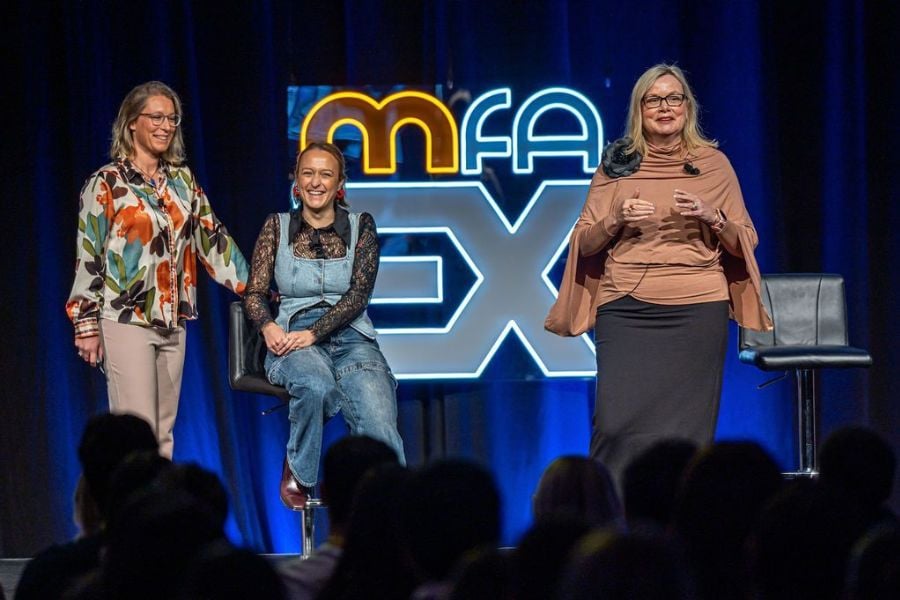
That was the blunt message from EssenceMediacom Sydney head of strategy Marine Turner at Sydney’s MFA EX, where she told an audience of 1,400 marketers and media buyers that brands are leaving serious money on the table by failing to include closed captions in their TVCs.
“According to the latest SMI data, $1 billion was spent on broadcast TV in the first six months of this year alone. If we look at one in five Australians [being deaf and hard of hearing], and one in five of these dollars doesn’t land because people don’t understand your advertising. You’re putting in the bin about $200 million,” said Turner during her panel titled Are We Overlooking One of Advertising’s Most Powerful Agents of Change?
The panel consisting of Turner, Rhonda Locke, CEO of Deafness Forum Australia and national head of WPP Media partnerships and addressable content, Alice Charlton kicked off the panel by explaining how “angry” they were that Australia is behind the eight ball when it comes to closed captions framework.
In the US, networks need captions on all content over five minutes. This includes both advertising content and entertainment. In Canada, an ad cannot air unless it includes closed caption. And in the UK, Channel 4 requires closed caption on all advertising that runs on its network. ITV and Sky in the UK are also heavily recommending that you deploy those.
But, in Australia there isn’t a framework that mandates closed captions on TVC spots. Which contradicts Australian Communications and Media Authority’s (ACMA) captioning rules on TV.
ACMA Commercial and national TV broadcasters must caption: all programs on main channels, from 6 am to midnight; all news and current affairs programs, at any time; and programs repeated on a multi-channel if the program was broadcast previously with captions. Yet, there is no frameworks on the ad breaks during these programs.
This does not mean advertisers should neglect closed captions just because frameworks do.
According to Priya Addams Williams, Shift 20 Lead, “including closed captions on assets ensures that the deaf and hard of hearing community can meaningfully engage with your campaigns — and it’s also essential given how Australians consume video content,” she said.
Shift 20 and The Research Agency’s recent research revealed that 49 per cent of people with disability use closed captions when consuming video content, as do 39 per cent of the general population. Usage jumps to 68 per cent amongst those aged 18-34, regardless of whether they have disability.
“Closed captions are yet another example of how creating accessible comms benefits not only the community they’re built for, but a much broader cross-section of Australians,” added Addams Williams.
As much as this problem can be blamed on the Australian Government or even creative agencies, Turner, Locke and Charlton put all the media folk in the crowd on notice.
“Today closed caption remains an option for all of us on the broadcast specs, there is very little detail about it in the broadcaster’s own document, and so we’re looking at an industry that could have been so much more inclusive by design for the deaf or hard of the hearing community. And now, I can hear you think this is a creative production problem, right? They’re the one that dispatched a closed caption file,” said Turner.
Before Charlton delivered the confronting blow.
“It is media problem,” she said.
“The good news is that it is also a media solution, and that solution is for you to put the requirement for closed captions into your media specs as standard.”
This is a simple solution which will help save $200 million of wastage.


