



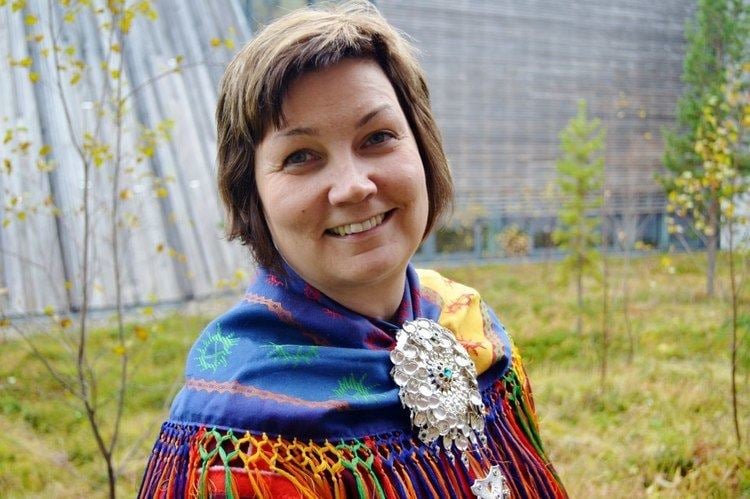
B&T is in Sápmi, northern Norway, with the Australian delegation to the World Indigenous Broadcasters Network conference. In this latest dispatch we talk to Aili Keskitalo, former president of the Sámi Parliament. Read our other coverage with SBS’ Tanya Denning-Orman; and Chief of War actor Kaina Makua.
The most uncomfortable speech of the week was delivered by someone who had every reason to give an easy one.
Aili Keskitalo led the Sámi Parliament of Norway three times — 2005 to 2007, 2013 to 2016, 2017 to 2021 — and was the first woman to head any Sámi parliament. She opened WIBN 2026 in a building she can see from her kitchen window. She joked that it doubles as a windbreak for the family home in winter.
She started warmly. Her late grandmother kept the radio tuned to Sámi Radio, morning and afternoon, and it framed her day. When the service extended its hours in the early nineties, her áhkku kept listening to all of it, out of obligation, until she complained about how exhausting the new schedule was for an old lady. She listened to the youth programming too, and was not always happy with the content.
“She did not take broadcasting in her own language for granted,” Keskitalo said.
Then she turned.
Indigenous media’s job, she argued, is to demand transparency and scrutiny of those who hold power over Indigenous peoples — and that includes power held inside Indigenous communities. “This will at times mean that Indigenous media turns their spotlight to Indigenous institutions and leaders.”
She wasn’t speaking hypothetically. She ran one of those institutions for a decade.
Her frame for it was Indigenous excellence, a phrase she returned to throughout. Indigenous institutions are young, built on frameworks designed by others, and short of trained professionals who hold both the culture and the craft. That makes hard questions more necessary, not less. “We want and we need Indigenous excellence.”
The sharpest passage went at her own culture. There are two everyday Sámi sayings, roughly *it’s good enough* and *we’ll make do*. Keskitalo read them as humility and adaptability, then asked whether they let people accept halfway solutions and substandard results.
“Are these expressions signs of resilience? Or can they sometimes become excuses?”
None of which lets governments off. She wanted the same rigour aimed at the states Sámi are citizens of, the companies operating on Sámi land, and mainstream media. “Demand transparency from them, demand justice from them, demand excellence from them.”
And she refused the comfortable version of history. “Colonialism explains a lot, but it cannot explain everything.” Power existed in pre-colonial societies, and power could be abused. Critical journalism would have been important then too.
Her closing worry was adaptation itself. Sámi children grow up moving between languages and worldviews — effective code-switchers, she called them, a genuinely useful skill. Then the warning: “Let us not be such experts at adaptation that we erase ourselves as peoples.”
Every media organisation in Australia claims to hold power to account. Very few invite it in the other direction.


