



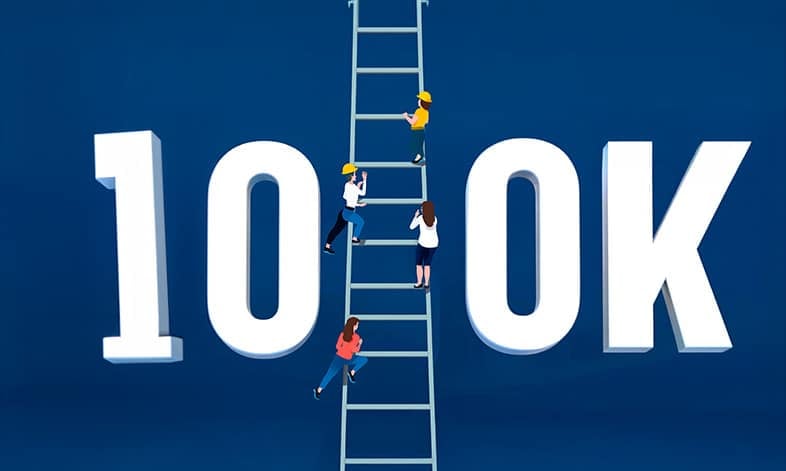
A new study looking at LinkedIn activity suggests that 100,000 followers is emerging as the most important inflection point on the platform for brands, resulting in rapid growth and influence.
The study, conducted by analytics platform Metricool, analysed 673,658 posts from more than 63,000 accounts on LinkedIn across 2025 and 2026, comparing performance across Company Pages and Personal Profiles.
Its central finding is that while growth on LinkedIn is relatively steady across most account sizes, personal profiles that cross the 100K follower mark experience a structural shift in performance that fundamentally changes how content spreads.

However, PR professional and managing director of AZK Media, Azadeh Williams told B&T although the 100,000-follower mark is “definitely a meaningful signal on LinkedIn”, she cautions brands against treating it as “the goal in itself”.
“What the Metricool findings really point to is the compounding effect of trust, consistency and relevance at scale,” she said.
“Once a brand reaches a critical mass, every ‘strong’ post has a bigger probability of being engaged with, reshared by employees, customers and partners, and then recirculated into adjacent networks. That’s where the momentum starts to build. But the keyword there is ‘strong’.”

Williams said her own clients across B2B and corporate storytelling find authority drives engagement more than vanity metrics.
“A smaller brand with a clear point of view, strong executive voices and genuinely useful content can outperform a much larger page that is simply broadcasting company news. LinkedIn’s algorithm increasingly rewards content that sparks saves, clicks, comments, reshares and meaningful dwell time, not just passive likes.”
“Metricool’s own data showing rising ‘invisible interactions’ like clicks reinforces that shift.”
She said although follower scale matters because it amplifies reach and creates stronger network effects, it all comes down to “content quality, distinctiveness and human-led thought leadership that turn scale into performance.”
“The brands winning on LinkedIn today are the ones acting like publishers, not advertisers.”
The study found that once hitting the 100K point, impressions no longer increase in a linear fashion. Instead, that reach jumps dramatically, with impressions rising roughly six times compared to the previous tier. Shares also surge by around 14 times, signalling a major change in how content is distributed and amplified across the platform.
The data suggests this is not simply a function of audience size, but of how the platform’s algorithm responds to scale. Once a personal profile reaches six-figure follower status, its content is more likely to be pushed beyond its immediate network, picked up by broader professional clusters, and redistributed at a far higher rate than smaller accounts.
This creates what the study describes as a compounding effect. Higher visibility drives more engagement, which in turn increases distribution, reinforcing a cycle where each post has disproportionate impact compared to earlier growth stages.
Below this threshold, however, growth remains far more incremental. Smaller and mid-sized accounts see gradual increases in impressions and engagement, but without the same acceleration in reach or shareability that emerges at 100K.

The findings also reinforce the growing dominance of personal profiles over Company Pages on LinkedIn.
While brands tend to perform better on shares, individuals consistently generate stronger engagement and more conversation, particularly in comments. But it is at scale where the gap widens most sharply, with large personal profiles beginning to behave less like standard accounts and more like media distribution channels.
And human quality matters too.
Marketing and corporate communications manager for a major industrial automation and digital transformation company, Rockwell, Daniel Anderson, has years of experience in brand marketing.
He told B&T that “all of their social platforms get better engagement from posts with a human quality than we do for corporate or product updates.”
“That’s true for LinkedIn where we have more than 1.2m followers and its true for some of the regional social platforms like Line where we’ve only just commenced having a presence. Every platform, every culture, every follower size – people are more interested in what we make possible than what we make.”
“Human = engagement.”

For marketers, the implications are significant.
The study suggests that influence on LinkedIn is increasingly hierarchical, with a small number of high-follower personal accounts commanding disproportionate reach. Rather than treating all creators or employee advocates equally, brands may need to prioritise those who have already crossed the 100K threshold, where content performance begins to accelerate organically.


