


Artificial intelligence (AI) is, if you believe the hype, rewriting long-established rules for the creative industries.
According to its evangelists, AI gives creatives inspiration on tap and the production capabilities to turn that inspiration into reality.
But while a blossoming of creative thought and production may seem net positives for the industry, Pinterest’s VP of global creative, Xanthe Wells, believes that we may stray farther from the light thanks to the technology.
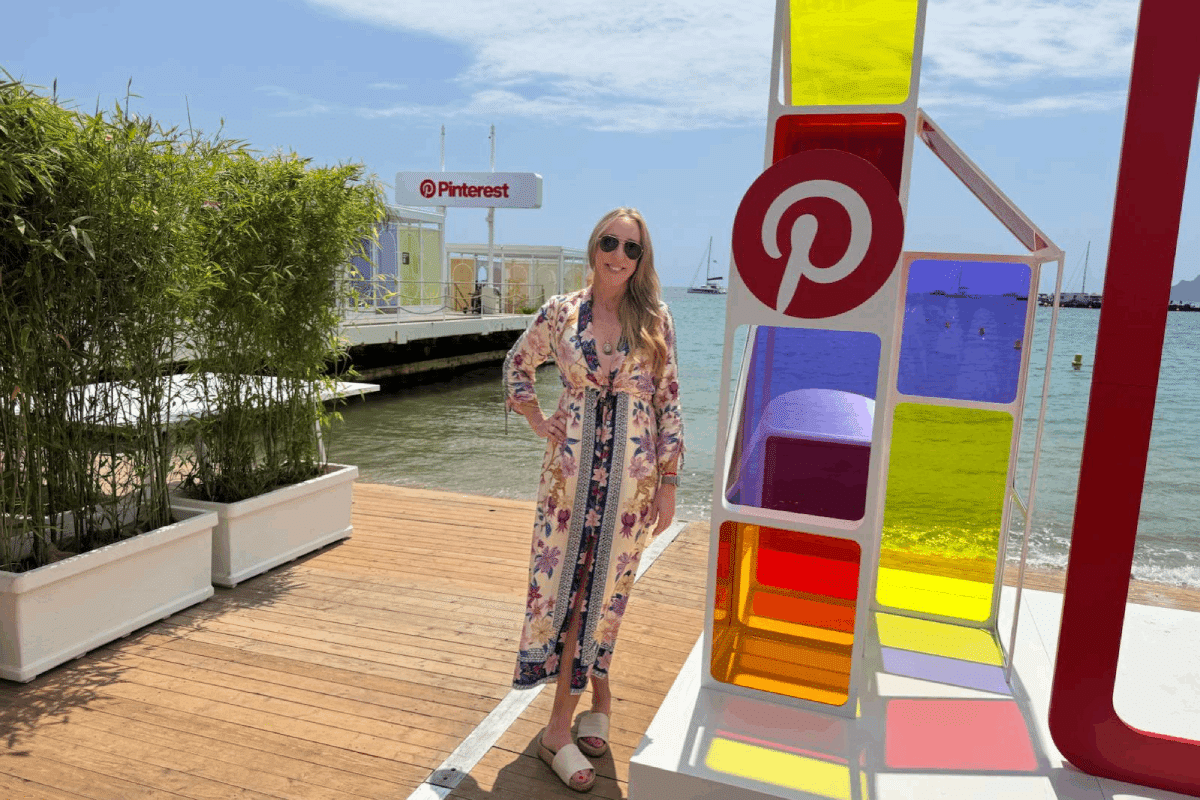
“I’ve been playing with human-written copy versus AI written copy and then asking AI what it thinks of both… over and over again, AI chose human copy and had a lot of reasons for its,” she told B&T on Pinterest’s beach activation at Cannes Lions.
She said that AI itself preferred human copy to its own work due to the “comedic timing of the human copy, the references, the riskier jokes [and] sentence structure.”

Meanwhile, AI found its own writing “bland, predictable” and had no real integration with an overarching brand where necessary.
“We are not going to be wiped away. It’s going to take over the grunt stuff that nobody in the creative industries wants to do. Granted, I say this gingerly because there are lots of job losses associated with that. But I do think people that use the tools to make their lives easier, even if they’re doing the 45 page of a website that three people go to, great! I’m glad you get to leave work at five now,” she said.
“But when it comes to differentiation, it’s going to become a garbage dump for the next five years. An onslaught of horrible, bland garbage. But people are going to rise from that and want to be differentiated. Every brand wants to stand out, so if every brand stands out in the same way, where’s the differentiation. AI cannot do that in the way humans can because the lived experience is not the same. There are no incongruous references, it’s all pattern recognition.”
That said, Pinterest is using AI as part of its internal creative process, under Wells’ auspices. It has an internal LLM based on ChatGPT called Helix. Wells said it helped her narrow her presentation in the Cannes Palais from 20 pages of notes to 10 and organise her thoughts. It is also using Google’s Veo and OpenAI’s Sora video models to help with creative visualisation.

“But the more I look at what’s out there in terms of video, it’s not there yet. There’s a perception that you can just put in a prompt and you get a perfect shot. But you don’t, you have to do 300. So is it really a cost-saving right now? I don’t think we’re there yet. Very far off. And it can’t be used on its own, I can’t replicate a brand campaign without a combination of multiple AI tools, a visual effects artists and all those different suites. At an enterprise level, having access to all those things is complex,” she said.
Talent pipelines & fear
There is, perhaps, a bigger question around how AI tools will change the talent pipelines and ways in which people conduct business. Wells gave the example of a person she knows in law school and how AI has become something of a crutch for students.
“All her peers are using AI and no one can reason. They give these rote answers and there’s no logic to it. They don’t own it,” she said.
“There still needs to be human interaction. We can’t pull out ChatGPT and have this conversation. You have to have something inside you, that’s the opportunity.
“There’s a huge opportunity [for creatives] if you actually learn how to write and have guidance to do that or the initiative to yourself to figure out. I think it’s going to be easier than ever to stand out to be honest.”
AI also can’t pull together an activation like Pinterest’s at Cannes, a regular highlight of B&T’s time in the south of France. Again, however, we steadfastly refused a tattoo from the on-site tattoo parlour. Wells described herself as a “proud mama bear” with the activation.

But with her background in a variety of TBWA agencies, including Media Arts Lab, its bespoke unit for Apple, Wells couldn’t help but sense a trepidation on the Croisette with all the talk of AI.
“Everyone is terrified and fear is never a good way to operate. People need to dive deep into what’s happening and be learners… We have to drive this. We have to drive how we’re going to use it, set the standards, talk about IP and be responsible. The more you know, the more you play, the more you go deep, the more you have a say in how this shapes up. We are more in control than I think we are,” she said.
“I was just talking to someone who runs big teams and she said all her creatives want to use [AI] but they don’t. They’re trying to meet deadlines. It’s like the revolution is upon us and then there’s another thing to learn. I could compare this to the beginning of my career when my before hours and after hours were all learning about this world voraciously, every article, every tool, anything I could get my hands on because that’s the only way for me to really feel OK and sleep at night.”
That said, Wells is still, in true Pinterest fashion, optimistic about the future for creatives.
“Being creative is more important than ever. You can click a button and have a creative output, or so you think, but it’s thin. There’s no depth…
“There’ll always be room for finding a human insight and universal messaging that has to be so good to cut through… those ideas are still going to matter but I don’t see a lot of them anymore. Brand advertisers have to figure this out and I don’t think we’ve cracked it yet. Maybe these engines are going to unlock a different way to advertise. And I think they will.”