



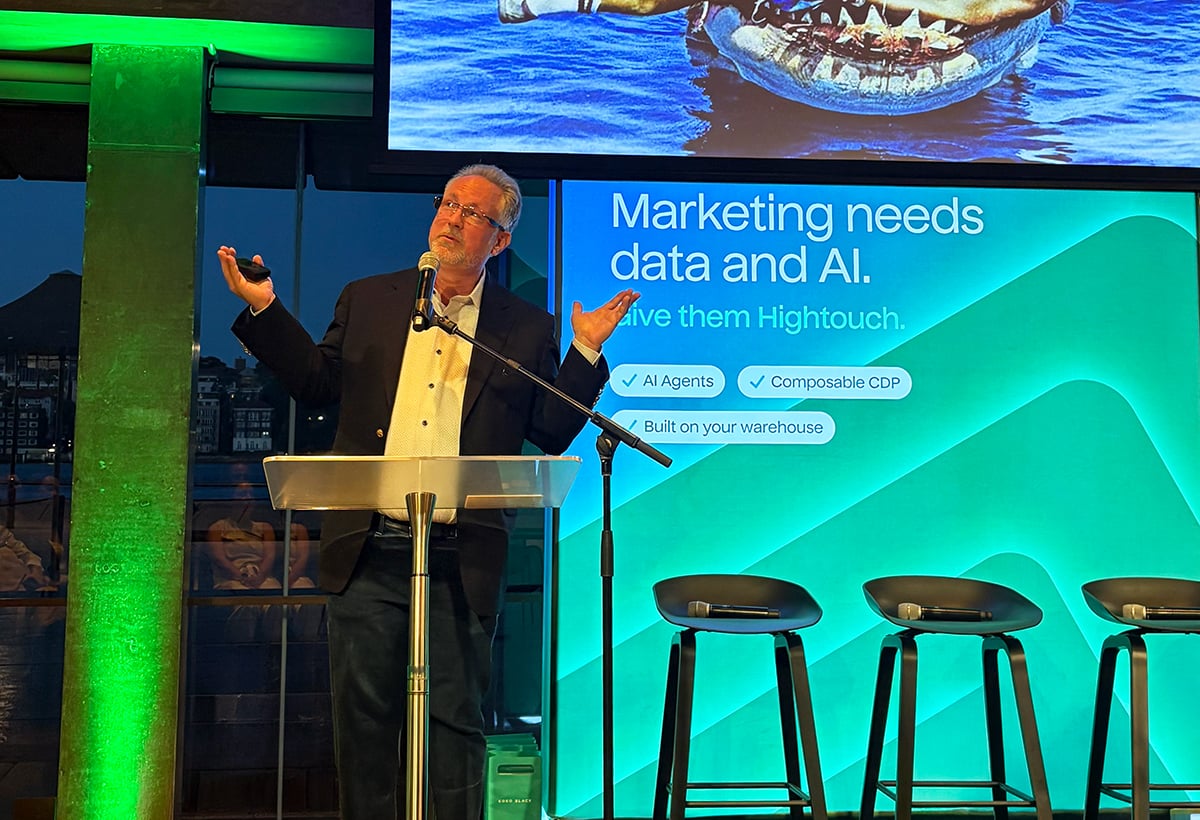
Martech pioneer Scott Brinker has warned companies in Australia against cutting marketing teams to replace them with AI, describing it as “naïve”.
Brinker shared his view at an event put on by martech firm Hightouch at the Sydney Opera House this week. Based in Boston, Brinker is an analyst, adviser and author who coined the concept known as ‘Martec’s Law’ and was an architect of the agile marketing movement.
Speaking to the room of marketers, he highlighted leaders who take the gains of AI as an “advantage” to cutting marketing teams was unacceptable.
“The naïve view is to say ‘Oh well, I used to have 10 people that worked in marketing; they were mostly doing the production analysis. Now I can do that production analysis with one or two people,” he said.
“Or [saying] ‘All right, I just cut marketing and we’re good to go,'” Brinker added.
“The reason why I say that’s naïve is because there is absolutely no competitive advantage to be gaining there. Every single company on the planet is going to get that same benefit of the efficiency gain.”
He also highlighted that having more AI efficiency won’t necessarily make your marketing team any different.
Beyond the technology itself, Brinker argued that marketers need to reconsider how they use the efficiencies AI is already creating. He divided marketing into three broad areas: strategy and creative; production and analysis; and, the marketing operations that support them.
Historically, much of the industry’s effort has gone into production and analysis, leaving comparatively fewer resources for the strategy and creative work marketers should value most.
AI is beginning to change that balance, he said, reducing the time and resources required to produce marketing outputs and analyse results.
Hightouch itself is a data activation platform. It sits between data warehouses, such as Snowflake and Databricks, and martech and adtech platforms such as Salesforce and Google Ads, allowing marketers to funnel data (without copying it) between the two types of systems.
Brinker’s comments come as marketing budgets and headcounts faced significant pressure this year. Southern Cross Media Group, for instance, announcing a sweeping “cost reset,” trimming 250 to 300 full-time roles and Meta Australia laying off advertising sales staff as part of a global restructuring effort.
And that’s not all. Earlier this year over 600 jobs at Monday.com were also cut in a restructuring plan for its product, marketing and go-to-market, embracing what it called “the new AI era”.
‘Huge’ growth opportunity
Brinker said that marketers in Australia have a “huge” growth opportunity with martech.
However, while AI makes it easier to build software, the opportunity, he argued, is not simply to build more, but to build “the right things”.
If marketers are building these tools, they should create tools that competitors cannot easily replicate.
“There is just a tremendous amount of work ahead, and there’s huge opportunity for companies to be better than their competitors,” he said.
“When every company on the planet has this incredibly efficient engine for the production analysis and marketing, how do you differentiate? How do you compete?
“I think the exciting opportunity is: we have the time, the resource composition, the technical capabilities to lean into new strategy and creative work that we couldn’t have even dreamed of before,” he added.
Brinker, who has spent decades tracking the evolution of marketing technology, said this would mark a departure for the industry which has become accustomed to adding single-use applications to solve specific, isolated problems.
He added that many businesses were “a long way” from connecting their AI systems and internal knowledge effectively.
“This isn’t going to happen in a quarter, or a year. This is going to be a multi-year journey of how do we transform marketing in this like very cool agentic environment that we all keep talking about,” he said.
In Australia, AI technology has been adopted at a rapid pace.
Research from the Marketing Association of Australia found three-quarters of marketers were already using AI tools at least weekly.
However, just under a third had actually undertaken any AI training.
Brinker said that early adopters may receive a short-term benefit, these will diminish as the technology becomes more widely available.
He said that could result in marketers finally tackling customer experience problems, improving how information is presented to customers or investing in strategic work that has repeatedly been pushed down the priority list.


