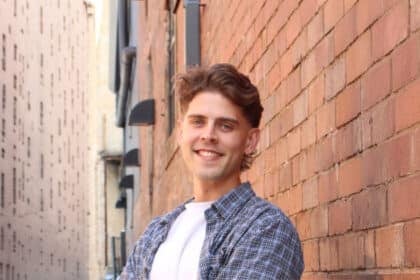

Hot Takes is Spark Foundry Australia’s new sharp, culture-savvy editorial series where strategists unpack human behaviour through candid conversations with thought leaders, stakeholders and commentators—serving up fresh perspectives that flip the convention and spotlight what really moves us. In this op-ed, Spark Foundry group strategy director David Dalgarno is in conversation with Dan Krigstein, director of The Growth Distillery.
Have you ever noticed how the future always feels like someone else’s problem? We toss around words like ‘futureproofing’ as if we’ve got a crystal ball tucked in the bottom drawer. Truth is, making it through the week with your head above water already feels like a win.
Humans Are Weird About Time
We’re told to plan ahead. Save for retirement. Think five, ten, twenty years out. But here’s the kicker: humans are terrible at imagining the future. We’re the only species that gets anxious about things that haven’t even happened — and yet, we’re equally bad at predicting what will make us happy when we get there.
Dan Gilbert, Harvard psychologist and author of Stumbling on Happiness, explains in his TED Talk that our brains have an ‘experience simulator’. They let us imagine future scenarios before they happen. Sounds handy, right? Except it’s wildly inaccurate. We overestimate how good or bad things will feel. Winning the lottery? Not as life changing as you think. Becoming paraplegic? Not as devastating long-term as most assume. Turns out, we’re not just bad at predicting the future – we’re bad at predicting how we’ll feel about it.
When I spoke with Dan Krigstein, director of The Growth Distillery, he added another layer: loss aversion bias. Our instinct to avoid short-term pain often trumps long-term gain.
“Otherwise, we’d all be incredible at saving and putting money into compound interest,” he said.
But we’re not. Because we’re wired to protect the now, not plan for later. And yet, we keep pretending we’ve got it all mapped out.
We’re Told to Plan, But We’re Wired to Panic
Generations show just how much this has shifted. Boomers planned for stability. Gen X hedged their bets. Millennials? Too many ‘unprecedented events’ blew up our timelines. And Gen Z? They’re not even pretending. They’re side-hustling, splurging, brain-rotting — trying to keep pace with a world that changes faster than the algorithm. Planning used to be a virtue, now it feels like a gamble.
Maybe the real issue isn’t that we don’t plan enough, it’s that we keep expecting certainty from a world that’s never offered it. We’re sold the idea that if we just work hard, follow the steps, and tick the boxes, we’ll end up safe and happy. But life doesn’t work like that and, maybe, it never did.
What If We Stopped Pretending?
Gilbert talks about ‘synthetic happiness’ – our brain’s ability to make peace with outcomes we didn’t choose. It’s not fake or ‘second best’. It’s how we’re wired to cope. So, maybe, the goal isn’t controlling the future but adapting to whatever it throws at us.
Krigstein agrees, but with a caution. “Focusing your planning to be less about control and more about flexibility” is smart in theory, but in industries like superannuation, too much optionality can cause overwhelm. What people really crave, he says, is perceived agency – the sense that they’re steering, even if they’re not pulling every lever.
In a chaotic world, simplicity becomes a superpower. Not just in product design, but in messaging, decision-making, and how brands show up in people’s lives.
What Does This Mean for Brands?
If the future feels foggy and people are more anxious than ever, especially in low-engagement, long-horizon categories, brands need to rethink how they show up:
1. Certainty is a given. Build confidence around it.
In categories like super and banking, certainty is non-negotiable. But in a world where stability feels like a myth, it’s not enough to simply say things are certain. You need to show it in ways that help people feel more capable of navigating uncertainty. Confidence is the new comfort.
Krigstein puts it bluntly: “Most Aussies are shifting into defence or survival mode. Doubling down on the ‘secure future’, especially when a third of Australia doesn’t believe they’ll ever get one, is actually decremental.”
2. Make the invisible, tangible.
Services, utilities, super funds, insurers – they’re all selling things people can’t see. Energy, time, compound interest etcetera. If people can’t picture the value, they won’t feel it. Use storytelling, design, and real-world context to make the abstract real. And avoid marketing to the ‘filtered self’ – the curated digital version of your customer.
“In the age of digitisation,” Krigstein warns, “you risk knowing less about your customers, not more.”
3. Embrace adaptive thinking, not rigid planning.
The old playbook was set a goal, make a plan, stick to it. But life is messy, and plans change. Brands that offer flexible, responsive solutions will feel more human and more helpful. Build tools that adjust with people, not lock them in. And maybe stop showing the ‘white picket fence’ as the ultimate goal.
“That vision of success is becoming increasingly antiquated,” Krigstein says. “People want to keep living the lives they love now, not sacrifice their best years for a retirement they’re not sure they’ll reach.”
The future’s still coming, whether we’re ready or not. We might as well meet it with curiosity, humanity, and a plan built with flexibility at its core.