There are few Australian national teams more successful than the Kookaburras and Hockeyroos. The pair regularly compete for podium places at the Olympic Games and Hockey World Cup, yet the sport has barely scratched the surface when it comes to attracting sponsors in Australia’s highly competitive sports landscape.
That could soon be about to change.
Hockey Australia has unveiled an ambitious strategic plan to more than triple in size (from 100,000 members to a community of more than 350,000) by 2028.
Underpinning this shift is a relatively new and expanding domestic league, Hockey One. Australia is also hosting more local fixtures in the international FIH Pro League, plans to bid for the 2030 World Cup, and has a a burgeoning grassroots program called Hook In 2 Hockey.
Hockey Australia is transforming how the code engages with fans, including overhauling consumer marketing, its website and use of digital platforms, athlete-driven content and is looking to scale its broadcast and streaming with partner 7plus.
Leading the charge to grow Hockey is chief commercial and digital officer Blair Crouch. He joined Hockey Australia in July 2025 after a stint as the general manager of the BBL franchise Melbourne Stars, and has previously worked in senior sports marketing roles at the AFL and agency side for Gemba and MKTG.
Crouch told B&T that in the past year, Hockey Australia has sharpened its focus on its content channels —telling better stories about its athletes and the sport—attracting new audiences, and growing the commercial program.
“We’re very fortunate that the Hockeyroos and the Kookaburras are iconic Australian national teams, and we’re hugely relevant during the Olympics, Commonwealth Games (except the most recent one) and the World Cup,” Crouch said.
“One of our challenges is finding more ways to be relevant more often. Additional events help, but also our ability to grow our digital and social footprints as we’re competing with the other leading sports in this country.”

One of hockey’s most famous advocates is Network Ten newsreader Sandra Sully. A former player, Sully spent more than a decade on the Hockey Australia board and served as co-vice president for the past four years (see Sandra’s breaking news alert about the formation of the FIH Pro League in the video below).
“Hockey is very tribal. It’s a family-friendly, gender-neutral sport,” Sully said. “Our men and women play on the same pitch on the same day, and often the men are the curtain raiser to the women.
“For those who are uninitiated, what I love about hockey is seeing their faces when I get them to that first game. At an elite level, they cannot believe the skill set and how fast it is.”
Sully told B&T the fact hockey has managed to grow its membership base marginally during an “explosion” of other codes—cricket, rugby league, AFL— chasing young women to participate is a measure of its success.
“Australia is the most competitive sports market per capita. When you consider that hockey doesn’t have the money of cricket or the football codes, holding out is a huge tick in my book.”
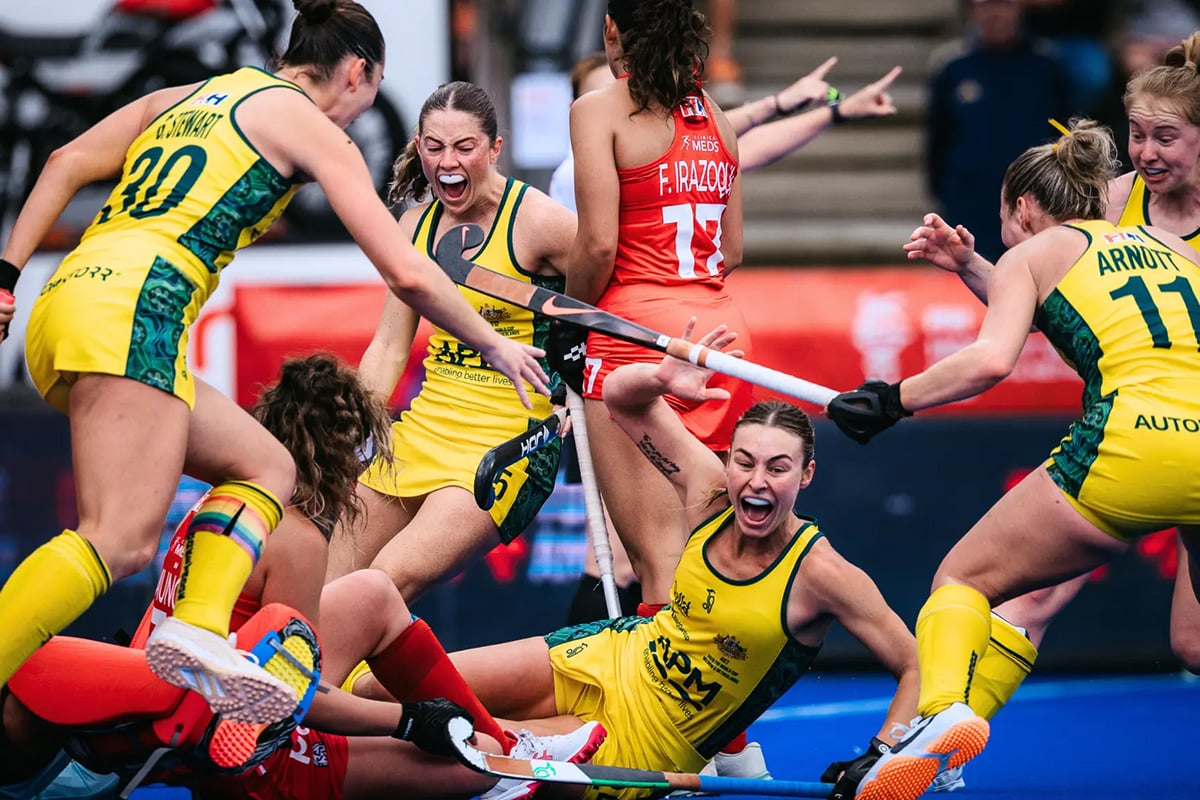
At the recent FIH Hockey World Cup in Belgium and the Netherlands, the men’s Kookaburras finished fifth and the women’s Hockeyroos (once Australia’s most successful national team) came fourth.
These results are considered somewhat underwhelming for a hockey nation that wants to be regularly placed among the top three by the 2030 World Cup
But it’s what happened off the astroturf pitch that Hockey officials hope will catch the eye.
For the first time, both the men’s and women’s teams sent content producers to cover the teams from the sidelines, attracting new fans to the sport across social media channels.
Tim Bowman, also known buy the handle What Now Tim?, was one of the content producers who shot this incredible footage of last season’s Hockey One women’s semi-final between HC Melbourne and Adelaide (see below).
“You’ve seen what things like Drive to Survive have done for Formula One. Our plan is to broaden the audience through quality content,” Crouch said.
“The challenge that we’ll continue to overcome is communicating that message to non-hockey fans who may not be regular consumers of our content through our channels,” Couch said.
“We are also continuing to work with Channel Seven, who are a great partner, and provide opportunities for them to cross promote the fact that they’re broadcasting pro league on 7plus.”
Hockey is funded through a combination of government grants, levies from member states, commercial partnerships and philanthropy.
The sport has a broad appeal, particularly in the country, although it doesn’t have the registration numbers of rival codes. There are more than 100,000 registered players from junior level through to masters; Australia’s most popular sport, AFL, has more than six times the number of registered players.
“Hockey is really unique in that it’s genuinely a sport for life,” Crouch explained. “We’ve got five-year-olds running around happily playing hockey, and through our masters cohort, we’ve got people who are still playing masters tournaments in their 80s.
“It’s one of the rare sports where you can commit to life as a participant.”
It is also a sport where women have equal billing to men. For example, the Hockeyroos are just as box office as the Kookaburras, and during Hockey One fixtures, fans get to watch both back to back for the price of one ticket.
The pitch to brands
In the past four years, Hockey Australia has grown its commercial non-government revenue by 110 per cent and is plans to grow turnover another 30 per cent by 2028
Hockey Australia’s commercial partners include the likes of employment services firm APM, Kookaburra, Kuhmo Tyers, Asics, Eastcoast Car Rentals, tech firm Automator and fast food franchise Roll’d.
The latter two are brands in categories that previously didn’t back the sport, evidence hockey is starting to gain traction in new, fertile ground.
“Like any commercial opportunity, it is very much about understanding what are the objectives of the potential partner, and then being quite clear about responding with a bespoke opportunity,” Crouch said.
“We don’t have, you know, the huge TV audiences that say cricket or football, do we probably have to be a little more creative in presenting a compelling proposition, which usually for our partners starts at the grassroots and then finds its way all the way through hockey up to the national team relationships.”
Crouch said the ambition is to continue finding commercial partners in categories that are new to the sport.
“The four biggest sponsorship categories in the world are financial services, telecommunications, automotive and alcohol. We don’t have a partner in either of those four, so that’s a good starting point,” Crouch said.
“We want to secure a partner that will help us achieve our objectives as well.
“If you look at what NAB have done for AFL’s Auskick, that’s a great example. We’d love to find a brand like NAB or CommBank, one of the big financial institutions, to work with us on growing Hook In 2 Hockey.”
Hockey One is ripe for commercial partnerships. It has previously had the likes of Kellogg’s Sultana Bran, Liberty, and Westfund Health Insurance.
Today the competition’s headline sponsor is hydration brand One Active, but there are many opportunities to back franchises, including Australia’s first Indian community-based professional sports team, the Melbourne Cobra’s.
Sully said that hockey is currently having “a number of earnest and secret squirrel conversations with a number of big brands”.
“So the competition is fierce, but I always say it’s pretty hard to find an Australian sport that’s gender-neutral where both the men and the women are in the top five in the world,” she added.
“If I could appeal to any sponsor, I’d say give us a go, there’s never been a better time to invest in hockey.
“We’re in a growth stage at a time when a lot of other national sports aren’t. We’ve got a brand new franchise starting in hockey One, the Melbourne Cobras, which is attracting Indian international talent. We want authentic, long-term relationships to grow with the sport.”