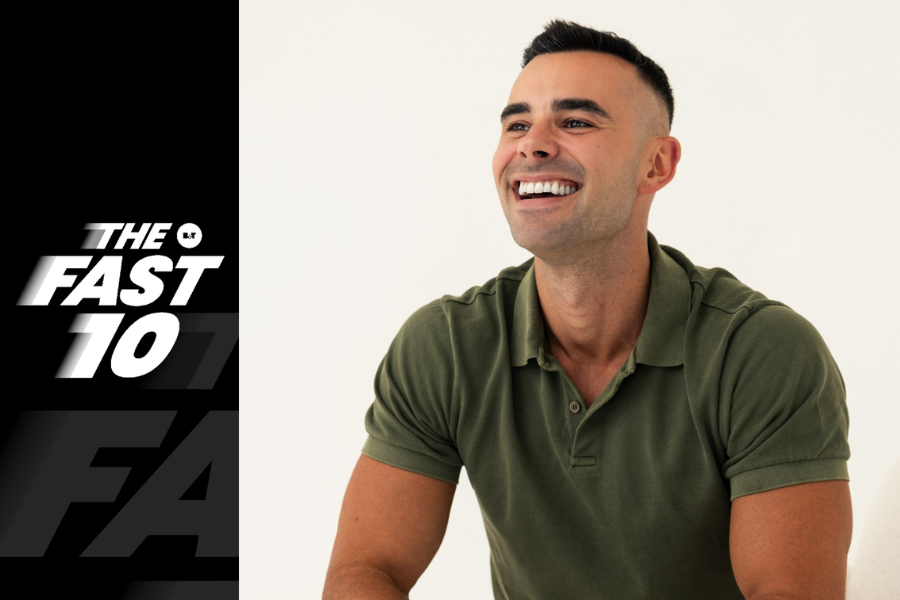
Taylor Fielding cut his teeth in media planning and buying before founding tfm.digital, an independent agency built to serve SMEs in the franchise and multi-location space.
He’s grown the business into a trusted partner for clients across fitness, wellness, retail and hospitality, all while running his own City Cave Float & Wellness Centre franchise on the side, giving him a rare view from both sides of the client table.
Following Greg ‘Sparrow’ Graham’s retirement, B&T supremo David Hovenden is now taking charge of the Fast 10. Though you’ll likely notice some similarities because, as the saying goes, if it ain’t broke, don’t fix it. Here, Fielding and Hovenden talk about building a team from the ground up and why marketers need to stop chasing shiny objects and nail the basics first.
1. You’ve had an amazing career, from account director at OMD Australia to chief executive at TFM Marketing. If you had to pick only one, what would be your career highlight so far?
Taylor Fielding: Honestly, it’s not a single campaign or award — it’s the team we’ve built at TFM. Watching people who started as juniors grow into heads of departments, seeing the leadership team run rings I never could have on my own…that collective cohesion is the thing I’m proudest of. Titles and Fast 100 rankings are nice, and don’t get me wrong, they look great on our walls, yet for me, a business is only ever as good as the people in it. We’ve learned a few things along the way, but building this team that genuinely wants to be here is the hardest, most rewarding thing I’ve done.
2. Bronze at AFR Best Places to Work. What’s the one thing you changed that had the biggest impact on culture?
TF: Building a real planning cycle. Undoubtedly. We stopped treating purpose, mission and values as an unread poster on the wall…and started using them to set individual and team goals every cycle. Baking in accountability for each person and department. That agency to make their own choices. When people can see a straight line from what they do day-to-day to what the business actually stands for, everything from engagement, sick days, retention, churn, it all improves as our people feel more ownership around their output. That alignment, more than any single perk or policy, is what’s shifted our culture.
3. You started in marketing comms and media buying, then went client-side as a franchisee. What’s one thing about owning a wellness franchise that agency experience never prepared you for?
TF: The P&L reality. In an agency, you’re advising on someone else’s numbers. As a franchisee, every dollar of cash flow was mine. When it’s the wages, rent, marketing, stock, all of it hitting the same account I was living off, it hits home differently and can make you more protective. Every dollar had to earn its place. It gave me a respect for the operator’s side of the table that no amount of agency experience could teach. I make better decisions for clients now because I’ve felt what it’s like to be the one signing the cheques.
4. As a young boy, what did you want to be when you grew up?
TF: Talent on a TV show — I wanted to be in front of a camera, not behind a strategy deck. Turns out I’ve ended up somewhere in between, hosting a podcast and doing plenty of talking, just with better KPIs attached.
5. You’ve been independent for a while now. What’s the best thing about not having a holding company looking over your shoulder?
TF: Speed. No red tape, no waiting on sign-off from a holding company three time zones away. If we see an opportunity — a new offering, a client need, a market shift — we can move on it within days, not later that quarter. In an industry evolving quicker than ever, and one which can reward agility, it’s that speed can become a genuine competitive advantage.
6. As an industry, what’s one habit marketers need to break?
TF: Forgetting the basics. Everyone’s chasing the next shiny platform or format, but half the time our marketing foundations, our fundamentals of a clear offering, matched with the right audience, maintaining a consistent frequency, and adapting where relevant, aren’t even in place. Marketing isn’t broken because it needs more innovation; a lot of the time it’s broken because we’ve skipped the boring stuff that actually works. It’s how we started TFM – by focusing on solving some of the harder elements in marketing, multi-location and franchise, across an underserviced niche. Venturing to solve problems that others can’t or won’t spend time on. That’s where we’ve been able to deliver value consistently.
7. What are the current challenges for your clients, and how are you driving growth?
TF: Media cost inflation is the big one right now — budgets are static or shrinking while the cost to reach the same audience keeps climbing. For our franchise and multi-location clients, that pressure is magnified across every location. We’re driving growth by getting sharper on efficiency: better media buying, smarter local-area marketing so individual sites aren’t wasting spend, and doubling down on channels with provable return rather than spreading thin. Budgets are often limited for the marketers we speak with and not everyone can simply spend more, so for us it’s about focusing on spending smarter.
8. What’s the best career advice you’ve ever been given?
TF: Business coach Kerwin Rae told me I needed to make sure I was fit to lead before I could expect to grow leaders underneath me. It reframed everything — you can’t build a strong team on a weak foundation, and that foundation starts with you. It’s advice I still measure myself against.
9. What’s one thing not on your LinkedIn profile?
TF: I was chasing a career on camera long before I was chasing clients. So while LinkedIn may tell show the marketing story, it omits the other side: the frustrated TV presenter waiting to be cast. Haha.
10. Important last question: Do your parents really know what you do?
TF: Honestly, they know I “do marketing” and that it’s going well. The finer details of media buying and franchise strategy, or any further shoptalk tend to be glazed over pretty quickly at family dinners. Anyone with partners or family outside the industry I’m sure can relate. But they know I love it, and that’s enough for them.