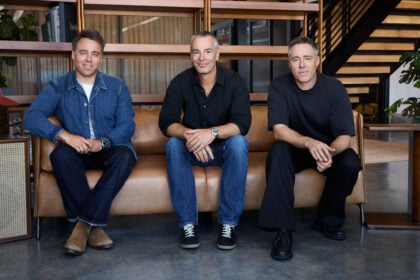

Ian Ball, global CEO of the Enero Group, is a measured talker. But when he starts, the Woolwich-born Arsenal fan is not one for vagaries, platitudes or cliches.
In this first part of an exclusive and wide-ranging interview with B&T, Ball explained the AI strategy transforming the BMF, Orchard and Hotwire parent business. The second part focuses on Enero’s place in the market and the economics of agencies in 2026.
Enero, he believes, is at a “sweet spot” in the global marketing services industry. It is not a boutique agency, nor is it one of the titanic ‘Big Five’ holding companies (formerly known as the Big Six).
It’s this position in the market that gives it deeper client intimacy, a fleet-footedness to react to market conditions and the chance to create genuine AI innovation in the space — rather than fretting about how it can continue to generate margin in an increasingly squeezed market. Scale, in his mind, is not everything.
It is, for want of a better word, the Goldilocks of the world’s holding groups.
This position, neither too big, nor too small, nor with too much inertia from decisions made thousands of miles away or thousands of days ago, has allowed it to develop an AI strategy that is distinctive and, in his mind, compelling.
“We are large enough to make significant investments and empower the human talent that we have with technology,” he said.
“Yet we are able to customise what we do to the needs of our clients and to the local market. We don’t have to have a one-size-fits-all global agency investment over years, born out of New York or London that is pushed out to individual markets and doesn’t fit the needs.”
Tooled Up
Naturally, every agency group of any significant size has fingers in the world of AI pies. Enero’s three agencies each have bespoke solutions tailored to the needs of their clients and the sectors they work in.
Tech-focused PR agency Hotwire has been the front-runner among the trio. Its Singapore office has been running an AI Lab for a number of years and the “early investment” in its capabilities a few years ago is starting to bear fruit.
It now has four products produced by the AI Lab: Spark, Radiate, Ignite and Ember. Spark and Radiate, respectively, monitor how brands are represented in AI search results and optimise client content for greater performance in these emerging platforms.

Ignite, meanwhile, is an AI-powered research tool that accelerates planning and account intelligence. Ember is the latest and was piloted in FY26, it turns survey, interview and customer data into interactive research personas.
“It really helps us differentiate in pitches,” Ball said, adding that across the financial year, it has helped Hotwire achieve a 30 per cent higher hit rate.
“It’s also paying dividends in client retention. Clients want innovation, they want more value… Third, we go to market with the product in and of its own right. We have more than 100 clients that use this and it’s sold, in some cases, as a subscription service. They’re telling us that the landscape is changing and they don’t want us to do a one-off diagnostic, they want to sign up every quarter and get our help as it evolves.”
Hotwire is not the only agency exploring subscription-based offerings, Howatson+Company, for instance, has been very vocal in the market about its Plus Also and Unicorn tools.
The AI Lab, Ball said, has also enabled an Enero-wide AI transformation, developing tools using a skills-based approach which can be deployed in other areas of the group.
This work has allowed creative agency BMF to create ‘Noggin’, a proprietary AI platform across five custom-built programs spanning creative effectiveness, production, delivery and operations.

“Anyone on the floor from BMF can tap into it. There are 30 skill-based agents in Noggin that anyone can use. One of those skills, for instance, is a board of advisors — the good and the great, the guru-tastic of advertising. If you’re a creative at the beginning of a brief and bouncing around ideas — how do we breathe new life into VB for Asahi — you can send ideas to the board of advisors and they will debate their merits, if it’s been done before, what they like, don’t like,” Ball explained.
“It cuts out so much time. It adds effectiveness. It adds different perspectives,” it’s just one of the 30 skills we have.”
Those other skills include Culture Radar, which gives cultural intelligence analysis specialising in Australian and global consumer culture; Extra Eyes, which reviews docs, decks and artwork files against brief, feedback, copy deck and rates readiness for client review and the brilliantly named Deck Head which iterates on creative ideas with structured feedback.
Orchard, meanwhile, has perhaps the most expansive vision for AI. Its “Agentic by Default” program has seen its team deliver measurable efficiency gains across production and in FY27, it will launch the Orchard AI Index, a proprietary benchmark of AI maturity across its core verticals.
“Orchard is quite different from the other two agencies,” said Ball, “it’s a digital marketing business and a large part of what it does is build and optimise websites and consider insights through data and analytics around optimising brand presence across different channels. It’s in the heartland of AI.
In practice for staff, Orchard’s Agentic by Default positioning means that its first recourse for solving any problem is to wonder whether an agent could achieve the task.
“If you think about building websites, you could argue that it’s basically a commodity-type service. They have to be very effective in what they do and they’ve got to be very cost-competitive,” Ball said.
“Orchard is probably ahead of the other two agencies in terms of embracing it internally. Hotwire has the external [embracing] but Orchard, because of the digital production nature of the business, it had to be quick to develop cost-competitive, efficiency-gaining agents. And that’s exactly what they do. The initial agent is about a 60 per cent productivity gain versus humans. That number is going to go up over the next six months to 70 to 80 per cent. That’s a good manifestation of Agentic by Default.”
Orchard, however, also operates in the healthcare space. This poses another challenge and opportunity for AI to solve.
“They write a lot of copy for drug information in the communications to healthcare professionals,” Ball said.
“It’s highly regulated, as you can understand, with lots of rules and huge amounts of information to digest and reconstitute. That’s the heartland of AI. We’re in the process of piloting a copywriter — which is a tool for an expert medical copywriter, not to replace a medical copywriter. But it takes a lot of the grunt work out of their time to assemble basic information in a format.”
People, resistance and pipelines
It has become a truism among the world’s agencies that AI will enhance, not replace the human workers currently staffing agencies. But there is a growing sense that people around the world are beginning to push back on AI — often, in a deeply ironic twist, these people happen to be the most ‘online’.
But not always. A recent story in the Australian Financial Review detailed the experience of Gabrielle Boyle, the AFL’s former participation manager for northern NSW. After raising concerns with management, she resigned from the AFL three days before it began a company-wide AI rollout, allowing it to access information on company-provided computers. Boyle now lives off-grid in a 1986 Toyota Troop Carrier with her cat and a flip phone.
While an AI proposition is now “table stakes” for agencies, according to Ball, he did say that helping staff to see the benefits of AI had been a “journey”.
“If you asked me the same question a year ago, I would have had much higher reservations about the ability of our people to willingly adopt and change. It was risky,” he said.
The pace of change and expansion of AI into other areas of life have helped staff see the benefits.
“I lived through the internet era, I was in the US when it happened, and it was similar. But I think it’s even more extreme this time. It’s faster and it’s more fundamental. I think that as people see AI more and more in everyday life, in the interactions they have, how they shop, how they do everything every day, they become more accepting that this is something that is not going to go away,” he said.
“It’s fundamental to business, it’s fundamental to the future and there is less and less optionality. There’s got to be guardrails around it and at Enero we have separation between the infrastructure, the security, the acceptable use of AI and then the front-end development.”
Again, many will be familiar with the idea that AI can remove menial work. But for Ball, the technology’s great benefit is its ability to “humanise the complex”.
“We went through a really big change at BMF in the past six months and it has gone remarkably well. We haven’t had a [negative] reaction. We have had people embrace it and, as I said right at the, we control the number of Claude licenses we give out. We’ve got people asking us whether they can have them. They want more AI, not less of it now,” he said.
“They’re seeing the impact of their colleagues, the work they do and the output.”
There remains another large unknown with AI — what happens to staff training? For years, creative services businesses have developed staff through what Ball has termed an “apprenticeship” model. They learn by doing small tasks, working their way up to larger, more sophisticated tasks before taking on management responsibilities and the cycle repeating.
He doesn’t have an immediate answer for that problem. But, to be fair, nobody does.
“The concern I have about AI, which I think everyone has, is that it is robbing juniors of their critical thinking capability which they outsource to an agent,” he said.
“I think it is important to continue to have a human element in all work so that you can continue to have access to the apprenticeship model. I think what AI tools give you is an extra dimension. It doesn’t replace what you do, but it gives you extra insights, it’s a complement to your thinking. It gets you to the start point, not the end point.
“It gets you to a certain level but then human talent comes in. That’s where the differentiation is. Our junior creatives are still going to work with Scott Nowell [BMF’s recently appointed creative chair], they’re still going to be working and seeing the genius and the craft. But they’re going to get to the start of the meeting in a more effective way than they might have done if they hadn’t had the AI tools.”
Tokens and water
At its heart, Enero’s approach to AI development and usage is straightforward. Every AI investment decision — from building products to assigning Claude licenses — needs to either make the business more efficient or effective.
“We don’t measure, like a lot of companies who are novices in this space do, adoption or usage of AI — token-maxxing. It’s a misplaced leading indicator of value. It’s not something we measure at all,” said Ball.
“We’re thoughtful about who we give what licence to and we’re very thoughtful about where we have implemented AI and what the value of that is.”
In practice, that means that many of BMF’s plays in the market are about continuing the agency’s standing as the most effective agency in Australia, according to the Effies.
“AI is a leveller. It’s allowing companies that don’t have the scale of the massive global holding companies to have the same capabilities as them because you can do a lot more with AI that doesn’t require you having huge data and analytics capabilities or numbers of people,” he said.
“You can do huge amounts of market research, you can really pick up a lot of information about clients, their needs and their strategies. You don’t need a lot of people to do that. You need a few experts empowered by a lot of AI and automation. If you build the skills through AI, which we have done, then we can leverage the human talent we have in a really effective way. But it’s all focused on driving client value… A lot of the plays we’re building for BMF is how to make them more effective in their competitive advantage.”
The other great unknown with regard to AI is its power consumption. It’s a topic that is rapidly gaining traction with the general public.
Information from Transgrid, which operates NSW’s power network, has upgraded its forecasts on power consumption. It now expects that electricity use by data centres in the state will expand four times as much in the next 10 years as was expected a year ago. It also expects that data centres will account for two-thirds of the growth in electricity consumption by 2035.
“It does concern me,” said Ball.
“The token consumption, which is the leading indicator of the power consumption, is an element that we are thinking about a lot. We measure very closely what our token consumption is and we’re now at a level of sophistication where we are conscious of what models we use for what tasks.
“We now issue instructions to staff about using Copilot for documentation like Word, PowerPoint and when you’re using Claude, think about the model you’re using and what capability to use for Claude. Obviously there’s a pragmatic issue around cost, but it’s also thinking about the extreme impact of power consumption on the environment and being sustainable.”
The Enero office in Sydney, for what it’s worth, is powered by renewable energy and it said that it has advanced work on its climate-related risk assessments in its annual report.
Enero, of course, is not directly responsible for the power consumption of Anthropic, OpenAI, Microsoft, Google or any of the other companies building AI tools. Nor are the countless other agencies around the world. But all have a responsibility to everyday consumers to ensure that we still have a habitable planet.
In Ball, Enero seems to have a leader who is not only cognisant of the challenges AI poses, as well as its opportunities but also thinks about both in a considered, meaningful way.