
Australasian independent full-service agency Bastion will merge with US indie network BUNTIN in a move that CEO Cheuk Chiang says will create a “global challenger network”.
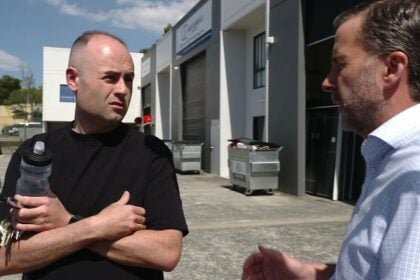
In an exclusive chat with B&T ahead of the announcement, Bastion Group CEO Cheuk Chiang and Jeffrey Buntin, Jr. revealed all about the news, which they said has been on the cards for some time.
The merger will see the Bastion Group name remain in Australia and New Zealand. In the US, the agency will operate under the BastionBUNTIN name. However, both arms of the business will be fully integrated — allowing the group to compete for significant global briefs while maintaining what it says are the distinctive client-centricity and agility of an independent.
Bastion already has offices in Los Angeles and New York. However, BUNTIN, founded in 1972 by Jeffrey Buntin Sr. has built up a very strong operation from its Nashville base. Its clients include Cracker Barrel (for which it designed the original logo), Coca-Cola, Trex and SERVPRO among many others. Bastion’s clients include Geely, Kellogg’s, Bunnings and L’Oreal, again among many others.
Alignment across the Pacific
“We’ve had a very strong business in LA and New York,” Chiang told B&T.
“But the desire has always been to scale that business further. When the opportunity came up, it was a meeting of two cultures and it was just right.”
Bastion and BUNTIN said they were aligned on a number of fronts. But it was in the agency’s culture and client centricity where the parallels were brought into the sharpest relief.
“A focus on clients and client-centricity has always been a big part of the Bastion culture. The same can be said about BUNTIN. It’s a 50-year-old family business,” Chiang said.
“We have met and are now getting to work with some of the best people we have ever met in advertising,” said Buntin.
“At some level, it is imperative to genuinely admire and respect the colleagues you work with, everyday, both in the work we do and also as people. That is getting harder to find in the industry – both for agency practitioners, as well as in how clients look at the people in their agencies. We have just felt a deep level of connection with our Bastion teammates in the US, Australia, New Zealand and at all levels of the organisation. For me, it is not an exaggeration to say it’s been a huge source of joy,” he added.
“From there, it is about clients and creativity. We’re incredibly excited about – and absolutely confident in – the unique value this will bring to clients. And, relatedly, I am excited about the Creative impact the legacy BUNTIN portfolio and creative reputation will have on Bastion’s ascent to a global creative powerhouse, as well as the work our teams globally are poised to bring into the world. We’re inspired to help shape the role great creative plays in solving the world’s hardest client problems.”
Chiang added that there were some economic forces blowing Bastion and BUNTIN together, too.
“It’s also important to understand what’s happening in the US right now and where its growth areas are. Businesses have been struggling in places like San Francisco and LA and a lot of the action is moving to cities like Nashville and Dallas. Oracle, Amazon and Meta have all moved part of their headquarters to Nashville. For us, it’s about going where the action is,” he added.
To be clear, Bastion still believes there is plenty of action in Melbourne, Auckland, Wellington and Sydney — where it has recently moved into some shinier, larger offices. This, as Chiang said, is about ambition.
Global goals
“If we’re going to be a true global network, then we need network clients. The desire is to start going after the global clients who are unhappy with the service and the delivery the holdcos are delivering right now,” he said.
The timing, coinciding with Richard Foster’s court battle with WPP over its alleged rebate scheme is purely coincidental. Though it is striking. WPP, for what it’s worth, said Foster’s allegations are “baseless” and “without merit”.
“We’re going to be a global challenger brand focused on client-centricity. But we’re not just building a network of scale, which is where the holdcos have been playing for many years,” Chiang said.
The two agencies are complementary in their offerings too. Both can serve clients on a full-service basis and combined, they will be able to deliver end-to-end capabilities across brand strategy, creative, media, communications, PR, digital, insights and experience.
Clients will be able to access these capabilities, the agency said, through integrated teams and specialist expertise across borders without the bureaucracy of traditional networks. B&T understands that the two agencies have already won a piece of business together for a global brand, though we were sworn to secrecy as to who it was.
“This partnership extends far beyond geography,” added Jeff Browe, the CEO of BastionBUNTIN and former CEO of Bastion Agency USA. “It’s about uniting people, ideas and expertise around a shared belief in integration and outcomes. We’re building a network for modern marketers that’s global by design and independent by choice.”
Browe and Chiang should know better than most about the upsides (and downsides) of holding companies and independents alike.
Prior to joining Bastion, Chiang spent more than 10 years as the CEO of PHD across Asia-Pacific and CEO of the Omnicom Media Group in Asia-Pacific. He also had four years with Dentsu serving in APAC roles.
Browe, meanwhile, had been with WPP for more than 20 years, and experienced several agency revamps. He served at Wunderman, Y&R, Wunderman again, then Wunderman Thompson and finally VML before joining Bastion in 2024.
“This is not about scale. We will build a business that is more client-centric and a network that is far more connected. That means that rather than putting anyone on any client, it’s having staff who are closer to their business and understand their category,” said Chiang.
“It’s about delivering stronger, better service. It’s about faster decision-making because of the way we’re structured with fewer layers between the idea and the outcome. And it’s about making sure that we deliver true integration. A lot of networks talk about it. But they are literally separate agencies still working in silos. We have a concept called radical collaboration. We have literally broken down every silo and we work in a federated manner with one thing in mind. We have one thing in mind — clients’ best interests.”
“I think this does more than change the landscape; I think it creates a new horizon line for clients. They can look out and see a different future, a different path, and a different type of partner to help them achieve their goals,” added Buntin.
“Clients can find in this a true business partner with the experience to illuminate the right path forward, then bring human and technology resources together to execute that path well, at the highest levels of integrity and accountability. It is just a radically different way to collaborate and work and, while the work is serious and the client marketing challenges are real, there is also an energy about working this way that is refreshing and, dare I say, fun.”
Around the World
There are more prosaic benefits for clients, too, such as the ability to offer near-round-the-clock service — when staff are finishing their lunches in Los Angeles, the Auckland team is arriving to work. Once the Kiwis pack up for the day, it’s still 3pm in Melbourne. Once the Melburnians start knocking off, it’s 4am in New York.
A European office would fill that three-to-four hour gap quite nicely. Chiang said an expansion there is “on the cards,” too.
“While it is not that shocking at face-value, the output we have already seen from this is palpable,” said Buntin.
“And there is genuinely deep team-building that happens when one group signs off for the night and hands a project over to their global colleagues to advance, and then that group hands it back as they sign off for the night, and so on. In just a few months’ time, I have seen this transform the level of output we can generate for clients, and it also just radically accelerates team building energy across the staff.”
Bastion Group staff can also expect some new opportunities such as the chance to work on “big global challenges,” Chiang said.
There might also be the chance to move offices. “I keep saying I would love to be a 24-year-old copywriter again, because I would be in HR asking to work in the Melbourne office for a year!” said Buntin.
Though presumably he hasn’t been informed about Melbourne’s rather drizzly weather compared to Nashville. Or Sydney.
Maximise Client Strength
But the main benefits for clients, Chiang said, sound tantalising.
“I’ve previously come from network and regional roles. This is playing well to my wheelhouse. But we’re doing this because we believe the industry deserves a brighter and better future,” he said.
“For all the challenges that we’ve had as an industry, we, from a visionary point of view, want to reset the path of the industry moving forward. Rather than talking about, for example, buying scale and a lack of transparency when it comes to media, we’re giving clients what they need to make sure that every working media dollar for them is delivering. It’s about bringing more of a science-based approach back to the thinking side of things where, as an industry, we’ve almost lost that. It’s about using technology in the right way rather than trying to sell systems and technology that don’t work as the holdcos have been developing.
“Dominance for many years has been defined by scale. More offices, more people, more process, more noise. This has created distance from clients. Marc Pritchard, chief brand officer of Procter & Gamble said it: ‘Don’t let your complexity be my problem’. Clients have called it out,” Chiang said.
“You’re seeing layers of governance, slow decision-making and an inflated cost-to-serve. Huge teams of finance, HR, audit rather than teams of client-focused and talented people. There has been a massive focus on profit optimisation from every single network, which means cutting costs. Over the past three years, more than 25,000 jobs have gone from the six major holdcos. The key is the opaque commercial models which are there to protect the agency’s profit and margin.”
Buntin added that the holding companies have “made clear” that they “risk weakening client points of vulnerability — not strengthening them”.
“BastionBUNTIN is designed to maximise client strength against every potential point of weakness in ways no other agency can deliver. This is what clients need today, and the reality is no other agency model is providing it,” he said.
“And the independents (even the largest ones, many of whom have solid reputations) lack the scale, globally integrated capabilities, and proprietary technology to do this at the level we can. We define success as becoming the world’s strongest independent agency network. It just so happens that we also define success as maximising the positions of strength we help achieve for our clients. Which means our goal for clients fully aligns with our goal for ourselves,” he said.
“This is the ultimate independent agency statement…Full and complete alignment of your goals with your clients’ goals. And the freedom to push everything else out of the way in pursuit of that. Being independent is essential in order to do that for clients. With two strong independents coming together, it just doubles the positive propulsion this creates, on pretty much every level.”