




With the Cairns Hatchlings, presented by Yahoo, wrapped for another year, we’ve been taking a look back at the work produced by the Round 2 runners-up, live in Cairns.
Round 2 tasked entrants with responding to a real challenge from the UN Foundation and OCHA, to raise US$23 billion (AU$32.8 billion) and save 87 million lives in 2026. The task had to be built around the single unifying platform idea of ‘Reunite for Humanity.’
Entrants had 24 hours to respond to the brief and submit their final work.
Grab an ultra early bird ticket to Cairns Crocodiles, presented by Pinterest 2027 now.
Last week, we looked at the OOH category. This week we’re looking at the Digital category.
Disha Nikalje and Aria Koudounis, Omnicom Media Group
Nikalje and Koudounis identified crisis fatigue as the central obstacle. They noted that the scale of humanitarian need isn’t shrinking and traditional fundraising built on urgency and guilt is becoming easier to scroll past.
Their insight: subscriptions have already made generosity automatic in other parts of life, with a third of Australians running three or more subscription services and 70 per cent leaving auto-renew switched on. If giving worked the same way, fatigue wouldn’t need to be overcome, just redirected.
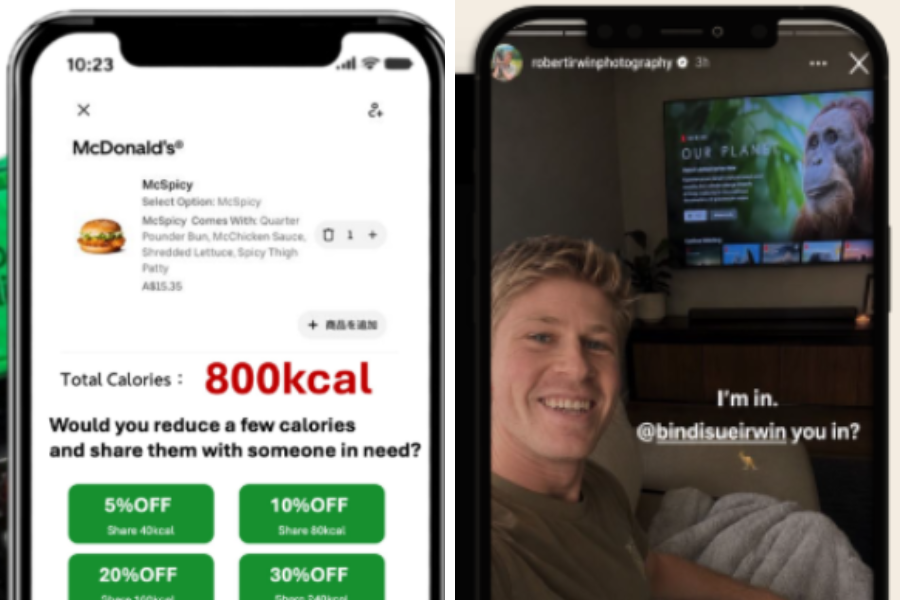
Their response was ‘You In?’. A campaign that turns humanitarian giving into a social subscription. Creators and athletes including Robert Irwin and Pat Cummins, seeded the idea socially with “I’m in, @friend you in?”, before Netflix’s own renewal interface prompted subscribers directly: “You In?”, add $1 to your plan, cancel anytime.
The four-stage rollout moved from culture (ambassador-led social posts) to amplification (paid social and display pushing the idea into the mainstream) to participation (the Netflix renewal prompt itself) to movement.
Its goal: prove that if generosity can be built into a subscription renewal as easily as any other add-on, humanity’s funding gap becomes just one more button people are already used to pressing.

Yohei Hamada and Kao So, DENTSU
Hamada and So identified a mismatch in global appetite as the central obstacle. They noted that while people in wealthy countries spend money on health apps and gyms to cut calories, 87 million people around the world need those same calories just to survive.
Their insight: donating money feels like a loss, but losing calories feels like a gain, the same act reframed as personal benefit rather than sacrifice.
Their response was ‘Donate the Calories’. A strategy that partnered with food delivery apps to make calories themselves a new unit of donation. At checkout, users ordering their usual meal are offered a discount, 5 per cent to 30 per cent off, in exchange for reducing a portion of the calories in their order, with the equivalent nutrition shared with someone in need.
The rollout moved through three stages: a “Calorie Off” prompt on the app’s home screen mirroring a standard discount notification, a checkout-screen offer letting users trade calories for savings without changing the price they pay and a feedback loop showing donors exactly who their calories reached and running tally alongside a “0kcal Menu” stunt, an empty box sold for full price, with all proceeds donated, plus integration with healthcare apps to keep people donating long-term.
Its goal: prove that a donation doesn’t need to feel like a sacrifice when it’s reframed as something the donor already wanted for themselves.

Winners: Priyanka Pradeep Gohil and Aman Ganesh Aragonda, Schbang Digital Solutions Private Limited.
Gohil and Aragonda identified diminishing trust in AI as the central obstacle. They noted that while AI is transforming daily life, it’s simultaneously making humanity feel smaller and less connected.
Their insight: every AI model is trained on us, yet every month billions of dollars in subscription value quietly disappears.
Their response was ‘The Humanity Subscription’. A strategy that turns a share of every unused AI credit into an automatic donation to humanity, no toggle, no tick-box required. Subscribers use AI platforms as they always do, and at the end of the month, the cash value of unused credits is calculated and a fixed percentage donated to OCHA’s Reunite for Humanity fund.
The rollout is centred on an open invitation to every major AI platform to sign a strategic partnership pact, timed to launch at the AI for Good Global Summit in Geneva. Inside the product, a “Lives Impacted” panel appears right in the chat window. Around it, a full media ecosystem THAT carries the message outward including personalised retargeting ads that tell individual subscribers how many people their unused credits helped feed or support, alongside social, display and OOH assets.
Its goal: prove that impact doesn’t need a toggle when it’s already built into the product and turn AI’s unused capacity into a scalable source of humanitarian funding.

Click here to view all the 2026 Cairns Hatchlings, presented by Yahoo winners across every category!


