



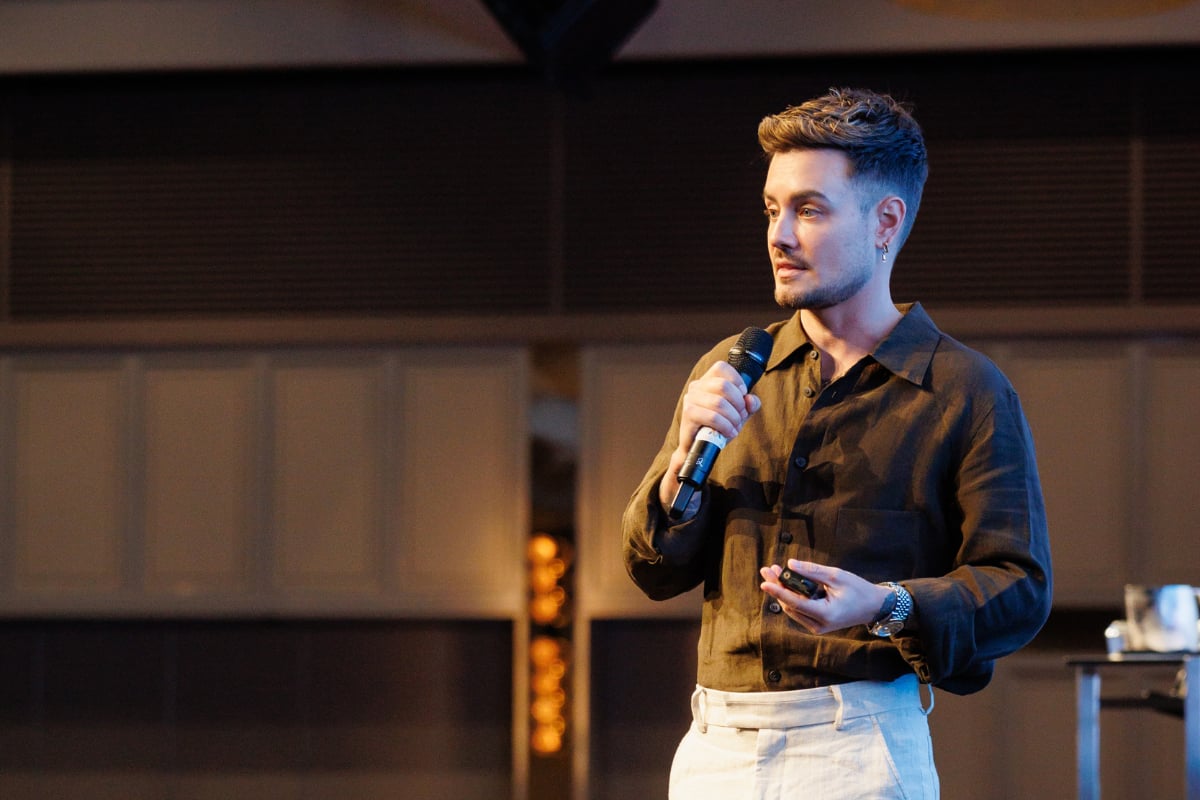
“The job of a marketing leader in the next decade comes down to exactly two capabilities. One is AI. The other is EQ.”
It’s a big statement coming from someone who has spent the past decade training senior leaders at some of the biggest companies in the world.
But according to Australian psychology thought leader and connection expert Mitch Wallis, that’s exactly where marketing is heading.
Speaking ahead of his session, ‘Real Conversations: The Marketing Leader of the Future Has Two Jobs – AI and EQ’, at the iMedia Future of Marketing Summit Australia in August, Wallis believes the industry is approaching a turning point.
He believes as AI reshapes how marketing gets done, emotional intelligence will increasingly define how marketing leads.
For years, marketing leaders have been measured by the brands they’ve built, the growth they’ve delivered and the strategies they’ve executed, and while those capabilities no doubt remain fundamental, they may no longer be the qualities that distinguish the very best leaders.
“When information is as available as oxygen and AI handles the technical layer in seconds, being the smartest technician in the room stops being rare,” Wallis said.
“Commercial thinking, strategy, technical craft – that used to be the edge. It’s now the entry fee.”
Marketing has always been a people-powered function.
Behind every successful campaign, brand strategy and transformation initiative is a team making decisions, challenging assumptions and taking creative risks.
Creating an environment where people feel confident enough to contribute is not separate from commercial performance. Increasingly, it is one of the things that enables it.
And according to Wallis, that’s where EQ becomes a commercial capability.
Because marketing has never lacked brilliant strategists, commercial thinkers or technical experts.
“What AI can’t do is bring the best out of a person. It can’t make a nervous junior brave enough to pitch the idea that scares them. It can’t rebuild trust after a brutal quarter.”

What it increasingly needs are leaders who can build teams capable of doing extraordinary work.
That shift is already emerging across Australia’s marketing community.
Discussions with the iMedia Future of Marketing Summit Australia Advisory Board consistently identified leadership as one of the defining challenges facing marketing teams today.
Senior leaders spoke about guiding teams through uncertainty, maintaining engagement in lean organisations, building future capability and creating environments where people continue to innovate despite constant pressure.
Those conversations mirror findings from the 2025 iMedia Marketing Industry Pulse, which revealed authenticity ranked ahead of strategic thinking and adaptability as the leadership quality marketers value most in a modern CMO. The research also found two in three marketers want stronger mentorship and peer support networks, highlighting a growing appetite for more connected leadership across the profession.
Taken together, the message is becoming difficult to ignore.
The future of marketing won’t simply be shaped by evolving technology.
It will be shaped by leaders who create environments where people thrive.
Wallis believes one of the clearest examples is psychological safety.
Not because it creates comfortable workplaces.
Because it creates high-performing ones.
“Psychological safety isn’t the absence of pressure. It’s the presence of trust under pressure.”
For marketing teams, that trust has tangible commercial consequences.
It determines whether someone raises concerns before a campaign launches instead of after it fails.
Whether a junior marketer feels confident enough to challenge an idea.
Whether a team shares difficult feedback early enough to change the outcome.
“A frightened team defaults to safe work. And safe work doesn’t sell, nor inspire,” Wallis added.

Ironically, one of the biggest barriers to this kind of leadership is the very thing that helped many marketers reach leadership positions in the first place.
They’re exceptional problem solvers.
They’ve built successful careers by moving quickly, making decisions and having answers.
But Wallis believes that instinct can quietly undermine trust.
“When someone brings you something real, there’s a tiny window at the start where they’re deciding, mostly unconsciously, whether it’s safe to open up or whether they should pack it back down,” he said.
“You don’t win that window by fixing, you win it by making them feel understood before you reach for a solution.”
It’s a challenge Wallis has distilled into what he calls the five characters of disconnection – the default ways people unintentionally shut down emotionally charged conversations, despite having good intentions.
“The Magician waves the wand and makes the problem disappear (‘Have you tried…?’). The Thief hijacks it with their own story (‘The same thing happened to me’). The Blind Optimist silver-lines it (‘At least it wasn’t worse’). The Helicopter becomes overwhelmed by the other person’s pain. And the Ostrich avoids the conversation altogether,” Wallis explained.
“The intent underneath all five is the same: I’d rather move this away than sit in it with you.”
Wallis said recognising these patterns is one of the first steps leaders can take to build stronger, more psychologically safe teams, and he’ll unpack the framework in more detail during his session at the iMedia Future of Marketing Summit Australia.
According to Wallis, the challenge for tomorrow’s leaders isn’t having better answers but rather creating the conditions where other people can find theirs.
“Stop trying to fix. Start trying to understand,” Wallis stressed.
“When someone brings you something hard, swap ‘here’s what I’d do’ for ‘tell me more about that’. Understand it completely before you move to close it.”
These moments may appear small, but over time they shape culture.
They influence whether people speak up, whether teams collaborate effectively and whether organisations are able to respond quickly when challenges emerge.

The expectations placed on marketing leaders will only continue to grow.
They’ll need to embrace AI, navigate commercial pressure, lead organisational change and make sense of an increasingly complex world.
But the leaders who thrive won’t be those who know the most, they will be the ones who create environments where other people can do their very best work.
That’s the conversation Wallis will explore at the iMedia Future of Marketing Summit Australia, held from 24–26 August 2026 at Sheraton Grand Mirage, Gold Coast.
Bringing together CMOs, marketing directors and senior marketing decision-makers from Australia’s leading brands, the invitation-only Summit explores not only the future of marketing, but the future of marketing leadership.
Under the theme ‘New Frontiers: Building Value in the Age of Opportunity’, the Summit will examine the strategies, technologies and leadership capabilities shaping the next era of growth.
To learn more or apply to attend, visit the iMedia Future of Marketing Summit Australia website.
About Mitch Wallis:
Mitch Wallis holds a Masters in Psychology from Columbia University and is the founder of Real Conversations®, delivered to more than 10,000 leaders across 200+ organisations.


