



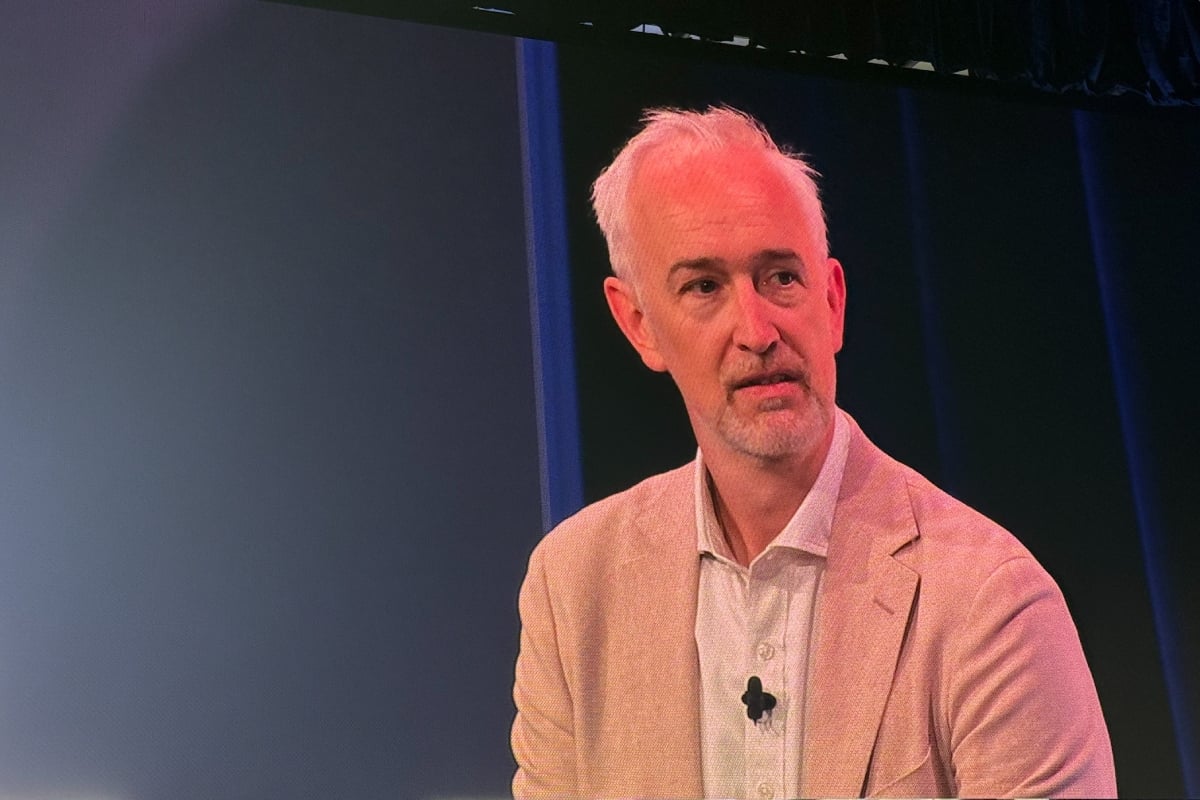
Investment in Australian media platforms, or the lack thereof, was a major talking point in the first session at the MFA EX conference in Sydney.
Omnicom Media CEO Kristiaan Kroon told the 1,400-or-so attendees at Royal Randwick that agencies need to remember that they are “custodians” of their clients’ money and need to invest it for maximum return, rather than purpose-driven reasons.
Moderator Mitchell Long asked Kroon why agencies keep “ploughing” funds into social platforms “despite their negative impact on society”.
“We are custodians of our clients’ money. It is their money. It is not ours. It’s always good to remind ourselves… Why do we spend on social platforms? Because Australians choose to spend a lot of time there,” Kroon replied.
“Whether they are good for the country or not, that becomes a question to have with the marketing department within [a client’s] business. It’s also a question for the government.
“Where you set the line, I think, is around whether you are a principle-led organisation or are you purpose-led? I would say we are a principle-led organisation… We’ve got purpose issues we support. People confuse the two sometimes.”

The role media agencies play in supporting Australian media has become a significant talking point in the industry following the the first tranche of media owner upfront presentations.
During Nine Entertainment’s upfront last week, CEO Matt Stanton told the crowd:
“The decisions you make on where to put your ad dollars has an impact on our industry and our country… You’re investing in everything you see here tonight: Australian news, sport and entertainment. When you back Australian media to grow your business, you also make Australia a better place to live, work and do business.”
News Australia at its five upfront presentations, also touched on the importance of investing in local news, particularly as consumers ask AI chatbots more complicated questions about purchasing decisions in regulated industry sectors.
Australian advertisers, according to the IAB, are expected to spend in the order of $3.1 billion on advertising in 2026. Some three-quarters of that is expected to go digital platforms including Google, Meta and TikTok.
Successive Australian governments have wrangled with the issue of how to support Australia-based media owners. The News Media Bargaining Incentive, passed earlier this year, is the latest attempt. It forces the major digital and social media platforms to pay 2.5 per cent of their Australian advertising revenue to a selection of local-based media owners unless they strike a commercial deal with the media owners.
The US’ National Foreign Trade Council (NFTC), whose members include Meta and Google, described the Bargaining Incentive as “highly unprincipled and coercive”.
“Placing the onus for the commercial viability of Australian journalism on a handful of foreign companies due to evolving media consumption patterns is a flawed premise,” wrote Tiffany Smith, NFTC’s VP of global trade policy.
US President Donald Trump’s administration described the Incentive as “foreign extortion”.
“The bigger one for me is not whether you’re global or local, it is [whether] you are investing in Australia?” said Kroon on stage.
“The vast majority of our media owners are foreign-owned. oOh!media is now American. Channel 10 is owned by Americans. It’s not whether you’re globally owned, it’s whether you are investing in our country? Are you investing in our ecosystem?
“But we have to remember, we make recommendations for clients. We make recommendations, but it is still the client’s choice and it has to work that way. Bear in mind, as well, that the vast majority of advertisers, half the top 20, are also global businesses, not Australian.
“How you balance that, I think, is whether you’re investing in a rich ecosystem in this country, which is what we would want, versus whether you’re globally or locally owned, which I think is unintentionally reductive.”
WPP Media CEO Aimee Buchanan, also speaking on the panel said the level of local media investment is something the MFA board has been talking about “a lot”.
“We do believe that we need a healthy ecosystem in the market. How we distribute but more importantly to provide news and editorial content, which is socially and politically critical,” she said.
“I do agree with KK that I think it is a client-by-client discussion. I don’t think it’s a corporate governance discussion. I think our job is to educate clients on where their investment is going and the implications to it. But it’s also important to be able to substantiate the impact that engagement in local content – whether that be sport, locally produced drama – that it is having a monumental impact on their business. We have to be able to put the data points around that.”
The kicker, perhaps, is that most of the advertising revenue collected by the large social platforms comes from small and medium-sized businesses, not from firms large enough to require a media agency.
IAB Australia’s latest Internet Advertising Revenue Report said that internet advertising spend climbed 14 per cent year on year in FY26. That outpaced the market’s six-year average growth of 13.7 per cent and marked its strongest financial-year growth since FY22.
“A lot of the new spend is coming from outside the usual base,” said IAB Australia CEO Gai Le Roy.
“While many established advertisers are working with budgets that aren’t growing, we’re seeing new and increased investment from small and medium businesses, from retailers, and from overseas advertisers targeting Australian audiences.”
There is another kicker. While Australian media (whether truly locally owned or not) is certainly doing it tough, it’s worse across the Ditch.
“New Zealand is on our doorstep… [it’s] really struggling. They were the canary in the coalmine. That’s something we should probably in Australia pay more attention to,” said Kroon.
As Karl Marx once wrote, history repeats itself “first time as tragedy, the second time as farce”. We’d hate for him to be right about Australian media and Napoleon Bonaparte.


