The advertising industry’s obsession with originality and invention in creative work is misguided, according to a recent panel discussion.
A single-minded pursuit of originality and uniqueness in advertising might make it harder than necessary for brands to talk to customers, according to Connecting Plots’ chief imagination officer Dave Jansen.
If brands are too single-minded, the quest for originality over all else—such as a piece of advertising’s effectiveness—can lead brands to fall into a trap they get “stuck up their own arse”.
“The quest for originality can be a bit of a red herring,” Jansen said during the agency’s Cannes Lions Creative Review event.
“If it’s something that’s not super original, but you put a twist on it and it’s entertaining, [customers] walk away with a smile and remember who you are. I don’t think there’s a massive problem with that.”
Customers, Jansen said, don’t engage with advertising as deeply as the client-side marketing teams or agencies that create it. As such, brands would be better served by putting a fresh twist on a familiar idea.
This discussion came off the back of a more difficult year than most for Australians at Cannes Lions.
Australia took home 11 Lions this year, down from 31 last year—a five-year low. We did, however, take home two Grands Prix: one for Special Australia and US for Uber’s Super Bowl commercial and Leo Australia for ‘Haven’ produced for Suncorp.
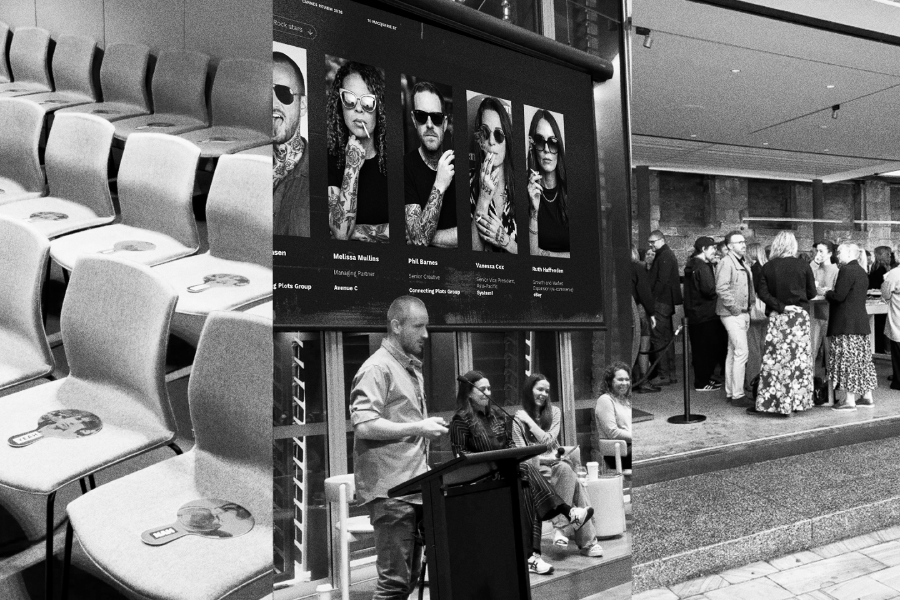
The Cannes Lions Creative Review saw the panel, moderated by Jansen and featuring Avenue C managing partner Melissa Mullins, eBay marketing boss Ruth Haffenden, System1’s Vanessa Cox and Jansen’s Connecting Plots colleague Phil Barnes, debate the merits of award-winning work from Cannes this year.
During the session, audiences were asked to choose whether a campaign was a ‘rockstar’ because it simply demanded attention or a more prosaic ‘musician’ because it had all the same fundamentals as a rockstar but lacked a certain star power.
One such campaign was Columbia Sportswear’s ‘Expedition Impossible’, created by adam&eve\TBWA. The campaign saw Columbia’s CEO bet the company that no one could find the end of the Earth and prove it was flat. It won the Brand Experience & Activation Grand Prix.
For Barnes, the brand’s willingness to alienate a potential portion of its audience meant it stood out from the crowd and, in the process, became a rockstar.
“I think clients underestimate how rewarding it can be to be provocative,” he said, though he did note that the work would not likely offend the vast majority of people.
“It’s a fantastic piece of work,” concurred System1’s Cox.
“Humour is all the way through it and that’s a really effective way to drive brand and advertising performance,”
“Nobody’s ever objected to laughing at anything.”
Up next was the PR Crisis Communications & Issue Management Grand Prix-winning ‘KitKat Heist’ campaign produced by VML. It also won two further Gold PR Lions.
The campaign split the room. Some questioned whether this well-funded PR recovery deserved the same creative credit as work built on a genuine cultural insight.
Mullins noted the campaign leaned on the brand’s existing fame rather than earning attention from scratch, which she argued was a fair tactic, but not necessarily achievable for other brands without KitKat’s baseline recognition.
“I think this is really fun and really great,” Mullins said.
“I do question from a marketing point of view whether it was worth the money investing in this to get over the fact that they didn’t have enough stock at Easter to sell, which feels like fundamentally a big thing for a marketer to go through.”
Haffenden, meanwhile, noted that the campaign, despite claiming the attention it garnered could not be purchased, probably did buy attention rather than earn it—unlike a real rockstar.
“All the media distribution, buying, having conversations and partnering with influencers, this feels like a campaign where they did buy that level of attention,” she said.
“Was there a cultural connection or human insight that would have made this story talkable and engaging and travel the world at the pace that it did without the money that was clearly put behind it? For me, it lacks that. It was very well orchestrated and there was a lot of content and news coverage… but if you’ve got a big enough media distribution budget you can get anything trending.”
“For broad, mass consumer brands, know your role and play it,” said Cox.
IKEA’s ‘Sleep Talk Reviews’ which won a Gold Audio & Radio Lion was also discussed. This campaign saw real customers spend a night in an IKEA store, sleeping on an IKEA mattress. Their talking in their sleep was recorded and served as the basis for the ad.
This campaign, perhaps more than any other, captured the idea that originality is not the be-all and end-all in advertising. In fact IKEA ran a similar campaign in the US and Canada in 2020, running a competition to let one ‘lucky’ customer and a friend sleep over in one of its stores.
The sleep talking element of the 2025 campaign gave it just enough of a twist.
“I think this is a brilliant example of lateral thinking,” said Barnes.
“To reframe sleep talking as a sign of good sleep, and then associate that with your mattress, that’s not just rockstar, that’s Mick Jagger.”
“I love this,” added Haffenden.
“It’s so hard to launch an idea that’s both genuinely entertaining to consumers and that ladders up to your product and what you want to do from a commercial perspective. It absolutely nails it.”
The discussion ultimately landed on a simple point: brands do not need to reinvent advertising to be effective. Sometimes the strongest ideas are those that entertain, tap into human behaviour and give audiences a reason to remember the brand behind them.
“We’ve started looking back to brands as light relief. It’s a really nice opportunity to go back to 90s advertising, where the jingles were in and we were here to entertain,” said Haffenden.