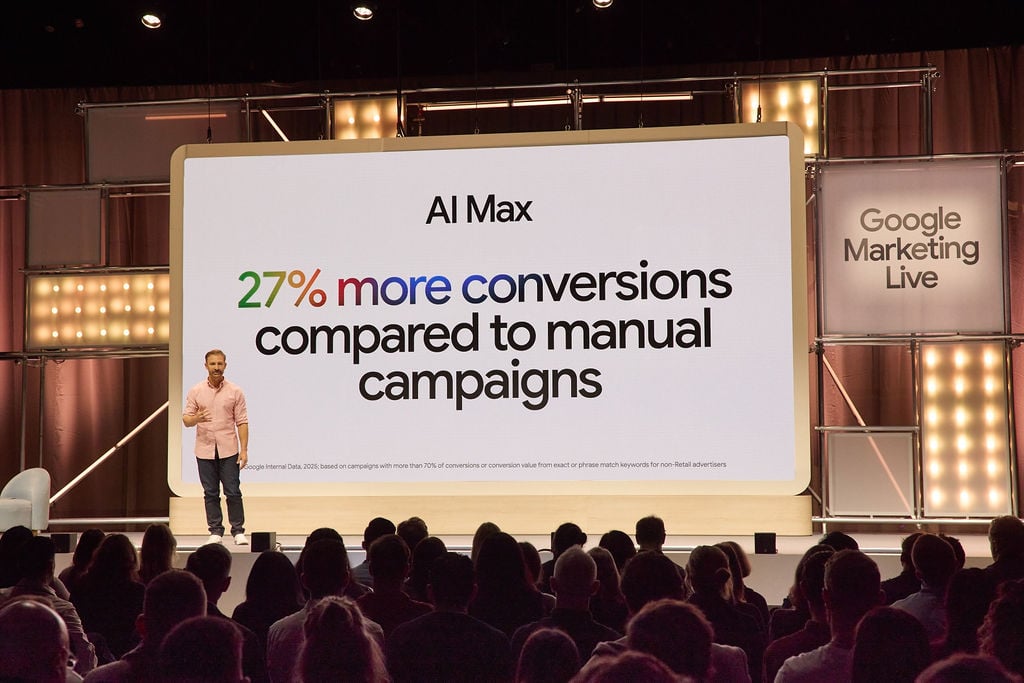
Google has officially rolled out AI Max for Search across Australia and New Zealand, describing the new AI-powered advertising suite as a response to the rapid shift towards conversational search behaviour.
Announced yesterday at Google Marketing Live Sydney, AI Max is now available to advertisers across the region, with Google claiming the technology is already delivering an average 27 per cent increase in conversions compared to traditional manually managed search campaigns.
The launch comes as Google continues to reshape Search around AI-powered experiences, including AI Overviews, AI Mode, Google Lens and Search Live, announcing a suite of other new tools recently in the US.

Speaking at the event, Adrian Vallelonga, Google’s head of performance solutions for Australia and New Zealand, said advertisers must adapt to a world where users “increasingly search using natural language” rather than keywords.
“Now that consumers can ask Google anything, the rule is simple – the best ads must be answers,” Vallelonga told attendees. “We’re moving way beyond simply matching users’ static queries, even the most nuanced and complex ones. We’re now anticipating what someone might actually say next.”
Vallelonga described modern search behaviour as “super empowered search”, allowing consumers to conduct deep, personalised research at the speed of impulse.
“We can ask Search an actual question in our words and even in our own voice and get a genuinely helpful answer,” he said.
“With Google Lens and Search Live, queries are enriched with images and video context, moving far beyond carefully chosen keywords.”
Google argues this evolution is creating better-informed consumers before they ever reach a brand’s website.
“More than 70 per cent of Aussies agree that they make more confident and faster decisions when they use AI Overviews and AI Mode,” Vallelonga said.
“The great news about this is by the time they visit your own site, they’re more informed and they’re more ready to buy.”

Among the brands seeing early success is Telstra, which used AI Max to uncover entirely new categories of search demand.
Speaking on stage, Emir Kazazic, head of digital intelligence at Telstra, said traditional keyword-based search campaigns were increasingly limiting the telco’s ability to reach potential customers.
“Manual keyword-based targeting meant we were only ever capturing the searches we already thought of,” Kazazic said.
“High-intent customers were out there asking simple questions we simply hadn’t anticipated, and we were missing them entirely.”
Operating in the highly competitive prepaid SIM market, Telstra partnered with OMD Australia to conduct a controlled A/B test comparing AI Max against traditional search approaches.
The results exceeded expectations.
“What AI Max unlocked was significant,” Kazazic said. “Instead of rigid keyword matching, it captured long-form conversational queries – queries the way people increasingly search today.”
The platform also identified multilingual search demand that Telstra had not been actively targeting.
“AI Max picked up queries across multiple languages that we weren’t targeting,” he said.
The campaign delivered a 74 per cent increase in click-through rate, alongside a 52 per cent increase in SIM orders and a 36 per cent reduction in cost per order.
“We’d expected to see more conversions at best at the same CPA, but instead we both saw orders and profitability improve,” Kazazic said. “In other words, it wasn’t just finding more people, it was finding the right people more efficiently.”
The results have since prompted Telstra to expand AI Max into additional business categories.
“The results gave us the confidence to go further, and now we’re scaling AI Max across other categories too,” he said. “For Telstra, this isn’t just a performance game, it’s a shift in how we think about search.”