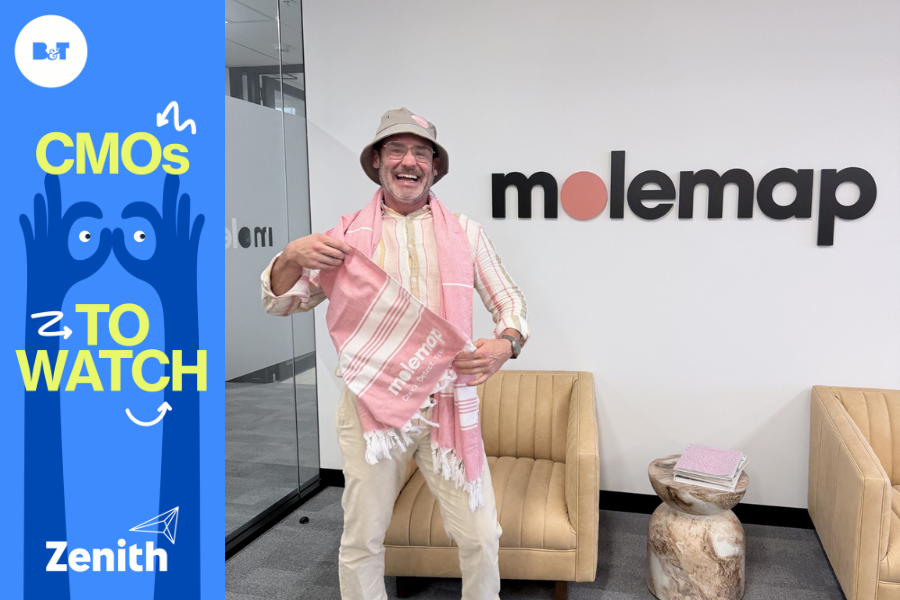
When Duncan Armour first took on the role of CMO at MoleMap ANZ, he explained to B&T he inherited a fragmented marketing function. After he built a growth engine and led a trans-Tasman team restructure, the brand is seeing some top results.
In fact, May 2026 was an all-time record booking month, up 46 per cent year-on-year and the strongest growth rate in the brand’s history.
A lot of this growth is in New Zealand where MoleMap has an 80 per cent market share. Now, Armour is faced with a separate problem of building the market share here on Aussie soil.
Now into our second season of B&T’s CMOs To Watch, presented by Zenith, Armour joins the ranks of visionary marketing leaders redefining the playbook. This series celebrates those who balance bold ideas with business impact and have a whole lot of fun along the way.
B&T sat down with Armour to discuss his first year as the CMO of MoleMap and how he plans to put MoleMap on the Australian map.
B&T: Let’s get to know you… What three things would you take to a desert island?
Duncan Armour: My two Boston Terriers, Stevie and Frankie (Stevie after Stevie Nicks, massive Fleetwood Mac fan; Frankie after Sinatra for the blue eyes and to keep the music theme going). Non-negotiable, they go everywhere I go.
And my journal. I’ve found over the years that daily journalling is one of the most underrated tools a CMO has. The job carries a lot of pressure and you absorb a lot. Writing it out keeps me clear-headed, honest with myself, and focused on what actually matters.
B&T: What is your passion outside of work? If you weren’t a CMO, what would you be doing?
DA: A few things fuel me outside of work. I sit on the board of Rainbow Giving Australia, which I care deeply about. Directing resources and support to the most marginalised corners of the LGBTQI+ community is work that genuinely matters. Being able to apply marketing strategy and governance expertise to shape policy and community outcomes in a sector facing more pressure than ever is extremely rewarding.
I also volunteer at Wayside Chapel in Kings Cross, serving in the community cafe and at their Christmas Day lunch, which honestly rivals any Christmas party I’ve been to. It’s great perspective. It changes how you see people, and being there to listen can make a real difference to someone’s week. It’s made a difference to mine too.
I also run. I ran the TCS Sydney Marathon, and raised money for the Kids’ Cancer Council.
There’s also something about marathon training that mirrors the CMO role pretty well: it’s long-form, uncomfortable, progress is incremental, and if you skip the unglamorous work in the middle, the finish line doesn’t come.
If I weren’t in marketing? Probably something in advocacy or community leadership. I’m drawn to working on things where the outcome is bigger than the organisation.
B&T: What was your favourite campaign of all time?
DA: My favourite campaign is one we recently launched for MoleMap. When the brand story is this powerful and the stakes are this real, you want to get it right. And I think we did with ‘Map your Future’, shifting away from the doom and gloom and scare tactics common in health marketing, and focus instead on optimism and motivation to act.
In terms of campaigns I admire more broadly, I’ve always been drawn to work that earns its place in culture rather than buys it. The brands that compound over time, where every campaign builds on the last and people genuinely feel something. That’s the standard I’m chasing, and it’s what I think healthcare marketing has largely missed. Make people feel confident and safe, and they’re far more likely to act.
B&T: Now let’s talk shop. What is your brand’s top priority for the next 12 months?
DA: When I came into MoleMap ANZ, I inherited a fragmented marketing function. Reactive, campaign-led, no attribution, no lifecycle capability, and vanity metrics standing in for commercial outcomes. In my first six months I was laser focused on building a proper growth engine. I led a trans-Tasman team restructure, onboarded new suppliers, and drove the business case for a full CRM integration spanning patient management, contact centre, website and ad platforms. I treated it as a commercial project, not a marketing one, gained board approval and put my name against the ROI numbers. We’re implementing full-funnel reporting, weekly channel forecasting and real accountability frameworks. Not the glamorous stuff, but the stuff that makes everything else possible.
That foundation is now in place and already delivering. May 2026 was an all-time record booking month, up 46 per cent year-on-year and the strongest growth rate in the brand’s history. Cost per lead is down 46 per cent. Lifecycle marketing, built entirely from scratch, is already running 25 per cent ahead of target. The total projected incremental commercial return across all new initiatives in FY26 is $2.4-2.5 million, and the CRM integration is expected to drive a 15.6 times three-year ROI on the HubSpot investment alone. Every one of those bookings is a person who might not have otherwise walked through our doors. That’s what keeps this work meaningful.
The next 12 months is about scaling our marketing function and repositioning MoleMap as the premium category leader in Australia. We hold 80 per cent market share in NZ and we’re significantly under-represented here. Closing that gap, backed by a strong earned media strategy and full-funnel attribution through phase one of the CRM integration, is the big opportunity. We’re targeting around 7,000 incremental bookings in H2 FY26 alone across acquisition, lifecycle, and contact centre. More bookings means more checks. More checks means more catches. More catches means more lives saved. That’s the actual mission.
B&T: What channel is exciting you the most and how do you split your marketing budgets between long/short and channels mix?
DA: Paid digital is delivering double-digit growth year-on-year since we rebuilt the campaign structure and got the right supplier in. In Australia, online bookings (OLB) are up 80 per cent from where they were flatlining, against a nine-month period where spend grew but bookings didn’t move at all. In NZ, we’re running 1,500 to 1,750 online bookings per month, the highest sustained run in 18 months, with the blended CPA less than half what it was at its 2025 peak. That kind of turnaround is what gets us excited.
But the channel that really excites me is earned media. PR and organic social. Our story tells itself. We’re a brand in the business of detecting skin cancer early and saving lives, and we’ve already seen a 3,000 per cent uplift in social engagement on initial posts since redesigning the strategy.
We ran a free mole mapping activation at the HOKA Half Marathon in Sydney, and a few weeks later received this from one of the people who came through: “I had a free mole map done at the HOKA Half Marathon, and during the check I was told that one mole looked atypical and that I should get it checked further. After having a biopsy it turned out to be melanoma, but luckily it was caught at Stage 0. I feel incredibly lucky that it was found early, as I probably wouldn’t have gone for a skin check otherwise. Your work genuinely made a huge difference.”
That’s what earned media and community activations do that a Google ad never can. We reach people who wouldn’t have come looking. With the right approach I think we can reach corners of this country that paid media alone never will.
On the long/short split, I’m firmly in the brand-building-compounds camp. Short-term performance is how you fund the business, but long-term brand equity is how you win the market. We’re building both in parallel.
B&T: What is the biggest challenge you currently face in the marketplace?
DA: Geographical coverage. MoleMap was born in New Zealand where we hold roughly 80 per cent market share. In Australia we’re still growing, which creates real challenges around reach, media efficiency, and brand recognition.
The stakes of that gap aren’t just commercial, they’re clinical. Every person in Australia who doesn’t know MoleMap exists is a person who might miss an early detection. Every structural decision I’ve made since joining has been patient focused and oriented around closing that gap. Better digital infrastructure, lifecycle automation, smarter media buying, a repositioning toward premium category leadership.
The Australian online booking CPA has already come down around 45 per cent from its peak, and we’re now running 80 per cent more bookings per month than during the nine-month flatline. The foundation is built. Now we execute.
B&T: What are you most excited about in the marketplace?
DA: That every new patient, every booking, every conversion we drive is a life potentially saved. That’s the actual reality of this brand.
We hit 46 per cent year-on-year bookings growth in May 2026, an all-time record month. Each of those bookings is someone who showed up for a check. Some of them will get the all-clear. Some of them won’t, and the fact that we got them in early could be the difference between a Stage 0 and something far worse.
The HOKA Half Marathon activation is the clearest example: someone came through who wouldn’t have otherwise booked. They found melanoma at Stage 0. That is what a well-targeted activation can do. Most marketers spend their careers working on products people want. I get to work on something people genuinely need, and might not know they need until it’s too late. That’s a rare thing and I don’t take it for granted.
B&T: Where do you see yourself in five years’ time?
DA: Still here, still building. MoleMap ANZ has enormous growth potential and we’re only just getting started.
The infrastructure is in place, the numbers are moving, and the Australian market is largely untapped for us. We’ve gone from a flatline in bookings to an all-time record month in less than a year.
The gap between where we are in Australia and where we are in NZ is the opportunity. Closing it, properly and sustainably, is a multi-year job. I want to be here when we’re really hitting our stride.
B&T: Speaking hypothetically what’s one brand, product or category you’d like to sink your teeth into right now as a marketer?
DA: Travel. Airlines, hotels, hospitality.
It looks impossibly glamorous from the outside, and as someone who does a fair bit of business travel, I can confirm it’s actually a lot of dark hotel rooms and 5am flights. But the marketing problem is genuinely fascinating. You’re selling aspiration and emotion at scale, across wildly different customer segments, with an enormous amount of complexity underneath. I’d love a crack at it one day.
B&T: Zenith believe there is untapped media potential we need to uncover. What is your prediction for media this year?
DA: The brands that win in the next 12 months will be the ones that get serious about attribution and embrace AI for real-time decision making. Not just claiming credit for everything that converts, but honestly understanding which channels are doing real work at each stage of the funnel. Too much media budget still hides behind vanity metrics.
For us, closing the loop from ad spend to attended appointments, which CRM integration gives us from July, will be a genuine step change in how we allocate. We’ve already fixed a major attribution gap: before 21 May 2026, nearly all our NZ contacts were landing as “Offline Source” in HubSpot, masking where they actually came from. Now paid search, organic, email, and social are all correctly attributed. From July we can trace spend all the way through to attended appointments. That kind of visibility changes every budget conversation you have. I think more marketers will demand that kind of full-funnel clarity from their media partners this year, and the ones who can deliver it will have a real edge.
Beyond that, audio and out-of-home are being undervalued right now. And earned media, genuine editorial coverage built on real brand stories, is the most underleveraged channel most brands have. Paying to be heard when you could earn it is a missed opportunity. The smarter CMOs are waking up to that.