
Reuters’ top editor has warned that journalism faces a threat far greater than social media upending advertising business models if the media is unable to secure licensing deals with AI companies.
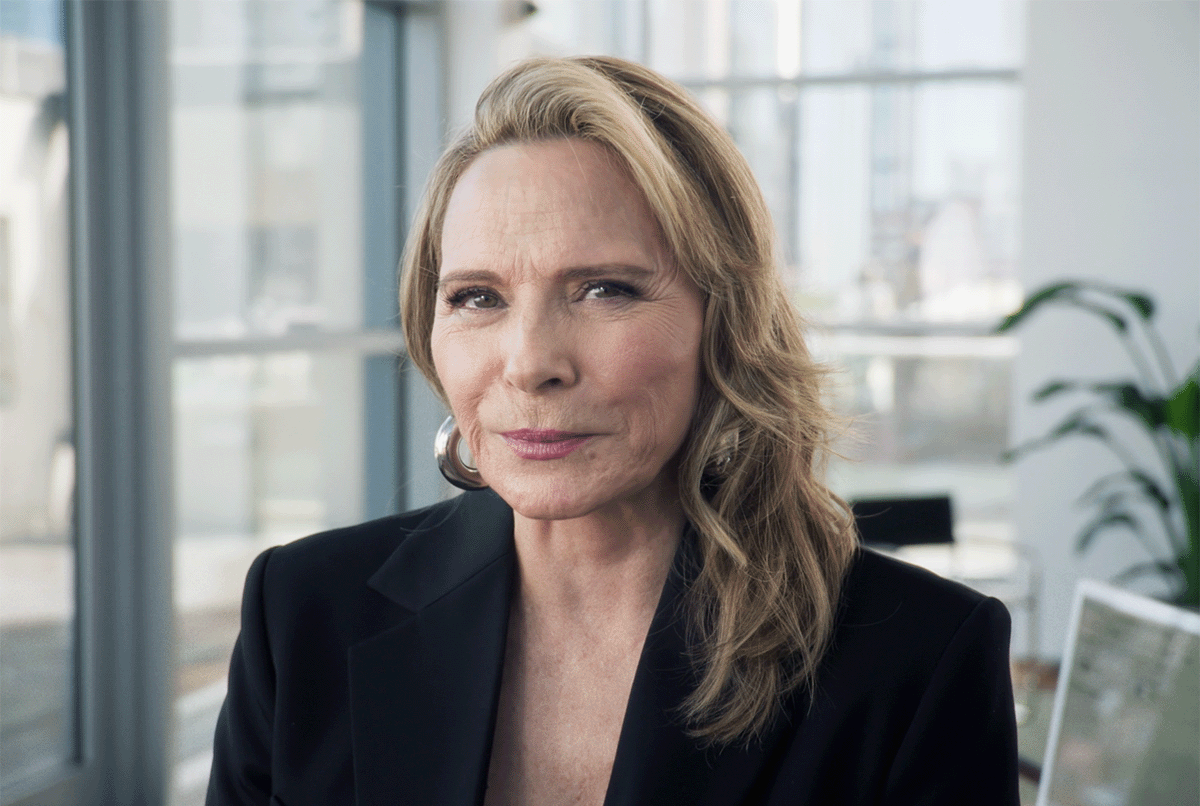
Speaking at the annual Andrew Olle lecture, Alessandra Galloni leads editorial at the world’s largest news agency and believes that AI companies must pay media companies to licence their journalism or one of the most important tenets of democracy faces an existential threat.
“AI companies themselves have acknowledged that original, high-quality journalism is disproportionately valuable for training and grounding their models. OpenAI has said it would be impossible to train AI models without using copyrighted materials in general,” she said.
“In my conversations with tech companies, I have often been struck by how little they understand about what original, first-hand, on the ground journalism is and looks like. And what it takes to produce this coverage.
“There is growing anxiety over how AI will undermine journalism and journalists. The fear is AI companies will continue to expropriate the content we have worked hard to gather and use it to train their models, stripping us of our intellectual property largely without consent or compensation.
“And, as a result, the revenue that should accrue to newsrooms and the audiences we have built are instead going to tech giants – a plunder that will undermine original reporting into the future.
“After two decades of battling the advertising drain of social media platforms and algorithms, the scourge of misinformation, and the slow creep of news avoidance, we now face a new, potentially existential challenge.”
Galloni acknowledged Australia’s hardening position on AI copyright theft.
Recently, Prime Minister Anthony Albanese said that Australia’s creatives sector, including the media, must retain ownership and control of their work.
“No company should use Australian books, music, art or news to build or train AI without the artist’s control,” Albanese said.
‘Our collective responsibility’
Following Galloni’s lecture, the media bosses of News Corp Australia, ABC, Nine and SBS joined a panel defended public interest journalism and called on AI companies to strike deals with new companies.
News Corp Australia already has licensing deals in place with OpenAI and Meta, while Nine recently inked a deal with Microsoft’s Copilot.
SBS managing director Jane Palfreyman said that AI companies should never be allowed to train their LLMs for free on news, while Australasia executive chairman Michel Miller described the practice as “theft” that posed a legitimate risk to their business.
ABC boss Hugh Marks said that Anthropic wants to compensate the public broadcaster to train its Claude AI LLM on decades of radio and TV content, according to a report in The Age.
Galloni’s business has been licensing its content with media companies and others for over 165 years and licences its text based archive to Meta and Microsoft Copilot.
She called on Australian media companies to “share openly what we all are learning every day about how to use AI responsibly in our newsrooms – and what are best practices”.
“I would venture that it is our collective responsibility – to the public, to society – to enhance our and their understanding about the pitfalls and possibilities of AI,” she said.
“Many of the challenges for news organisations in the era of AI are crystallising. There are legal, regulatory and technological challenges. But, for us, this is also a challenge of imagination.
“What will a trusted, sustainable, global news organisation look like in an era of agentic AI?”