



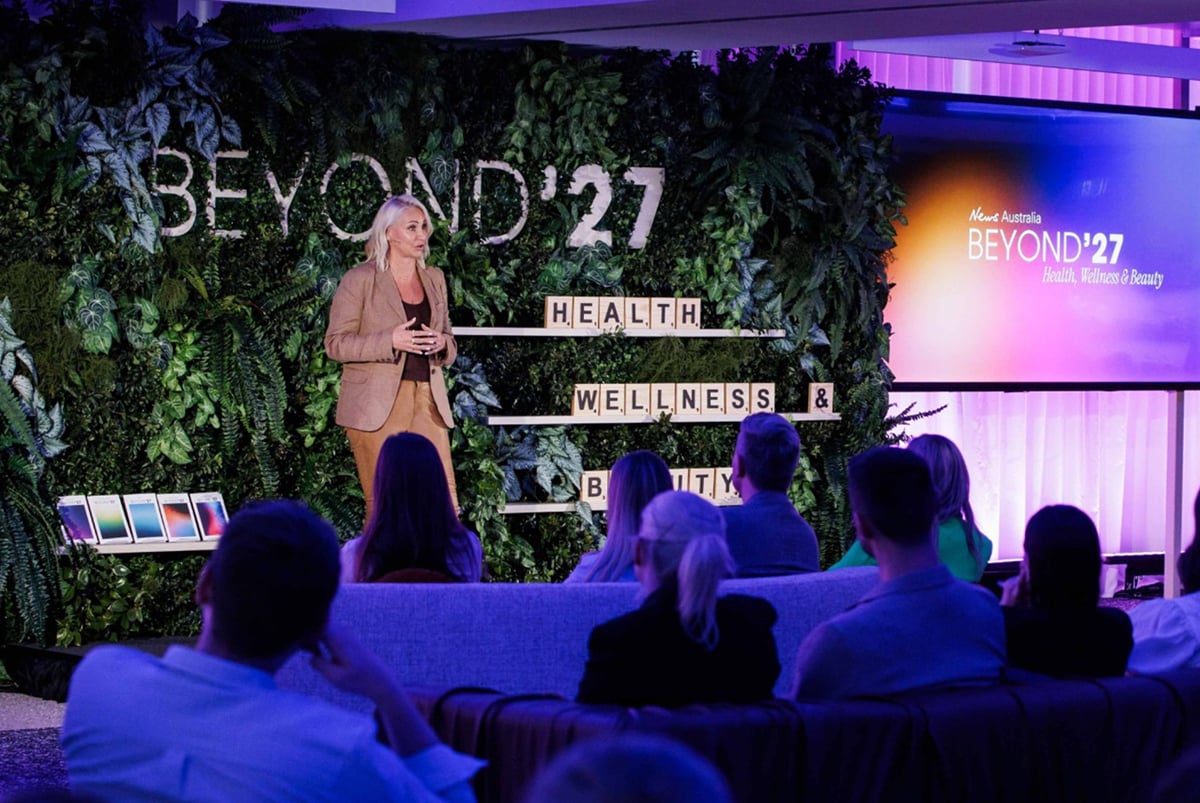
News Australia is doubling down on health and wellbeing, announcing a new slate of initiatives spanning men’s mental health, fatherhood, happiness and wellness — as new research shows Australians are increasingly struggling to know who and what to trust when it comes to their health.
The publisher unveiled the initiatives at its Health, Wellness & Beauty Upfront in Surry Hills on Friday, with research from The Growth Distillery’s Leigh Lavery revealing that 57 per cent of Australians are content to maintain their current health status quo, while 65 per cent say they are looking for new health goals to get themselves to a better place.
However, 59 per cent said there is so much conflicting wellness advice that it is difficult to know what, and who, to trust — rising to 65 per cent among women. It is against that backdrop that News is positioning its health portfolio as a way to combine editorial credibility with audience scale, with the publisher arguing it can use its reach to make Australians engage with issues they might otherwise avoid.
At the centre of the announcements was ‘Better Men’, a new platform focused on fatherhood, mental health and modern family life, which News plans to launch next year.
Better Men will run across news.com.au, Body+Soul and Kidspot, while the wider health slate will also include Health of the Nation, across the same three titles, and The Happiness Project, which will span news.com.au, Body+Soul, Escape.com.au and Taste.com.au.
Health of the Nation 2027 will see News Australia’s annual flagship health survey expand into a video-first platform championing sustainable wellbeing, while The Happiness Project is a campaign solution directly addressing happiness as the primary health goal for Australians. The platform delivers a comprehensive program of editorial content, commercial features and expert advice across mind, movement, food, travel and relationships.
Announcing the new initiatives News Australia chief revenue officer Lou Barrett said consumers are inundated with “more advice, more claims, more creators, more data and more AI-generated answers than they ever have before”.

The Better Men initiative in particular will start off by focusing on the mental health of new fathers, with News aiming to make mental health checks standard for new dads.
She said, however, that influx of information hasn’t made the path forward clearer.
“It’s made it harder to know what’s true, what’s useful, and what’s genuinely worth acting on. And these aren’t low-stakes decisions. They are decisions about how people feel in their own bodies, how they manage their health, how they age, how they build confidence, and whether they feel in control of the life ahead of them,” she told the audience.
Barrett highlighted that in personal moments, Australians are after clarity, credible proof and guidance that makes progress feel possible.
“The brands that grow will not be the ones that simply win more attention. They’ll be the ones that consumers believe first. And that means backing credibility over clutter, replacing hype and short-term transformation with useful support, sustainable progress, and visible proof, and showing up consistently in trusted environments through expert voices and formats that make the next step easier to understand and easier to take,” she said.
‘We cried as the baby was still crying’
News.com.au deputy editor Liz Burke said Better Men comes as new research has identified a “structural opting out” among Australian men,. It’s an issue reflected in literacy rates, high school dropouts, university enrolments and unemployment.
She said nearly half of young men experience psychological distress, while suicide remains the leading cause of death for Australian men.
Yet while new mothers are typically surrounded by healthcare services and proactive check-ins, fathers can be left without the same level of support.
Speaking at the Upfront, Burke drew on her own experience of becoming a parent, describing a night when both she and her husband reached breaking point with their newborn.
“We cried as the baby was still crying, and we held each other, and we took turns holding the baby,” she said.
That following morning, Burke received a call from a maternal child health nurse checking on her wellbeing. Her husband, however, received no equivalent check-in.
“As a new mum, there were so many services and so much support not only available, but proactively being offered. As a new dad, my husband was in the exact same situation, but he didn’t get any of that,” she said.
She said what “drives her” about news.com.au is its ability to “engage people with topics they might otherwise avoid”.
She pointed to previous campaigns including Can We Talk, which focused on mental health, and About Bloody Time, News’ campaign around endometriosis.
About Bloody Time began after News reporter Lexi Cartwright shared her own experience of struggling to receive an endometriosis diagnosis. Burke said Cartwright had taken “five years and almost $50,000 to receive a diagnosis”.
The resulting campaign called for longer, Medicare-funded consultations for endometriosis diagnosis and treatment. News said it secured more than 20,000 petition signatures within 24 hours of launch, with the figure surpassing 50,000 by International Women’s Day.
Twelve weeks after launch, the government then announced a $49 million investment in funding. Talk about a great success.
‘Australians want to see raw, real experiences’
The publisher’s approach resonated with advertisers and agency executives attending the Upfront, with several highlighting the value of brands appearing alongside credible stories as such.
Myer chief customer officer Amanda McVay said the “emotional nature” of the initiatives stood out, particularly when News used real experiences from within its own organisation.
“When I saw the initiatives today from an emotional side, it definitely caught my interest in regards to the emotional connection that it can bring with consumers and issues that perhaps aren’t as easy to talk about,” she told B&T.

“But these types of initiatives allow the safety and security to be able to have those conversations that can be really important.”
McVay said consumers were “increasingly looking for a bridge between content creation and traditional media”, with trusted editorial environments allowing brands to participate in conversations rather than simply sell products.
Myer is also partnering with News’ newly launched Glamour Australia, becoming the title’s exclusive retail and beauty partner.
The partnership will connect Glamour’s digital content and product recommendations with Myer’s physical retail experience, with McVay saying the retailer wants to meet consumers wherever they are spending their time.
“For us, we want to evolve our go-to-market strategy to meet them where consumers are,” she said. “We want to be a part of the conversation”.
News takes on social video — but agencies want more proof
The Upfront also placed a strong focus on short-form social video and News’ efforts to meet audiences in formats they have become accustomed to consuming on platforms such as TikTok and Instagram.
For advertisers, however, the opportunity comes with a question around what News can offer that social platforms and influencers cannot.
EssenceMediacom’s Melbourne GM Jeremy McNamara said the abundance of information available to consumers made trusted environments increasingly valuable.

“What really matters for marketers and advertisers is environments where consumers really trust and have a high belief in the content that they’re reading,” he said.
“The opportunity for advertisers is certainly to be able to lean in and leverage and borrow that credibility from environments like what News has.”
However, McNamara said he wanted to hear more about how News’ social video strategy would differentiate itself from influencers and other social platforms.
“I was naturally thinking about the trust and the credibility which News obviously has, but obviously the boom of the influencer industry as well,” he said.
He said News had an opportunity to combine the credibility of its editorial brands with the formats audiences are already consuming, but added that he wanted more detail around how its editorial talent would operate across platforms such as Meta and TikTok.

Meanwhile, Andrew McDonald, national head of digital at Dentsu, told B&T the Upfront was “thought provoking”.
“Backed by some of the latest data and personal experiences, it highlighted key tensions points around the immense scale of the wellness space and how brands navigate trust and credibility, which is a big issue in the space,” he said.
“There was a big focus on personal and highly emotional experiences. I think all the speakers deserve a big shoutout for their advocacy work and for getting up and telling their stories. It highlighted that when we look at the data, these issues are so much more common that we realise, but often go unknown, not talked about, or misunderstood,” he said.
However, McDonald believes “this is changing”.
“At dentsu, we ran a series called the dentsu diagnosis, which was facilitated by the team at News. We had health professionals come in and present to our teams and this was the first time I really understood the scale and impact of endometriosis. It’s great to see News pushing ahead and going all in on these areas.”
He believes brands are likely to spend in this space for several reasons.
“Trust and credibility were a key theme. We are currently operating in an AI driven world where algorithms influence a large amount of the content we consume. Science backed, trusted sources become critical, especially for anything around health and wellbeing. Despite some decline in trust in news media in Australia, there is a growing sense of consumer cynicism towards AI slop, creators, and misinformation on social media. Brands still see value in the editorial process and rigour that goes into content production.
“The speakers also spoke about the importance of data and how it’s used on a daily basis to drive editorial decisions and content strategy. For brands, it’s essential that the data stacks up and they have a clear purpose and vision of health and wellbeing. Working with trusted partners, that drive credibility, will allow them to show up in ways that benefit both consumers and wider society.”
However, he felt he would’ve liked to know more about “the impact that AI is having on health and wellbeing”.
“As consumers turn to AI for answers and we see AI integrated into our everyday health and wellness apps and devices, how does this further impact credibility of content and how brands show up.”
Specsavers backs the push
Specsavers, which has partnered with News on its initiatives, also highlighted credibility as a key factor in the relationship.
Specsavers marketing executive Samantha Ferreri said the partnership provided an opportunity to connect the brand with trusted content while contributing to conversations around health.
“We’re really excited about what News can do for men’s health as well, because it’s something that’s often ignored and the male population are very important to Specsavers,” she said.

She noted that men can be among those least likely to seek healthcare, making initiatives designed to encourage more open conversations particularly valuable.
“Anything that we can do to help them is very valuable,” she said.
McNamara said News’ previous campaigns, including About Bloody Time, demonstrated how editorial credibility could translate into tangible behavioural and even political change.
“For Specsavers, that’s an opportunity for us to borrow and buy into that credibility,” he said.
‘You don’t have to be the tough guy’
For Myer Group general manager of retail media Michael Sharlassian, Better Men “struck a chord”.
As a father of two, Sharlassian said the initiative reflected the difficulty many men have in being vulnerable and openly discussing their mental health.

“Australians want to see raw, real experiences. They don’t want to hear claims,” he said. “Authenticity is really important. I think, for me, the one about men really struck a chord.”
Sharlassian said he had also experienced the impact of suicide personally, having lost a close friend who had struggled with his mental health.
“If we had known, and us boys got around him, but if we had known more what was going on, and he was more vulnerable with us, we could have done something more,” he said.
He said men could often feel pressure to remain strong and act as protectors, making it difficult to acknowledge when they were struggling.
“We don’t like being vulnerable,” he said. “We just got to talk about it. You don’t have to be the tough guy.”
Sharlassian said he wanted to model a different approach to vulnerability for his own children.
“I don’t want them to be like, ‘Dad doesn’t cry, Dad’s not vulnerable’, and this initiative is super important,” he said.
He described a ritual with his daughter which he calls “salon” where the pair sit down together while he does her hair.
“The reason I bring that up is because for me it’s our intimate time together that we can talk and be really open,” he said.
For his son, he said, demonstrating sensitivity and affection was equally important.
“It’s like how can I do it differently so my boy grows up to be the best possible man he can be,” he said.
Sharlassian said the conversation also had implications for workplaces, where leaders could play a role in creating safe spaces for men to discuss what was happening beneath the surface.
“I always talk to my team about the iceberg. You only see a small element on the surface, only the tip, but then what’s happening underneath?” he said.
“In the past it’s been very focused from a female perspective, but you’ve got to have those same conversations with the males and allow them that safe space to be able to talk to you, too.”


