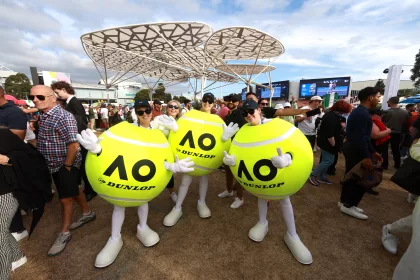

In this exclusive op-ed, WBD’s senior director, marketing Sasha Mackie discusses experiential marketing and measurement and shares her thoughts on the way Return on Investment ROI should be looked at and how “being remembered” is something to be prioritised.
Whenever we create an experiential stunt, the question inevitably comes up: how do you measure it? I think the problem is less about whether it can be measured, and more about whether we’re measuring the right things.
A year after successfully launching HBO Max in Australia, we have one response and it’s simple. It’s one of the best ways to keep your funnel honest.
I’m a big believer in marketing that lifts beyond the billboard and beyond the screen so fans can truly immerse, celebrate and share their experience.
The mission statement for my own marketing team is, “we create for the fans because we’re fans too” and this has become a true reflection on behaviour and impact.
Sharing, online and in real life, builds communities and creates memories. And memory is the part most marketers rush past, when really it should be the whole game. No, it doesn’t show up like a CPA from a Meta ad driving a click, but that doesn’t make it any less valuable.
We are living through the most performance-obsessed era marketing has ever seen. Every dollar invested needs to deliver, and in this climate, the first thing to die, sadly, is the activation.
That’s why I’ve given this so much thought, because I think as a profession we’ve been answering that question lazily and it’s really cost us, so here’s my very honest response.
Since launching HBO Max in Australia, we’ve really invested in our biggest tentpoles to celebrate the series / iconic franchises and the fans who love them. They’ve been able to physically step inside the worlds they’re obsessed with including, House of the Dragon. IT: Welcome to Derry, Euphoria, And Just Like That and soon – Harry Potter and the Philosopher’s Stone.
Each of these titles had media spend to drive awareness and acquisition, but the media plan was never the whole strategy. The strategy was always rooted in the belief that face-to-face engagement builds mental availability and shifts behaviour in a way a pre-roll never will.
When House of the Dragon returned for Season 3, we turned Sydney’s tunnels under Wynard into a fiery realm and let the city answer the call of the dragon. People didn’t see an ad for the show. They could see, hear, feel and know what it was like to stand inside the Dragon’s Lair, hold a dragon egg and sit on that famous throne.
So, to me, that’s where the ROI conversation should start because a live experience is not one metric, it’s a ladder.
We run every activation against four clear points:
- See – Someone can walk past it. That’s pure reach with the same currency OOH buys, except this is three-dimensional, so you can smell it, touch it and feel like you’re a part of it on your daily commute.
- Stop – People want to see more, to pull out a phone, to engage, to take a photo, to speak to a real person (in this case a guard in front of Dragons Lair), and they engage.
- Stay – They step inside and spend real minutes of their life (not just “average view time,” minutes) inside a world we built. Their time is attention, and attention is the only thing we’re actually buying. The average time for people visiting Dragons Lair was 30 minutes, which is an incredible metric when they’re making memories. In a tunnel that breathed fire, we built an emotional imprint, a skippable ad does not.
- Share – Then social and word of mouth do their thing. The photo or reel goes up, and algorithms care about content merit and relevance rather than simple follower counts. This is the fire. The reach compounds, for free, and crucially it compounds with credibility, because it’s coming from a human and someone just like you. So when someone tells me experiential can’t be measured, my honest reaction is that you’re not measuring it right.
See, Stop, Stay, Share isn’t a warm-and-fuzzy story we tell after the fact.
It’s a funnel.
It has stages, it has drop-off, and every rung has a number attached to it.
The stunt isn’t the opposite of performance marketing. The stunt is the fuel that makes your performance marketing cheaper. When the memory is already there, brand love and connection begins and the biggest driver of intent to purchase is brand love.
HBO Max was the fastest growing streaming service to launch in Australia, so we knew that marketing that lifts beyond the screen was not the ‘soft’ option.
Executed with discipline, grounded in brand and innovation and clearly measured it was the hardest-working money we spent. The best work gets shared, and then remembered.
And to be remembered is the only ROI that keeps paying long after the campaign is over!