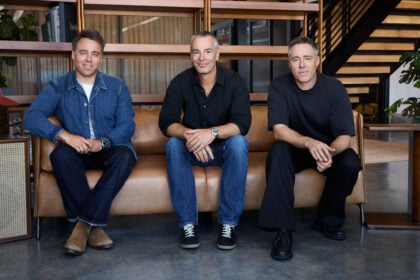
Ask Emma Lamb and Leigh Aramberri, the founders of Mischief and Wonder, what makes a TV show a hit and they won’t give you a straight answer. Not because they don’t know, but because they don’t think anyone does anymore.
The reality production duo — behind Turned On: Dirty Sexy Money, I’m a Celebrity… Get Me Out of Here! and more — pointed to Married at First Sight as an example.
It’s arguably one of the most commercially successful formats in Australian television — spawning US and UK versions off the back of it — and yet it has never won a single industry award.
“No one wants Married at First Sight to be given that award because of what it means for our viewing habits,” Lamb said.
It’s a sign of how reluctant the industry is to credit reality TV’s commercial success. The genre remains, as Lamb put it, “everyone’s dirty secret”.
The bigger issue, they argued, is that the metrics buyers and broadcasters actually care about have splintered. It’s no longer just about overnight ratings. Now it might be whether a show holds viewers past episode three, whether it pulls new subscribers into a streaming platform, whether it shifts the demographic of who’s signing up, or simply how much press coverage it generates.
None of those things resolve on the same timeline. A show can look like a failure in week one and a slow-building success a year later.
Their view is blunt: the industry probably won’t have settled on the metrics it’s using right now for the better part of a decade. Ultimately, they said, what counts as “success” comes down to the individual broadcaster or streamer and what they’re optimising for.
That same instinct showed up again when the conversation turned to the Stan Original reality docudrama, Turned On: Dirty Sexy Money. It’s a series following creators on adult content platforms and the kind of premise plenty of executives would have politely passed on.
But Aramberri and Lamb insist that risk for risk’s sake is a dead end creatively; audiences see through it and don’t stick around.
What actually earns attention, in their view, is when a “risky” premise turns out to be a door into something more layered than expected. The difference, as they put it, is between drawing an audience in with noise and actually keeping them there because they’re discovering something.
Part of that meant reframing who the women at the centre of the show actually were.
“It’s always been treated as someone’s secret. We treated it as their job,” said Lamb.
A distinction that shaped how the series was pitched, filmed and edited. That thinking is also what got the show commissioned in the first place, and here’s where the metrics conversation and the risk conversation quietly converge.
Aramberri and Lamb had already tested the concept in the UK and watched buyers there pass, wary of straying into territory that felt “dark and grey”.
Stan took it on in Australia instead.
The pitch worked because of how it was framed, not because Australian buyers are inherently bolder. Setting the series on the sunny Gold Coast, rather than leaning into the shadowy documentary treatment the subject usually gets, changed how the risk read to a buyer evaluating it.
“It’s less about which place will take risk and more about how you package that risk up and present it to the buyer,” Aramberri said.
None of that packaging works without a network willing to let go once cameras start rolling.
“The one thing you’d fight for isn’t the creative, it’s the autonomy to make decisions in the moment,” Aramberri added.
That same tug-of-war between handing over control and trusting the framing to land is part of why the old ways of judging a show’s success no longer hold up.
It’s a pointed observation for anyone on the buying or selling side of programming right now.
If the metrics for judging a show’s performance are genuinely this unsettled, and likely to stay that way for years, then how a project is framed at the pitch stage matters more than ever.
A “risky” idea and a “smart” idea can be the exact same show with the only difference being how it is framed before any episodes air.
For marketers and media buyers navigating an industry that doesn’t always agreed on what winning looks like, that’s arguably the more useful skill to watch for in a production partner than any award on a shelf.