
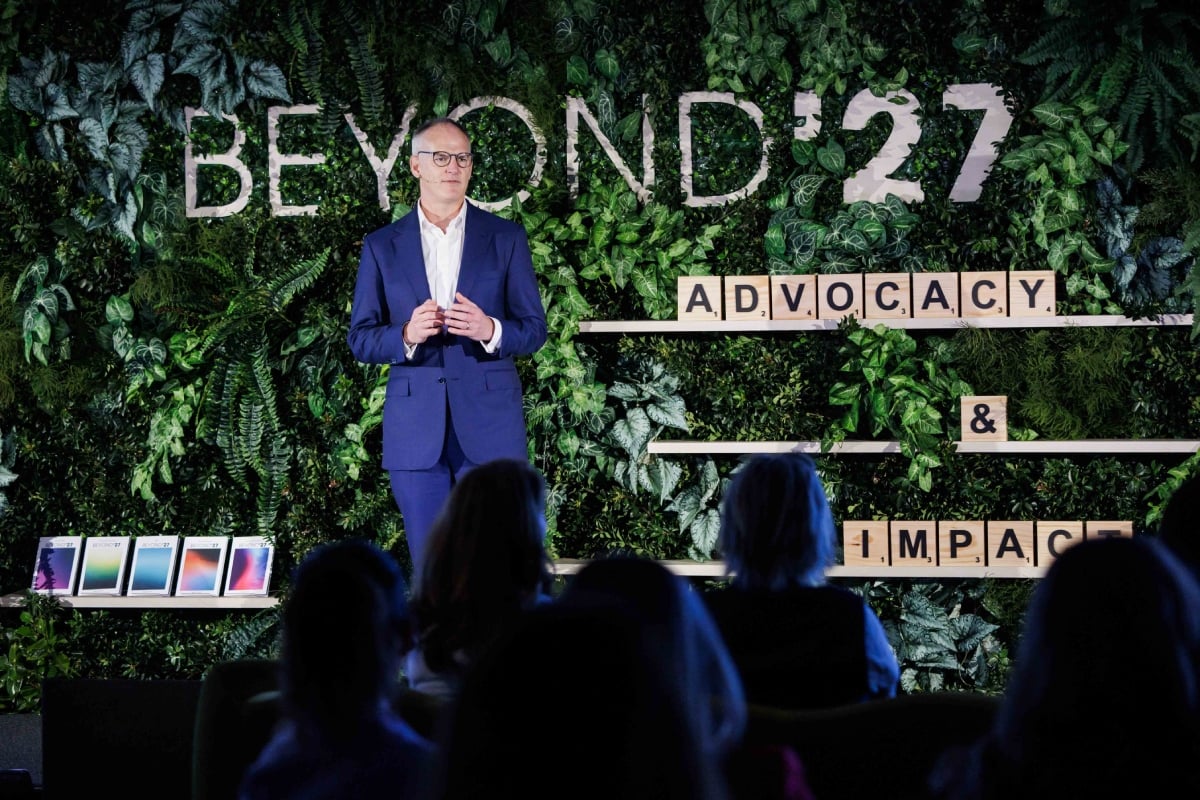
News Australia has unveiled a new national advocacy program, appointing four dedicated ‘Impact Editors’ and revealed a slate of new advocacy brands for brands and corporates to partner with at its first ‘Beyond’ upfront event in Sydney.
The new advocacy slate spans three core themes Better for Our Nation, Better for Our Communities and Better for Our Families. These, News said, creates a structured framework for brands to align with major editorial initiatives.
Under Better for Our Families, News is launching Let Kids featuring three dedicated campaigns. ‘Let Kids Play’ advocates for children’s right to active, healthy lives; ‘Let Kids Thrive’ focuses on improving mental health and ‘Let Kids Save’ builds financial literacy for the next generation.
News is also continuing its Let Them Be Kids advocacy program, which spawned these three sub-brands. Back Australia is returning for another year, as chief revenue officer, Lou Barrett told the crowd yesterday afternoon. Category-exclusive partnerships for both are available now.
Sarah Blake will lead the advocacy work across state and regional mastheads including The Daily Telegraph, Herald Sun, The Courier-Mail and The Advertiser. Lillian Saleh will co-ordinate national coverage across News’ free mastheads and lifestyle titles including Body+Soul, Escape and Taste.com.au. Liz Burke will lead at news.com.au and Danielle Long will drive advocacy across The Australian and Prestige brands, as well as her continuing role as editor of The Growth Agenda.
This new approach to the market is much more than a way to create long-running paid media campaigns, News said.
“Reputation is your proxy for trust”
On the line is not just the future of journalism but, to a large extent, the future of Australia. And brands’ reputations, which face a wider variety of threats than ever.
“I’ve worked in media for more than three decades, but my understanding of advocacy came much earlier,” Michael Miller, News Corp Australasia’s executive chairman told the crowd.
“Growing up in the upper Hunter, I watched my mother serve on an advisory group that that ensured mining companies contributed to the local community. They pushed for trees to be replanted and waterways protected. They secured scholarships, support for school bands and funding for local sports. What stayed with me was that grassroots engagement wasn’t simply about pointing out what was wrong. It was about pushing for something better. When people saw mining companies give back, trust and support followed.”
This experience, Miller said, has stayed with him throughout his career and when he was fronting Senate committees and the like, it reinforced that “reputation is built long before you need it”.
He added that News Australia has plenty of heritage in the space, pointing to previous campaigns such as ‘Fair Go For the West’, the Bush Summit and the aforementioned ‘Let Them Be Kids’.
“Our journalism brings important issues into the national conversation and keeps them there until something changes,” Miller continued, with News executives referencing the long-running campaign to build an airport in Western Sydney.
“We don’t just shine a light on issues; we bring communities, decision makers, and companies together around solutions. For businesses, that creates an opportunity to become part of a solution of genuine public value. When a brand’s purpose aligns with an issue Australians care about. Advocacy creates more than just attention. It creates relevance. It strengthens reputation, and it creates a trusted relationship,” Miller added.
This trusted relationship has always been important. But as Leigh Lavery, the general manager of The Growth Distillery said, it is becoming more important in the AI, digital world.

“Reputation is your proxy for trust,” he declared.
“When people can no longer easily verify what they’re being told, they fall back on reputation as the shortcut.”
Lavery quoted a number of stats from The Growth Distillery’s own research to support the argument. Eight in 10 Australians are tired of brands claiming to be trustworthy; seven 10 agree that institutions — such as governments, corporations, religious organisations — always put their own interests first. Nearly three-quarters say they are more cautious about trusting brands than they used to be. Three-fifths are concerned about online safety, privacy and scams.
Think Beyond the Bottom Line
It’s in this environment, the thinking goes, that brands showing Aussies they care or have their best interests at heart, rather than simply telling (remember all those trite ads from brands during Covid?) will reap the benefits.
“Take a moment to consider the dilemma that creates for business leaders: speak and you’re not believed, stay quiet and you’re assumed guilty,” said Lavery.
“Our answer to both is reputation. When times are good, reputation takes share. When they’re not, it protects it. It has become both your growth engine and your defence system… There is inevitably a storm of some type coming for all of our businesses, and silence loses… AI will scale misinformation faster than a neglected reputation can recover. It doesn’t matter if you’re a bank, a supermarket, airline, or even a football club. Silence is not neutral. If you are silent, the vacuum simply gets filled by misinformation and suspicious signals.”
Lavery added, pointing to IPA data on well-executed purpose-driven campaigns, that this kind of work deliver higher returns for brands, too. Adding that Suncorp’s ‘Resilience’ platform, starting with ‘One House to Save Many’ and evolving into the Titanium Lion-winning ‘Haven’ platform was a prime example of a brand showing, rather than simply telling, consumers it cared about climate change and that it could help them.
NRMA Insurance’s work with News Corp’s Queensland titles on the ‘Help Our Highway’ campaign was also referenced as a great way for brands to put themselves into a position of advocacy, but also achieving brand goals — NRMA Insurance had a problem with salience in Queensland, with many assuming it was a New South Wales-only business. Former marketing chief Michelle Klein, now at Westpac, would take the stage later to talk about its success with News’ Chris Jones.

“This is What’s on Normal People’s Minds”
That’s the theory and the pitch. But will this really move the dial for brands? And, more importantly, move their media or corporate advocacy budgets into these campaigns?
“It was an excellent presentation. It did a great job of highlighting the role that organisations like News Corp have, and have always had to some degree, in shaping public issues and public debate and the making sure that advertisers and communicators think about that as part of their campaigning and overall communication,” Damian Damjanovski, director of strategic comms, government relations and corporate affairs agency General Strategic told B&T after the show.

“It’s not all about selling your wares. A lot of it is to do with public issues that affect every Australian… Advocacy in this day and age has moved from what it used to be, which is how to fatten the pig on market day, to advocacy as an always-on proposition.”
For Chris Colter, managing director of Accenture Song Media, the benefits for brands are clear — something he had seen first-hand with NRMA Insurance in his previous life at media agency Initiative. He also confirmed that NRMA Insurance had seen significant improvement on a number of important metrics as a result of the campaign.
“They deliver on so many variables like brand trust and reputation [but] it provides an avenue for brands to deliver action through media, which I think is really important,” he told B&T.

“A lot of brands want to take on big, systemic challenges but they don’t necessarily have all of the tools at their disposal to do so. So borrowing the clout and influence that News has and adding the unique insight that a brand might have — like NRMA for example being able to share road safety data to actively help in that cause — means that you’re not just driving a consideration uplift but you’re driving billions of dollars worth of infrastructure or changing government policy. That’s the value of advocacy campaigns — it creates marketing that is generationally impactful,” added Colter.
Damjanovski (a former B&T 30 Under 30 Awards winner), his colleague head of operations Julianna Burgess and Colter all said that they could see and would be interested in taking brands aboard some of News’ advocacy campaigns.
“The success of Let Them Be Kids is something that News is naturally going to trade off. I won’t lie, I sent a couple of text messages during the presentation [to clients about the campaigns], so in short yes, absolutely. You’d be crazy if you’re an Australian common household brand not to get involved in these campaigns because they affect the majority of Australian households,” Damjanovski said.
“This is what’s on normal people’s minds. No one is wondering whether this insurer is better for them or not. They’re thinking about their kids, their day-to-day lives and mental health. Of course you’d want to attach to these campaigns.”
“It’s similar to the Bush Summit. That’s such an incredible way in which regional voices can have a forum. I don’t think they really have had much of a chance to do so outside of traditional pathways in the past,” said Burgess.

“I think the more that important brands like News Corp can keep doing that, the better everyone will be.”
However, the trio did note that there were some things that News left unsaid.
“They talked about the framework and sort of measurement program that sits around it. I wanted some more information from that — how does it come to life? How do brands get into this? What are the rules, best practices? So hopefully there’s a follow-up to educate the market on how to best play in this space,” said Colter.
“I’d be curious to know more about how they select which causes to advocate for, whether that would be more of a client- or corporate-initiated process and the process works with advocacy and industry groups,” added Burgess.
But you should always leave the reader wanting more. Something News should know better than most.