
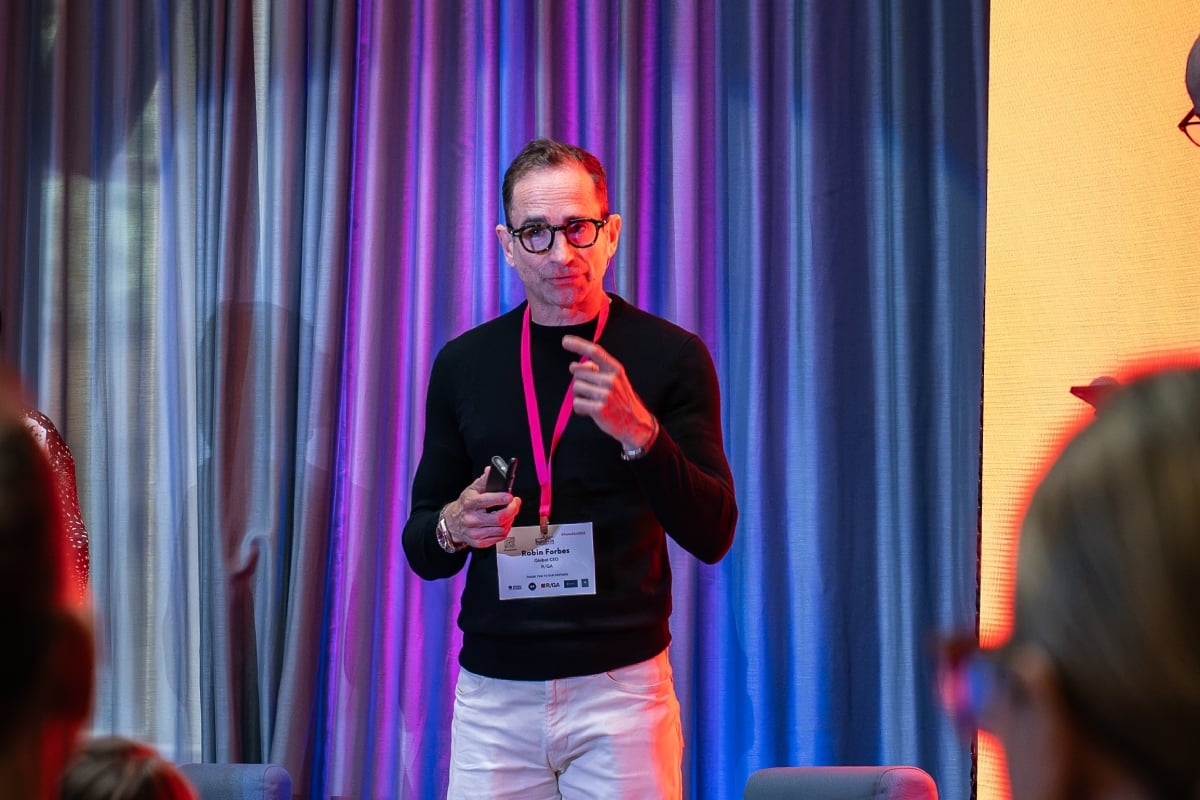
Who would be an agency CEO? The sands, which have never truly been stable, appear to be shifting under their feet more violently than ever due to consolidation, in-housing and, increasingly, AI. But Robin Forbes, CEO of R/GA told B&T exclusively following a keynote presentation at the humAIn conference in Sydney, that it is in a better spot than ever to survive and thrive in the coming years.
That confidence, in large part, comes from its release from the holding company world.
R/GA had been part of IPG. In March last year, after 23 years, it returned to private ownership as part of a deal between the agency’s mangement and private equity firm Truelink Capital. IPG, of course, would itself be acquired by Omnicom as part of the industry’s most seismic mega-merger in late 2025.
It also comes from R/GA’s cross-functional abilities. While operating under the holding company model, the agency, Forbes conceded, had sometimes struggled to fit within the traditional creative/media/production swim lanes created to pigeonhole agencies and client work.
Released, in his mind, from that myopic way of working, R/GA is ready to generate top-line growth for clients in very modern and rapidly evolving ways.
“It’s been a 180-degree change and I could quite honestly say, always for the better,” Forbes told B&T about the acquisition.
“Suddenly, all the ways of working and the past policies, expectations and so forth disappeared. It was all about charting our own course moving forwards and charting what’s ahead. It’s given us autonomy to think about what we want to be in three years from now as we contend with probably the biggest technology shift in this of R/GA.
“We no longer have to conform to the quarterly reporting cycle which, in my view, drives a lot of short-term decision-making and compromises. We can think three years ahead instead of three quarters ahead. We can invest in the kinds of things that we think are going to be necessary to create new value for our clients and help us grow as a business. That can be new kinds of talent, investments in R&D, software development and acquisitions. We were very constrained in the old days.”
Since it returned to private ownership, R/GA has started to take some chunkier swings. Last year, for instance, it created a dedicated global AI products team that would work to create actual, sellable AI products that could move the agency away from the billable hours model.
Find out more: R/GA’s Ben Cooper & Michael Titshall Plot Business Model Transformation With New AI Products Team
It also acquired Addition, an AI system design and development studio which worked with the likes of Google, Unilever, Prudential and Amazon.
“All the holding companies are consolidating and centralising a lot of capability. That meant we were further restricted in what we could offer, the geographies we could be in. All of those things restricted us from growing,” Forbes said.
“It was interesting during the sales process… when we had discussions with suitors about what it was like to operate inside the holding company model, the folks that didn’t know the sector were shocked. They asked us what the value creation model was and I said, ‘You seen in the performance of some of the holding companies that there isn’t a value creation model, or it’s been broken.'”
That conversation about the value creation model has been amplified as AI has started to take hold of the creative industries.
During his keynote at humAIn, Forbes said that while “all signs” point to AI becoming the third party in a consumer’s relationship with a brand, discussions focus far too heavily on efficiency rather than opportunity.

“Most of the language about AI systems and brands are focused on reducing costs, speed to market and scaling delivery, scaling production… I believe if bottom-line gains and the use of AI for efficiency is your sole strategy, that is a strategy with diminishing returns. As most business leaders know, the real mission is top-line growth,” Forbes told the crowd.
This approach in driving top-line growth, not reducing cost of production in aggregate, is borne out in R/GA’s BRDNA (pronounced Brand DNA) strategy.
“Our view, our commitment, as we work with these tools is that we can’t just scale your brand. We have to scale what makes your brand different and valuable,” added Marie Conley, R/GA’s executive strategy director for APAC.
“It’s going back to the core elements of your brand and codifying what makes your brand unique so that those elements, those elemental components are brand writeable and brand readable, so systems can interpret them and deliver new experiences.”
This approach, Conley said, has been put to use for a variety of clients, from Google’s Android operating system to AI infrastructure company G42 and WA-based gym brand Zoo Fit.
“The real acceleration of the AI transformation that coincided with our independence have driven significant change for our business and growth,” Forbes told B&T.
“There are a lot of clients trying to contend with how to maximise the opportunity with this technology. They look to an agency like R/GA. We’ve always been hard to categorise by design, even within the holding company. I think that’s why we didn’t necessarily fit within the holding company. They have these verticals: advertising, media, production. We work across those functions and that’s in fact where we provide a lot of value for clients.”
That said, Forbes said that discussion of AI in creative or UX/UI work can overshadow discussion of the work’s efficacy. In other words, the means has become more important than the end. It also means that its approach works across categories and industry sector.
“What really matters is whether you have a product that is differentiated. Does it solve a problem? Does it fill a gap in the market? Does it have a unique value proposition? And then have you built the right positioning, identity, communications and so forth?” Forbes said.
“That’s still core to what we do and, for us, our approach with BRDNA starts there. It starts with brand strategy.”
“We work with big pharma — hugely regulated. We work with finance, again highly regulated. Here in Australia, we work with Toyota,” Conley told B&T.
“In a way, LLMs are better with highly regulated [categories].”
Forbes added that a client’s openness to or adoption rate of AI is not an inhibitor to working with R/GA.
“We have amazing clients who, for one reason or another, might be earlier on the adoption curve. The fundamental thing we do is brand strategy, brand design, experience, production and experience design for websites and application and communication. More of that is becoming AI-enabled in terms of how we produce the work or is resulting in the deliverables,” he said.
From talking to Forbes, who was shortly jetting off to visit the R/GA Melbourne office, it seems there is plenty on the table for the agency.
Perhaps it may become the defining digital agency of the late 2020s, as it was, in many ways, the late noughties.