



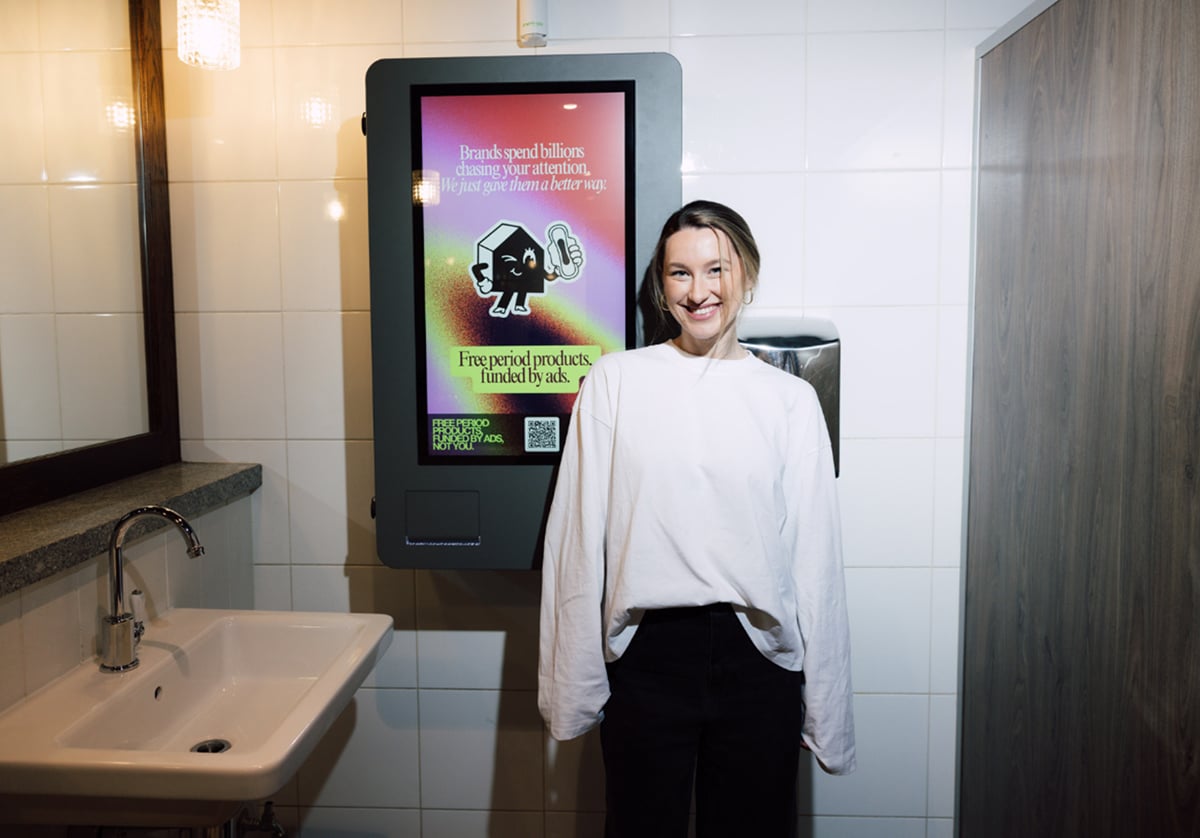
Australian startup ON THE HOUSE has raised $5.5 million in Series A funding as it looks to expand its network of digital advertising screens in women’s bathrooms from 55 to more than 500 nationally in 2027.
The funding round values the business at $20.5 million post-money and will support the rollout of more than 500 new machines across Australia, ahead of changes to the National Construction Code that will make sanitary product dispensers mandatory in new commercial and public buildings.
Founded by Remy Tucker, ON THE HOUSE operates a network of wall-mounted dispensers that provide free period products to women in public venues, with advertising from brands funding the service.
Each dispenser features a 32-inch HD digital screen, giving advertisers access to audiences in high-traffic venues while removing the cost of providing the products for venue operators.
The company said 89 per cent of advertisers from its 2026 launch campaigns have rebooked, with brands including Afterpay, ahm, the Queensland Government, Salomon, Forty Winks, Pillow Talk, Frontier Touring and Hnry returning to the network.
The Series A comes as the business looks to capitalise on growing demand for the service and an upcoming regulatory shift. Victoria adopted the 2025 National Construction Code in May, with NSW, Queensland, South Australia, Tasmania, Western Australia and the ACT set to follow on 1 May 2027.
ON THE HOUSE plans to have more than 500 machines operating nationally in 2027, with international expansion scheduled to begin in 2028. Its longer-term ambition is to reach 20,000 machines worldwide.
The network currently operates across Brisbane, Sydney, Melbourne and the Gold Coast, with screens installed at major venues including Cbus Super Stadium, The Gabba, Suncorp Stadium, Nissan Arena and Topgolf Gold Coast.
The company is also pointing to early advertiser results as evidence of the channel’s effectiveness. Its internal post-dispense survey of 2,930 women found 93 per cent were more likely to buy from an advertiser after interacting with a dispenser, while the same proportion said they trusted the brand more.
Afterpay also recorded 61 per cent campaign recall four weeks after its campaign ended, according to a separate campaign survey.
“Brands aren’t sponsoring us. They’re buying a media channel that works,” said Tucker. “Women give a brand their full attention in that moment, and they remember who paid for the product in their hand.”
Afterpay’s head of brand, Mikaela Wagner, said the model gave brands an opportunity to connect with consumers while supporting access to essential products.
“ON THE HOUSE earns attention by being useful in the moments that matter,” she said.


