Having spent years 16 years helping bring Cirque du Soleil productions to life, Welby Altidor believes creativity has far more to do with how people work together than what they produce.
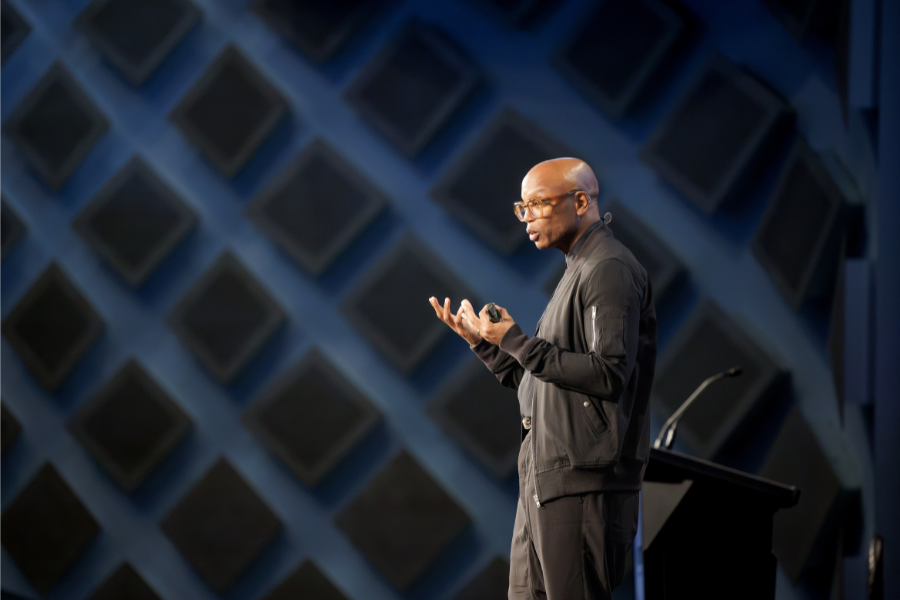
Backstage at the WOBI World Business Forum, Altidor told B&T that businesses need to rethink their relationship with creativity, particularly as artificial intelligence changes the way ideas are developed and executed.
“Creativity is about finding solutions to problems where there is no manual guides and no ready-made solution already out there,” Altidor said.
“Creativity is really a dance with the unknown.”
It is a perspective shaped by his time at Cirque du Soleil, where creativity was the foundation of the entire operation.
However, even when staging the same production hundreds of times a year, Altidor said the challenge was not keeping the show itself fresh. It was keeping the people bringing it to life creatively engaged.
For Altidor, that meant creating the right conditions for performers to continually renew themselves, both on and off stage. It also meant reminding them that, regardless of how many times they had performed a production, the audience watching could be experiencing it for the first time.
The lesson for brands attempting to sustain creative output is that the work cannot be separated from the people responsible for making it.
During his WOBI presentation, Altidor argued that leaders should focus on creating environments where people’s abilities can develop rather than trying to force results.
Having worked with acrobats who regularly put their lives at risk, Altidor said he had seen firsthand how psychological safety could enable people to push boundaries and take creative risks.

He also shared his views on how AI will impact creativity.
“AI is a material, one that’s much more complex than say working with stones or wood. But nonetheless, it’s a material that can be shaped, interacted with, and essentially the randomness or the unexpectedness of human beings makes it that I think it’s going to be a very interesting duo,” he said.
Altidor acknowledged the ethical ambiguity surrounding AI, but stood firm in the idea that it presents opportunities for new forms of creative collaboration.
The challenge is ensuring technology does not become a substitute for the thinking.
Altidor believes the difference between an experience that simply entertains and one that genuinely moves people comes down to three elements: purpose, emotion and motion.
While spectacle, special effects and the latest technology can capture attention, he argued that meaningful experiences need a deeper reason to exist.
“When you focus just on emotion, the latest trick, AI, and so on. You unfortunately get something a bit closer to AI slop,” he said.
He described the tension between delivering ambitious outcomes and ensuring the process does not become destructive, pointing to the importance of care, safety and trust in creative teams.
Altidor’s broader message is that creativity is not an exclusive artistic skill reserved for those working in design, advertising or marketing. It is a fundamental human capability, and one that becomes particularly valuable when there is no established solution to a problem.
“The truth is we’re all born with creativity,” he said. “If we didn’t have that creativity, we wouldn’t be here.”