
Thanks to the rapid evolvements in AI, the marketing funnel is getting “flatter”.
What once looked like a long journey from awareness, consideration and comparison, through to conversion is increasingly being squeezed into a single AI conversation.
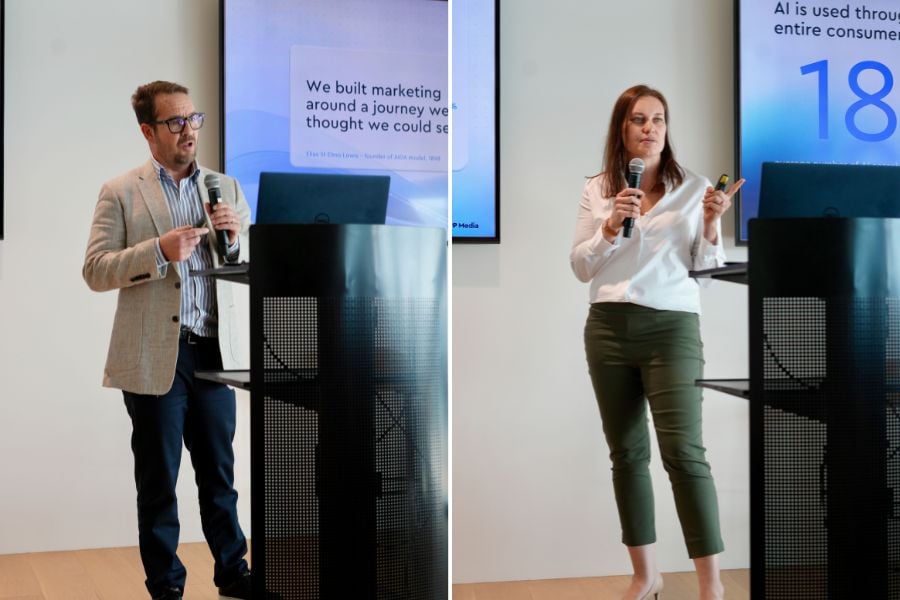
“The purchase funnel is becoming shorter. It’s potentially becoming more competitive, and AI is having an influence on it in high consideration categories,” WPP Media’s Daniel Benton, managing director of digital solutions told B&T.

Consumers can discover a category, ask which brands they should consider, compare their options, interrogate whether they can trust them and narrow down a shortlist, all without leaving the same conversation.
Speaking to B&T, Catherine Wolkers, national head of research and insight, WPP Media said, “In the high consideration, high emotion categories that’s where it’s having the biggest disruption across the funnel. It’s really flattening the funnel because you can do everything from brand discovery to comparisons to create a shortlist [of brands to buy]… You can do it all within a single source now, and incredibly quickly.”
With the entire journey compressed into a single interaction, consumers are reaching decisions faster than ever.
Some 91 per cent of consumers 2,500 Australian consumers surveyed by WPP Media said that AI accelerated their decision-making process. Half said that the time they take to make purchase decisions has as much as halved thanks to AI.
The marketing funnel framework was first developed in the 1890s.
Over decades, this framework evolved to best reflect observable consumer behaviour. This included digital marketing, identifying what people search for, clicked on and which sites they visited.
While the pathway was never perfectly linear, enough of it was visible to plan against, optimise and measure. Now, the most influential part of that pathway is happening somewhere marketers can’t see. The pathway has moved somewhere conventional reporting can’t follow, and it has quickly become one of marketing’s biggest blind spots.

The marketing being flattened can be attributed to the rapid rise in AI.
ChatGPT was the first large language model (LLM) to be publicly available in November 30, 2022. Since then the usage of AI search has ballooned. Even so, Telsyte Australia revealed that 17.4 million Australians (77 per cent of the 16 plus population) used AI in the 12 months leading to June.
For the 17.4 million users, ChatGPT is the AI model of choice with 13.8 million Aussies turning to its servers, followed by Google Gemini (9.1 million), Meta AI (5.6 million) and Microsoft Copilot (5.4 million).
But, not only is the marketing funnel being flattened, but categories are becoming more competitive.
“One of Catherine’s brilliant now takes from the research was it’s actually introducing options that you wouldn’t have even considered,” added Benton.
On average, 61 per cent of buyers are discovering new brands they had not thought to consider, with 38 per cent learning about them at the very start of the decision-journey.
Fear not, because Benton and Wolkers has some tips for brands to help them stand out in LLM chats.

“Marketers need to understand the importance for their category, understand the sources that shape understanding for their category, and actually invest in it appropriately. And we’re not saying that this is a singular top priority for all categories because for some low consideration categories, it’s probably going to be around the edge. It’s not going to be influential. But, brands need to resource it appropriately and treat it as a channel,” said Benton.
Most web-enabled LLMs draw from a similar set of source types, even if they weigh them differently. The main categories look like: news sites, and other journalistic coverage; content about you on other companies’ sites; your own content; press releases on newswires or your site; official or research-heavy; Wikipedia, reference sites; and Reddit, forums, social posts.
Reddit is a massive one for showing up in Gemini and OpenAI. This is because the social media platform signed a $60 million annual content licensing deal with Google and a similar deal with OpenAI worth around $70 million annually that gave them privileged API access to Reddit’s content.
Wokers doubled down on Benton’s point by explaining that brands need to be “making sure that they’re showing up in as many contextually relevant scenarios as possible”.