



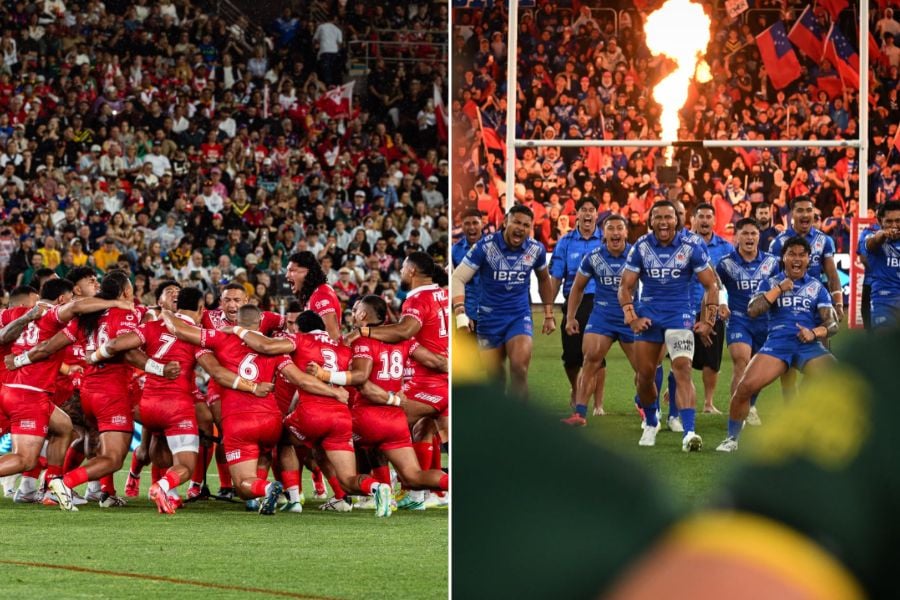
The Rugby League World Cup has taken Australia by storm, so much so that even the most die-hard NRL pundits have been surprised by the audience numbers. Seven, however, wasn’t among them.
While some may have considered the tournament a “punt”, the broadcaster “backed it in”, expecting the rise of the Pacific nations to help drive audiences.
B&T sat down with Chris Jones, Seven’s director of network sport ahead of the World Cup’s blockbuster grand final on Sunday night, to discuss the tournament’s outstanding metrics.
“This [the Rugby League World Cup] has been a a raging success on all metrics for us,” Jones told B&T.

All eyes have been on Seven since 15 October. From the very first whistle, which was to signal the kick-off between Australia and New Zealand, audiences have been coming to the broadcaster in droves.
The blockbuster opening fixture reached 3.3 million people and had a total TV national average audience of 1.7 million. This was not an anomaly, Seven has continued to score these metrics across the World Cup.
Just last week in the semi-finals of the competition, 6.5 million people tuned in to Seven across the two action-packed games.
“World Cups are World Cups, and we now have a Rugby League World Cup with more than just two teams that are of interest, that will drive revenue, ratings and the whole kit and caboodle. It’s been a great month for the game on the global stage, and I truly believe that this has shifted the dial for the game moving forward,” said Jones.
Jones is referring to the fact that the international game has traditionally been a three-horse race between Australia, New Zealand and England. This year however, Tonga, Samoa and Fiji all proved they can mix it with the traditional powerhouses, adding a new dimension to the competition.
This was not a shock to Seven.
When we asked Jones if he expected the rise of the Pacific nations, he replied with: “we certainly were and that’s why we backed it in.
“Before the tournament started, we made the schedule along with the NRL and the ARL. We placed Tonga vs Samoa on a Sunday night to go in prime time on main channel into every market. That was the one we circled at the start of the tournament as the match that we were most excited about.”
This proved a masterstroke, as the match between the two little nations raked in 2.9 million viewers and drew a national average audience of 1.5 million. This was despite the match being a dead rubber, with both sides already through to the semi-finals.
View this post on Instagram
Brooke Hall, Seven’s chief of content, was the person who identified the opportunity and pushed for matches to air on the main channel across every market, rather than limiting that prominent placement to Australian games.
Jones said Brooke was willing to “take the risk”— though he stressed Brooke himself did not see it as a punt. The decision reflected confidence in the tournament’s premium international appeal and in the growing strength of teams such as Tonga and Samoa. Seven chose familiar, high-quality coverage and broad exposure, giving audiences in non-traditional rugby league markets such as Melbourne, Adelaide and Perth the chance to engage with the whole tournament.
Which Jones expressed that those decisions have “been a big part of the reason why it’s gone so well”.
But Jones emphasised the success of the metrics could not have been possible without the players.
“To get the result that the players have really delivered us. Yeah, we’re very proud of our coverage, but make no mistake, this World Cup has been what it has been because of not just Australia and New Zealand — that audiences have been used to — but Tonga and Samoa. It’s been really fun to watch.”
Seven originally decided to pick up the rights as it fitted into its schedule perfectly.
“What an amazing time slot and time of the year for us, to have the World Cup sitting perfectly in between the end of the footy seasons and before the cricket,” added Jones.
“We’ve also had a really great relationship with Peter V’landys [executive chairman of the NRL and ARL]. “He’s someone that we worked with closely on racing, and we’ve been able to do some wonderful things with him. From a trust perspective, we knew that we could work really, really closely with with him and and his team at the NRL.”
This begged the question. Was Seven interested in the NRL rights, before they were handed to Nine and Foxtel?
“We absolutely do not hide away from the fact that we want to play with fantastic sport offerings. We want to be the the undisputed home of sport when it comes to free-to-air television. We absolutely had conversations, but we do have an extraordinary winter offering with the AFL, so it would be very difficult for someone to hold both the AFL and the NRL rights,” said Jones.
But, Jones has not ruled out the possibility of broadcasting more international rugby league games in the future.
“We’ve got a taste for it, and we’ve absolutely loved it,” he concluded.
All eyes will be on Seven again this weekend when Australia take on New Zealand in both the male and female grand finals.
View this post on Instagram